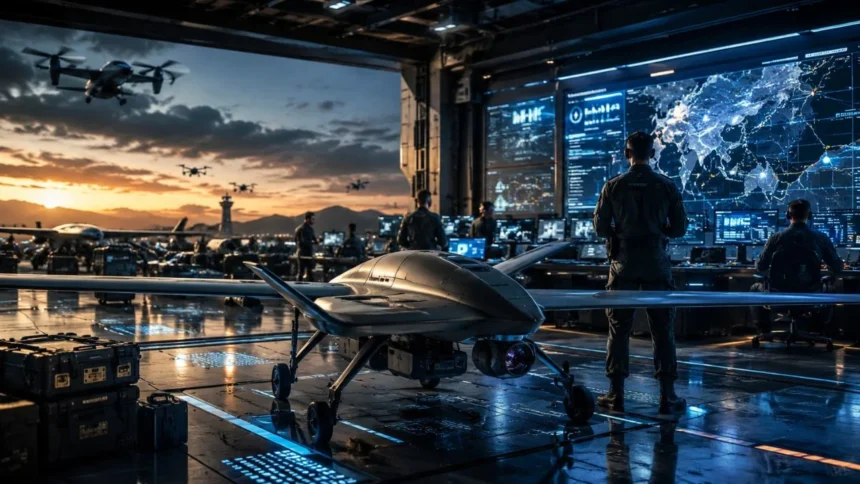
The defense industry is entering a period of rapid technological change. Military forces are looking beyond a small number of expensive platforms and considering larger fleets of affordable drones, autonomous aircraft, precision munitions, surveillance systems, and counter-drone weapons. Mach Industries is one of the young companies attempting to build the technology and manufacturing capacity required for this shift.
Founded in 2023, Mach Industries is a privately held defense technology company headquartered in Huntington Beach, California. It develops unmanned defense systems while building its own manufacturing, propulsion, testing, and component infrastructure. Rather than focusing on a single aircraft, the company is creating a broader portfolio that includes strike systems, surveillance platforms, counter-UAS technology, propulsion components, and flexible factories.
Mach Industries has moved quickly from startup funding to government contracts, flight demonstrations, acquisitions, and production planning. By June 2026, the company reported five active vehicle programs and announced that production was expected to begin on at least three of them during the year. It also raised $300 million at a $1.8 billion valuation, marking a major increase in investor confidence.
However, fast growth does not guarantee long-term success. Defense systems must perform reliably in difficult environments, pass strict evaluations, remain affordable at scale, and satisfy government requirements that can change over time. This article explores Mach Industries’ products, technology, contracts, manufacturing model, funding, opportunities, and challenges without assuming that every announced system will automatically reach large-scale deployment.
What Is Mach Industries?
Mach Industries is an American aerospace and defense startup founded by Ethan Thornton. Its stated mission is to develop and manufacture asymmetric defense systems and components at extremely high volumes. In practical terms, the company wants to help the United States and its allies produce more unmanned aircraft, precision systems, propulsion units, and defensive technologies without relying entirely on slow traditional production methods.
The company describes itself as a vertically integrated defense manufacturer. Vertical integration means controlling more stages of product development internally, including design, engineering, propulsion, testing, assembly, and production. This can reduce dependence on outside suppliers, although it also requires significant investment in facilities, specialist employees, equipment, quality control, and regulatory compliance.
Mach Industries is headquartered at Forge 1, a 115,000-square-foot facility in Huntington Beach dedicated to engineering, prototyping, and advanced manufacturing. In February 2026, the company also announced a San Francisco hub intended to provide greater access to software, aerospace, engineering, and research talent while leaving its main manufacturing headquarters in Huntington Beach.
The company’s current public portfolio includes Viper, Glide, Stratos, Pike, and Dart. It has also introduced Atlas through a Defense Innovation Unit program and worked with Divergent Technologies on a rapid aircraft prototype called Venom. Together, these projects position Mach as more than a drone manufacturer; it is attempting to become a full-stack supplier of unmanned defense capabilities.
Why Mach Industries Is Attracting Attention
One reason Mach Industries is gaining attention is the growing demand for affordable military systems that can be produced in large numbers. Recent conflicts have demonstrated that small drones, long-range munitions, mobile launch systems, electronic warfare, and counter-drone defenses can influence operations alongside more expensive aircraft, ships, and missile systems.
Traditional defense programs can take many years to move from early design to large-scale manufacturing. Mach Industries is promoting a different model based on faster development cycles, modular systems, private investment, commercial engineering practices, and flexible production. Its Venom aircraft partnership, for example, reportedly moved from concept to a flight-ready prototype in 71 days.
Another reason is the company’s focus on affordable mass. This defense strategy is based on deploying enough capable systems to create operational difficulty for an adversary without using an extremely expensive weapon for every target. Mach’s product range reflects this idea through lower-cost interceptors, one-way aircraft, scalable strike munitions, and platforms designed for decentralized deployment.
Mach is also part of a larger group of venture-backed defense technology companies challenging traditional industry structures. These startups often emphasize software, artificial intelligence, autonomous systems, rapid prototyping, and modern manufacturing. Their success will depend on whether they can turn engineering demonstrations into dependable products that military customers can purchase, maintain, and use at scale.
Mach Industries’ Main Defense Technology Portfolio
Viper is a turbojet-powered, vertical-takeoff, one-way unmanned aerial system. Its vertical launch design is intended to reduce dependence on runways and separate launcher infrastructure. This could allow military units to deploy the aircraft from a wider range of locations while keeping the system mobile and reducing the physical footprint required for launch operations.
Glide is described as a low-cost precision-strike glider designed to deliver effects over extended distances. Unlike a conventional powered cruise missile, a gliding system may use altitude and aerodynamic efficiency to travel toward its target. The company provides limited public technical detail, which is normal for defense products still being developed, tested, or evaluated by government customers.
Stratos is a high-altitude pseudo-satellite intended to carry communication systems, sensors, or other payloads in the stratosphere. High-altitude platforms can potentially provide persistent surveillance or communication coverage without the full cost and launch requirements of an orbital satellite. Mach identifies Stratos as one of its five active vehicle programs.
Pike is presented as a long-range, low-cost munition designed for decentralized and modular deployment at scale. Public information about Pike remains limited, but its inclusion in the company’s production portfolio shows Mach’s interest in systems that can be distributed across smaller units rather than launched only from large, specialised platforms.
How Viper Could Change Tactical Strike Operations
Viper grew from a U.S. Army effort known publicly as Strategic Strike. Mach Industries was selected by the Army Applications Laboratory to develop a vertical-takeoff cruise missile for maneuver forces. The contract was awarded during the third quarter of 2024, and the company publicly announced the program in March 2025.
According to Mach, the Strategic Strike design was locked by the end of September 2024. The company then demonstrated a vertical takeoff followed by wingborne flight in January 2025. These milestones were presented as evidence that the development team could move quickly from contract award to a functioning flight demonstration.
The main operational idea behind Viper is runway independence. Traditional fixed-wing systems generally require a runway, catapult, long launch rail, or another piece of supporting infrastructure. A vertical-takeoff aircraft could be transported and launched closer to the unit using it, potentially making the system easier to distribute and more difficult for an adversary to locate.
The challenge will be combining vertical launch, long-range flight, guidance, reliability, payload performance, and affordability within one system. Vertical takeoff can increase technical complexity and energy requirements. Viper’s future importance will therefore depend on successful testing, government evaluation, manufacturing cost, and its ability to perform consistently under operational conditions.
Dart and the Growing Need for Counter-Drone Defense
Mach Industries introduced Dart in January 2026 as a counter-unmanned aerial system designed to defeat Group 1 through Group 3 aerial threats. These categories include smaller drones as well as larger and faster unmanned aircraft. The company presents Dart as a system capable of responding not only to individual drones but also to coordinated swarm attacks.
Dart combines detection, tracking, command-and-control, and physical interception. It uses a frequency-modulated continuous-wave ground radar developed by Mach Industries and connects that sensor to lower-cost kinetic interceptors. The goal is to create an integrated process that identifies an aerial threat, follows its movement, makes an engagement decision, and launches an interceptor.
Cost is one of the biggest problems in counter-drone warfare. Using a highly expensive air-defense missile against a relatively inexpensive drone can be financially unsustainable, especially when many drones arrive at once. Dart is intended to improve this cost relationship by providing an interceptor that can be produced and used at a scale closer to the threat.
Counter-UAS systems must still solve difficult problems. They need to distinguish hostile drones from friendly aircraft, track small objects in cluttered environments, operate against electronic interference, and avoid creating unnecessary risks to nearby people. Dart’s long-term value will depend on testing against realistic targets, integration with military networks, and reliable performance under heavy demand.
Stratos and High-Altitude Surveillance
Stratos represents a different part of Mach Industries’ strategy because it is designed as a high-altitude pseudo-satellite rather than a direct strike or interception system. A pseudo-satellite is an aircraft that remains in the upper atmosphere for an extended period and performs some missions normally associated with satellites.
Mach says Stratos can carry communications equipment, sensors, and other effects while travelling thousands of miles from its launch point. Such a platform could potentially support intelligence gathering, communications relay, navigation assistance, border observation, disaster response, or military operations in areas where traditional infrastructure is limited.
High-altitude platforms may offer greater flexibility than satellites because they can potentially be recovered, updated, repositioned, and launched without a rocket. They can also operate above most commercial air traffic while remaining closer to the ground than an orbital system. This may improve sensor detail or communication performance for certain missions.
However, high-altitude flight brings major engineering challenges. The atmosphere is thin, temperatures are extreme, winds can be difficult, and energy management becomes essential. Stratos will need to demonstrate endurance, payload capacity, reliable communications, weather resistance, and an operating cost that makes it more useful than satellites, conventional aircraft, or other unmanned systems.
Atlas and Runway-Independent Maritime Operations
In June 2026, Mach Industries announced that it had received a Defense Innovation Unit contract for the Runway Independent Maritime Expeditionary Strike program. Mach is serving as the aircraft integrator and working with Whisper Aero to develop Atlas, a long-range unmanned aircraft intended for operations from ships and remote locations.
The project addresses a difficult military requirement. Large fixed-wing aircraft normally depend on established runways, while carrier aircraft require specialised ships and launch systems. A runway-independent platform could theoretically operate from smaller vessels, islands, temporary bases, or locations where runways are damaged, unavailable, or vulnerable to attack.
Whisper Aero brings an electric propulsion approach to the project, while Mach leads aircraft integration and overall program execution. According to the companies, the design is intended to reduce acoustic signature, improve energy efficiency, limit logistical requirements, and provide useful range from maritime or austere operating locations.
Atlas is an important example of how Mach may expand beyond its original product lines. The company is not developing every component alone; it is combining its systems-integration and manufacturing capabilities with technology from another specialist. Success would demonstrate that Mach can manage larger collaborative programs as well as internally developed products.
Forge and the Plan to Manufacture at Scale
Forge is Mach Industries’ flexible manufacturing network. The company describes it as a group of decentralized factories that can produce asymmetric aerospace and defense systems in large numbers. Instead of relying on one enormous facility, Forge is intended to place adaptable manufacturing capacity closer to customers, partners, or areas of demand.
The facilities are designed to be retooled for different products. This could allow a factory to shift between aircraft, components, propulsion systems, or partner designs as military requirements change. Flexible manufacturing is particularly relevant for unmanned systems because product designs may need to evolve quickly in response to new sensors, electronic threats, software, or battlefield lessons.
Mach’s flagship location, Forge 1 in Huntington Beach, combines engineering, rapid prototyping, and advanced manufacturing. Bringing these activities into one facility can shorten the distance between designers and production teams. Problems discovered during assembly can be communicated to engineers quickly, while design changes can be tested without waiting for a distant supplier.
The decentralized model could improve resilience because production would not depend entirely on one site. However, running several factories introduces challenges involving quality consistency, secure data, workforce training, supply coordination, regulatory oversight, and equipment costs. Mach must prove that flexible production can deliver military-grade reliability rather than only faster prototypes.
Mach Propulsion and the Importance of Jet Engines
Propulsion is one of the most important and difficult parts of an unmanned aircraft. Even a well-designed airframe cannot complete its mission without an engine that provides suitable range, speed, fuel efficiency, reliability, and cost. Dependence on a limited number of propulsion suppliers can also slow production when demand suddenly increases.
Mach Industries announced Mach Propulsion in March 2025 as a division focused on high-performance propulsion systems. The company also announced plans for a jet-engine manufacturing facility with an intended annual capacity of 12,000 engines. These engines are expected to support Mach’s platforms as well as products developed by other defense manufacturers.
Producing engines internally could give Mach more control over aircraft design and production schedules. Engineers can develop an engine around the exact requirements of a platform instead of redesigning the aircraft around an available third-party engine. Internal production may also reduce supply-chain delays if the company can secure materials and components reliably.
Yet engine manufacturing is highly demanding. Turbine components must survive extreme heat, vibration, pressure, and rotational forces while remaining consistent across thousands of units. Reaching the planned production capacity will require specialised machinery, experienced employees, testing equipment, supplier relationships, and strict quality systems that take time to establish.
Mach Energetics and the Exquadrum Acquisition
In May 2026, Mach Industries announced that it had acquired Exquadrum, an aerospace and defense technology company with more than two decades of experience. Exquadrum was integrated into Mach as Mach Energetics, giving the company additional capabilities in propulsion, rocket motors, pyrotechnics, munitions, testing, and related technical services.
The acquisition added solid rocket motor technology, launch systems, divert and attitude-control systems, space propulsion testing, high-pressure testing, cryogenic testing, and explosives-related infrastructure. These capabilities can support both Mach’s own platforms and components produced for external defense customers.
Mach Energetics operates from a 70,000-square-foot facility in Victorville, California, supported by a nearby propulsion and energetics test location. Integrating testing and manufacturing can allow engineers to evaluate a component, study the results, modify the design, and conduct another test without depending on several separate organisations.
The acquisition also reflects Mach’s wider vertical-integration strategy. Controlling propulsion and energetics can reduce bottlenecks, but it also increases responsibility. Mach must now manage hazardous materials, strict safety procedures, environmental requirements, specialised testing, and highly regulated manufacturing while continuing to develop multiple aircraft programs.
Government Contracts and Defense Partnerships
Government contracts are essential for a defense technology company because military agencies are the main buyers of its products. Mach’s publicly announced relationships include work with the U.S. Army, Air Force, Special Operations Command, Defense Innovation Unit, and allied governments. These connections give the company access to real military requirements, testing opportunities, and potential production programs.
The Strategic Strike contract with the Army Applications Laboratory became one of Mach’s most visible early programs. It allowed the company to demonstrate its vertical-takeoff aircraft concept and provided credibility beyond private fundraising. Government selection does not guarantee a large production order, but it shows that an agency considers the technology worth developing and evaluating.
The 2026 Atlas contract represents another significant step because Mach is leading the integration of a new runway-independent maritime aircraft. Defense Innovation Unit programs are intended to connect the military with commercial and venture-backed technology companies that can develop solutions faster than conventional procurement programs.
Mach also works with private technology partners. Divergent Technologies helped produce Venom using its digital manufacturing platform, while Whisper Aero is providing propulsion technology for Atlas. These partnerships allow Mach to use external expertise without developing every material, manufacturing process, software system, and propulsion technology entirely on its own.
How Much Funding Has Mach Industries Raised?
Mach Industries has attracted substantial venture-capital investment in a relatively short period. In June 2025, it announced a $100 million Series B led by Khosla Ventures and Bedrock, with participation from Sequoia Capital and existing investors. The funding was intended to expand Forge, grow Mach Propulsion, and support Viper, Glide, and Stratos.
One year later, the company announced a $300 million Series C led by Infinite Capital and Ribbit Capital. The round valued Mach Industries at $1.8 billion. The company said the new capital would support government contracts, product development, talent recruitment, Forge expansion, and production of its unmanned systems.
This rapid increase in valuation reflects investor interest in defense manufacturing, autonomous systems, drones, propulsion technology, and military supply-chain resilience. Investors are betting that governments will direct more funding toward companies that can produce affordable unmanned platforms and critical components faster than traditional procurement timelines.
Large funding rounds also create high expectations. Mach must build facilities, hire specialised talent, complete government milestones, conduct flight tests, manage multiple products, and convert development contracts into production revenue. A high valuation can provide useful capital, but it places pressure on the company to show that its technology and manufacturing plans are commercially sustainable.
The Role of Autonomy and Artificial Intelligence
Modern unmanned systems depend on more than engines and airframes. They need navigation, flight control, sensor processing, communications, mission planning, target recognition, electronic protection, and the ability to respond when conditions change. Artificial intelligence can support some of these functions, although the exact level of autonomy varies between platforms.
Mach Industries describes several of its products as autonomous or unmanned systems, but detailed information about their software architecture is not publicly available. This is understandable because guidance, communications, autonomy, and electronic-warfare capabilities may be sensitive. Public descriptions therefore focus more heavily on mission type, manufacturing scale, propulsion, and deployment.
In future systems, AI may help aircraft interpret sensor data, identify obstacles, adjust routes, coordinate with other platforms, or operate when communication links are unreliable. Human control and military rules will remain important, particularly when a system carries weapons or makes decisions that could affect civilians and friendly forces.
The effectiveness of autonomous defense technology depends on dependable software, secure communications, realistic testing, and protection from cyberattacks or manipulation. A system that works well in a controlled demonstration may behave differently when facing bad weather, damaged sensors, electronic interference, inaccurate data, or an intelligent adversary deliberately trying to confuse it.
What Makes Mach Industries Different?
Mach’s most important difference is its attempt to combine product development with manufacturing infrastructure. Many startups specialise in software, sensors, airframes, or individual components. Mach is building aircraft, munitions, interceptors, engines, energetics capabilities, testing facilities, and a flexible factory network under one broader organisation.
The company also emphasises production volume early in the development process. Its stated objective is not merely to create a small number of advanced prototypes. It wants to design systems that can be produced by the thousands or potentially millions, depending on the component and future demand.
Another difference is the speed of its development model. The company’s Army aircraft moved from design work to a vertical-takeoff flight demonstration within months, while the Venom partnership produced a flight-ready prototype in 71 days. These examples suggest an engineering culture focused on rapid hardware iteration.
Speed must still be balanced with reliability. Military equipment cannot be judged only by how quickly the first prototype appears. It must survive repeated use, transportation, storage, extreme temperatures, vibration, communication problems, operator mistakes, and active opposition. Mach’s true difference will become clearer when more of its systems enter sustained production and operational service.
Challenges Mach Industries Must Overcome
One challenge is moving several products into production at the same time. Each system requires engineering, suppliers, testing, software, manufacturing tools, quality control, documentation, training, maintenance planning, and government approval. Managing five active vehicle programs alongside Atlas, propulsion expansion, and an acquisition creates considerable organisational complexity.
Another challenge is cost. Mach’s strategy depends on making defense systems affordable enough to deploy in significant numbers. Early prototypes are often expensive because parts are produced in small batches and designs continue changing. The company must lower unit costs without reducing the reliability or performance expected by military customers.
Government procurement is another uncertainty. A successful test or development contract does not always lead to a large order. Military priorities, budgets, leadership, threat assessments, and technical requirements can change. Mach will need to compete with established defense contractors and other well-funded startups for limited programs and production funding.
Ethical and policy questions surrounding autonomous weapons will also affect the company’s future. Governments and the public will expect clarity about human control, accountability, testing, civilian protection, cybersecurity, and compliance with the laws of armed conflict. Technical capability alone will not determine whether an autonomous defense system is accepted or deployed.
What Mach Industries Means for the Future of Defense Tech
Mach Industries represents a broader change in how defense systems are funded and developed. Private investors are providing startups with enough capital to build factories, test aircraft, hire engineers, and acquire established aerospace companies before receiving traditional large-scale government production contracts.
Its flexible factory strategy also shows how manufacturing is becoming part of defense innovation. The future of military advantage may depend not only on who designs the most advanced system, but also on who can produce, repair, upgrade, and replace large numbers of systems during a prolonged crisis.
The company’s product portfolio reflects the growing importance of unmanned warfare. Viper and Pike focus on distributed strike, Stratos supports high-altitude missions, Dart addresses drone defense, and Atlas explores runway-independent maritime operations. Mach Propulsion and Mach Energetics provide the components and testing infrastructure needed to support those platforms.
Mach Industries is still a young company, and many of its largest ambitions remain unproven at full production scale. Nevertheless, its funding, contracts, facilities, acquisitions, and expanding portfolio make it an important company to watch. Its future will depend on whether it can turn rapid innovation into dependable, affordable, and responsibly deployed defense capability.
Conclusion
Mach Industries has grown from a newly founded defense startup into a company valued at $1.8 billion with multiple aircraft programs, government contracts, manufacturing facilities, propulsion capabilities, and a dedicated energetics division. Its growth reflects strong interest in autonomous defense systems and scalable military manufacturing.
The company’s central strategy is vertical integration. By bringing aircraft development, propulsion, energetics, testing, prototyping, and manufacturing closer together, Mach aims to shorten development cycles and reduce dependence on slow external supply chains. The Forge network is intended to extend that model into flexible, decentralized production.
Its products address several important defense needs, including precision strike, counter-drone protection, high-altitude surveillance, long-range munitions, and runway-independent aircraft. Mach’s partnerships with the Army, Defense Innovation Unit, Divergent, Whisper Aero, and other organisations suggest that government and industry customers are willing to evaluate its approach.
The next stage will be harder than the first. Mach must prove that its systems can perform reliably, pass military testing, reach affordable production costs, and operate responsibly in real environments. If it succeeds, the company could become a significant part of the next generation of American defense technology and manufacturing.
FAQs About Mach Industries
What does Mach Industries do?
Mach Industries develops unmanned defense systems, precision-strike aircraft, counter-drone technology, surveillance platforms, jet engines, propulsion components, and flexible manufacturing infrastructure.
Who founded Mach Industries?
Mach Industries was founded in 2023 by Ethan Thornton. The privately held company is headquartered in Huntington Beach, California.
What products does Mach Industries make?
Its publicly announced portfolio includes Viper, Glide, Stratos, Pike, and Dart. It is also developing Atlas with Whisper Aero and previously demonstrated Venom with Divergent Technologies.
How much is Mach Industries worth?
Mach Industries announced a $300 million Series C in June 2026 at a valuation of $1.8 billion. The investment was led by Infinite Capital and Ribbit Capital.
Does Mach Industries have military contracts?
Yes. Mach has announced work involving the U.S. Army, Air Force, Special Operations Command, Defense Innovation Unit, and allied governments, including programs for Viper and Atlas.