Cities contain thousands of parking lots, garages and commercial spaces that remain underused for large parts of the day. REEF Technology was created around the idea that these locations could provide more value than simply storing vehicles. By combining physical space with digital systems, the company aims to bring useful goods, services and experiences closer to people.
The REEF Technology business model has changed over time, but proximity remains at the centre of its strategy. Its network can connect property owners, consumer brands and independent operators within locations that are already close to customers. These spaces may support food services, digital ordering, product collection, local delivery or other neighbourhood-based activities.
Technology plays an important role in making these urban hubs work. REEF OS helps operators receive orders, manage different brands, monitor inventory and connect with delivery platforms through one system. This digital infrastructure can make a small physical location capable of serving several customer needs without requiring a large traditional store.
However, REEF’s journey has not been free from difficulties. Its earlier expansion into delivery-only kitchens faced regulatory, operational and financial challenges, encouraging the company to adjust its approach. Today, its public-facing model places greater attention on marketplaces, food halls, micro-fulfilment, local operators and technology-enabled services.
What Is REEF Technology?
REEF Technology is a company that uses physical locations and digital tools to connect consumers with nearby goods, services and experiences. It originally developed from ParkJockey, a parking technology business founded in 2013. The company later changed its name to REEF as its ambitions expanded beyond parking management into broader urban services.
The company describes its model as the “power of proximity.” This idea is based on bringing products and services closer to the people who need them. Instead of relying only on large warehouses, distant restaurants or traditional shopping centres, REEF seeks to activate smaller locations within busy neighbourhoods and commercial areas.
REEF Technology connects several groups within its ecosystem. Property owners provide or make space available, brands offer products and services, and local operators manage activity at individual locations. Consumers then gain access to food, convenience items or services through nearby physical sites supported by digital ordering technology.
The company should not be viewed only as a parking operator or ghost-kitchen business. Its current model is closer to a technology-powered marketplace connecting real estate, brands and entrepreneurs. Parking locations remain part of its history, but its wider purpose is to make single-use urban property more flexible and productive.
From Parking Lots to a Proximity Network
Parking lots were the foundation of REEF Technology’s original urban strategy. These locations are often positioned near offices, homes, shopping areas, hospitals, universities and entertainment venues. Their central locations make them valuable even when demand for vehicle parking changes throughout the day.
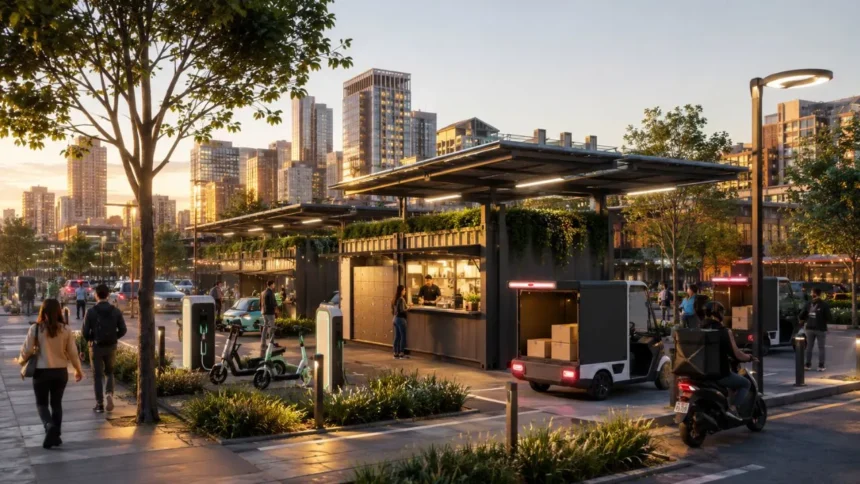
REEF recognised that a parking area could support other activities without immediately requiring permanent redevelopment. Modular structures, food carts, digital kiosks and collection points could be placed in suitable locations. This approach offered a potentially faster way to test new services compared with constructing a full traditional building.
The company’s proximity network expanded this concept beyond one type of service. A location could support food preparation, product pickup, delivery operations or local retail activity depending on neighbourhood demand. The aim was to treat urban space as an adaptable platform rather than a property with only one fixed purpose.
This shift reflects a wider change in urban planning and commercial real estate. Cities increasingly need spaces that can respond to changing consumer habits, remote work, delivery demand and new mobility patterns. REEF Technology offers one example of how existing property can be reorganised instead of completely demolished and rebuilt.
How REEF Transforms Underused Urban Real Estate
Underused urban real estate creates costs for both property owners and communities. An empty section of a car park or poorly used commercial area may generate limited revenue while still requiring maintenance, security and management. REEF’s model attempts to create additional activity within these overlooked spaces.
A property owner may use the network to introduce food services, collection facilities or convenience options. These additions can attract more visitors and provide existing customers with a better experience. A university, hotel, airport or shopping centre could therefore offer more services without operating every individual business itself.
Flexible installations can also allow a location to change as consumer demand develops. A service that performs well may be expanded, while an unsuccessful concept can be replaced more easily than a permanent building. This adaptability can reduce some of the risk associated with introducing a new commercial use.
Transforming space successfully requires more than placing a container or kiosk in an empty area. The location needs utilities, access, safety planning, permits, signage and a clear reason for customers to visit. REEF Technology’s real value depends on coordinating these physical requirements with brands, operators and digital systems.
Smart Parking and Digital Urban Infrastructure
Smart parking remains relevant to the wider discussion around REEF Technology and urban transformation. Traditional parking facilities often rely on fixed payment equipment, manual monitoring and limited information about demand. Digital platforms can make it easier to reserve spaces, manage payments and understand how a location is being used.
Data from parking activity can help property managers identify busy and quiet periods. This information may support better pricing, staffing and traffic management decisions. It can also reveal when parts of a facility might be available for temporary events, delivery activity or other commercial uses.
Digital parking services can improve the customer experience by reducing the time spent searching for a place or waiting at a payment machine. Mobile booking and contactless entry can make arrival more predictable. This is especially useful near airports, arenas, hospitals and other high-demand locations.
However, smart parking should not simply encourage more vehicles to enter crowded city centres. It works best when connected with broader urban mobility planning, public transport and pedestrian access. The goal should be to manage existing vehicle demand efficiently while gradually creating more flexible and people-friendly urban spaces.
Multi-Brand Food Halls in High-Traffic Locations
Food halls are now one of the clearest examples of REEF Technology’s current urban-space strategy. The company offers multi-brand food hall systems for locations such as airports, malls, campuses, hotels and entertainment venues. Customers can choose food from different brands without visiting several separate restaurants.
A shared food hall can use one ordering system to manage multiple menus. Customers may place an order through a kiosk or web application and combine items from several brands in one transaction. This makes the experience more convenient for families or groups with different food preferences.
Food lockers and seat-side delivery can make these locations more useful in busy environments. Airport passengers may collect an order without standing in a long queue, while guests at a venue may receive food near their seats. These options connect digital convenience with a real physical service point.
For property owners, a multi-brand setup may create variety without requiring a large number of full restaurant units. However, quality still depends on staffing, kitchen design, food safety and reliable preparation. Technology can organise orders, but it cannot replace strong operations and consistent customer service.
REEF OS and the Technology Behind the Network
REEF OS is the digital operating system used to support locations within the network. It brings together functions such as ordering, inventory management, customer engagement and performance reporting. Operators can use a central system instead of managing several disconnected applications and devices.
The consumer-facing tools may include QR-code ordering, kiosks and cloud-based point-of-sale systems. These options allow customers to order in the way that best suits the location. A contactless system may work well at an airport, while direct counter ordering may remain important at a neighbourhood food cart.
Behind the scenes, REEF OS can combine orders from different channels. An operator may receive purchases from an on-site kiosk, a direct web application and third-party delivery platforms. Bringing these orders into one workflow can reduce confusion and help staff prepare items in the correct sequence.
The platform can also provide live performance information. Operators may use data to understand popular products, peak ordering times, unavailable items and delivery performance. When used responsibly, these insights can improve staffing, reduce waste and help individual locations respond more effectively to customer behaviour.
Micro-Fulfilment and Last-Mile Delivery
Last-mile delivery is one of the most expensive and complicated parts of modern online commerce. Large distribution centres are usually located outside city centres, meaning products must travel long distances before reaching individual customers. Micro-fulfilment centres can bring selected inventory closer to areas with strong demand.
REEF Technology has promoted micro-fulfilment as a way for convenience and retail brands to offer faster local delivery. Smaller facilities can hold frequently requested items and prepare them for collection by couriers. This approach may reduce travel time compared with sending every order from a distant warehouse.
Urban micro-fulfilment can be especially useful for groceries, convenience products and time-sensitive orders. Customers increasingly expect accurate delivery windows and quick access to everyday essentials. A nearby facility may help a retailer meet those expectations without opening a complete customer-facing shop.
The model still requires careful planning because small facilities have limited storage. Operators must predict which items customers are likely to purchase and restock them efficiently. Poor inventory decisions can create shortages, waste or unnecessary delivery journeys, reducing the benefits of being closer to consumers.
Creating New Opportunities for Local Entrepreneurs
REEF Technology’s Ulysses programme is designed around independent entrepreneurs operating individual business locations. Participants may select an available site, choose approved brands and use REEF’s technology to manage their operation. The company provides tools and a platform, while the entrepreneur remains responsible for daily performance.
This model can lower some barriers associated with opening a traditional restaurant or retail business. A new operator may gain access to an equipped location, established brand concepts and digital ordering tools. That can reduce the need to develop every part of the business from the beginning.
Local ownership may also help a location respond more closely to neighbourhood needs. An operator who understands nearby workers, residents or visitors can adjust opening hours, customer service and brand selection. This local knowledge may be difficult to reproduce through a completely centralised corporate system.
However, entrepreneurship still involves risk, long working hours and financial responsibility. Access to technology does not guarantee strong sales or profitability. Potential operators need to understand costs, agreements, local demand and operational expectations before committing to a REEF-powered business.
Benefits for Property Owners and Real Estate Managers
Property owners are an important part of the REEF Technology ecosystem. The company’s model gives them a way to introduce additional uses within an existing site. A single-purpose location may become a place for food, collection, delivery or other services without requiring a complete property redevelopment.
Additional services can make a building or venue more attractive to visitors. A campus with convenient food choices, a hotel with digital ordering or a mall with fast pickup options may provide a better customer experience. These improvements can support foot traffic and strengthen the value of the wider property.
Flexible commercial uses may also create new revenue opportunities. Instead of leaving part of a property inactive, an owner may generate income through access agreements, service partnerships or increased customer spending. The exact financial benefit will depend on demand, operating costs and the structure of each agreement.
Property owners must also consider potential concerns such as traffic, waste, noise and delivery activity. A new service should fit the surrounding area rather than create additional problems. Successful urban activation requires clear operating standards and communication with tenants, customers, residents and local authorities.
How Consumers Benefit From Proximity Commerce
Proximity commerce aims to reduce the distance between consumers and the products or services they want. For customers, this can mean faster collection, shorter delivery times and more choice within a nearby location. The value is especially clear in dense areas where convenience strongly influences purchasing decisions.
A multi-brand ordering system can simplify decisions for groups. One person may want a burger, another may prefer a healthier meal and a third may choose a snack. Placing everything in one digital order is easier than managing separate transactions from several restaurants.
Nearby fulfilment can also make same-day or rapid delivery more practical. Instead of waiting for a product to travel from a distant warehouse, customers may receive it from a local micro-fulfilment location. This can be valuable for groceries, convenience products and other frequently needed items.
Convenience must still be balanced with affordability, reliability and privacy. Customers will not continue using a service simply because it is nearby if prices are high or orders are regularly incorrect. REEF’s long-term impact therefore depends on delivering genuine value rather than only promoting speed.
REEF Technology and the Future of Urban Mobility
Urban mobility is changing as cities respond to congestion, electric vehicles, ride-hailing, cycling and public transport. Parking facilities may need to serve a different purpose as private car use changes in some neighbourhoods. REEF’s flexible-space concept fits within this wider discussion about the future of city movement.
A parking location could potentially support vehicle charging, courier collection or connections between different transport options. It might also provide temporary space for local services during periods of low parking demand. These uses can help a property remain valuable as mobility habits continue to evolve.
Last-mile delivery activity must be managed carefully to avoid creating additional congestion. Poorly organised courier pickups can block pavements, loading areas and surrounding streets. Designated collection points and digital order timing can make these movements more predictable and less disruptive.
REEF Technology does not control city transportation policy, so its locations must work within local plans and regulations. The most useful projects will be those that support public goals rather than working against them. Coordination with city authorities is essential when introducing new forms of urban activity.
Can REEF Make Cities More Sustainable?
Using an existing site for multiple purposes may reduce the need for immediate new construction. Adaptive use can extend the value of urban property and limit the amount of land required for separate commercial buildings. This can support more efficient development when locations are selected carefully.
Closer fulfilment may also shorten some delivery journeys. A product stored near the customer does not need to travel from a distant warehouse for the final stage of every order. Electric cargo bikes or compact delivery vehicles can further reduce the environmental impact within dense neighbourhoods.
However, proximity alone does not guarantee sustainability. A network may create additional packaging, energy use or courier traffic if it is poorly managed. The environmental result depends on delivery methods, building efficiency, waste reduction and whether locations genuinely replace longer journeys.
Food operations must pay particular attention to packaging and food waste. Data can help operators predict demand and avoid preparing more items than customers purchase. Reusable materials, responsible sourcing and efficient delivery routes can make the wider model more environmentally credible.
Supporting Local Services in Busy Urban Locations
Busy urban locations often have large numbers of people but limited service options. Airport passengers, university students, hotel guests and event visitors may all need quick access to food and convenience products. REEF Hubs are designed to serve these high-demand environments through shared digital infrastructure.
A multi-brand storefront can offer more choice within a limited physical area. Instead of building separate counters and kitchens for every brand, several concepts may operate through a coordinated system. This can make better use of expensive space in airports, malls and entertainment venues.
Seat-side delivery and food lockers can also reduce unnecessary queues. Customers receive clearer pickup instructions and spend less time standing around busy service areas. This can improve movement within a venue while giving operators a more organised way to distribute completed orders.
The quality of the experience depends on accurate technology and clear physical design. Customers need to know where to order, how long they will wait and where they should collect their purchases. Confusing instructions can quickly remove the convenience that the digital system is supposed to create.
The Role of Data in Smarter Urban Operations
Data helps REEF-powered locations understand what customers are ordering and when demand is highest. This information can guide staffing, inventory and operating hours. A location near offices may experience lunchtime demand, while an entertainment venue may see a sharp increase before and after events.
Real-time information can help operators react to changing conditions. If an item becomes unavailable, it can be removed from the digital menu before more customers order it. If one brand becomes unusually busy, staff may adjust preparation priorities or provide more accurate waiting times.
Property owners may also learn which services attract visitors and increase activity. This can support better decisions about tenant mix, event planning and future investment. Data can turn an experimental use of space into a measurable business strategy.
Responsible data management is essential because digital systems can collect information about purchases, locations and customer behaviour. Companies must protect personal information and explain how it is used. Smart-city technology should improve urban life without creating unnecessary surveillance or privacy risks.
Challenges REEF Technology Has Faced
REEF Technology gained significant attention during the rapid growth of food delivery and ghost kitchens. The company opened many delivery-focused locations, but the model became harder to maintain as pandemic-era demand changed. Operating hundreds of small kitchens also created complex staffing, safety and quality-control requirements.
Some locations faced regulatory problems because modular kitchens did not always fit clearly within existing local rules. Permits, fire safety, utility connections and food-service regulations differ between cities. A model that can be deployed quickly still needs to satisfy every relevant requirement before beginning operations.
The company also faced the challenge of proving that every location could generate sustainable demand. A concept may appear attractive at a national level but perform differently from one neighbourhood to another. Food preferences, delivery competition, operating costs and population density all influence success.
These difficulties have encouraged REEF to evolve its approach. Its current public offering places greater emphasis on enabling operators, providing digital tools, connecting brands and installing food halls in high-demand venues. This shift shows that urban innovation often requires adjustment rather than following one fixed plan.
Why Regulation Matters for Urban Innovation
Urban spaces are controlled by planning rules designed to protect public safety and neighbourhood quality. A company cannot automatically convert a parking lot into a kitchen, shop or distribution centre. Each new use may require permits, inspections and approval from different government departments.
Food facilities need suitable ventilation, water, waste disposal and fire protection. Delivery hubs must manage vehicle movement and avoid blocking streets or pedestrian routes. Retail and service locations may also need to meet accessibility, employment and consumer-protection standards.
Clear regulation can slow deployment, but it also protects workers, customers and nearby residents. Problems arise when innovative business models operate faster than local rules can adapt. Companies and city authorities must communicate early instead of dealing with safety or zoning concerns after a location opens.
REEF’s experience provides a useful lesson for other urban technology companies. A strong idea and advanced platform are not enough on their own. Successful transformation requires reliable operations, community acceptance and full compliance with the physical rules governing each location.
How REEF Technology Differs From a Traditional Developer
A traditional property developer may purchase land, construct a building and lease permanent units to tenants. This process can take years and require substantial investment. REEF’s original concept was more flexible, using existing spaces and modular operations to introduce services closer to customers.
The company also acts as a connection point between different participants. It can connect a property owner with brands, independent operators and digital systems. This network-based structure differs from a landlord that simply provides a building and collects rent.
REEF OS adds another layer by supporting ordering, delivery and operational data. The physical location is therefore only one part of the product. Technology, brand access and operator support are also central to how the network is expected to function.
This model can respond more quickly to change, but it may also be harder to coordinate. Each participant has different goals and responsibilities. REEF must create enough value for property owners, brands, operators and consumers for the entire system to remain sustainable.
Is REEF Technology Building Smart Cities?
REEF Technology is not building complete smart cities, but its model connects with several smart-city ideas. These include flexible real estate, digital commerce, local fulfilment and data-informed operations. Its locations can act as small pieces of urban infrastructure rather than isolated businesses.
The company’s strongest contribution is showing how existing space can support more than one purpose. A parking area, venue or commercial property can become a platform for food, delivery and local services. This challenges the traditional idea that every urban site needs one permanent use.
Smart cities should improve everyday life rather than simply introduce more screens and applications. A REEF-powered location is valuable only when it saves time, supports useful services or creates genuine local opportunity. Technology is a tool for achieving these outcomes, not the final goal.
City-wide transformation will require cooperation among businesses, planners, residents and transport providers. REEF can contribute technology and operating models, but public authorities must still shape wider priorities. The future of urban space will depend on combining private innovation with responsible public planning.
What Is the Future of REEF Technology?
The future of REEF Technology is likely to depend on how effectively it develops its marketplace and software-based services. Its platform can connect brands with independent operators and suitable locations. This asset-light approach may be more adaptable than directly operating a very large number of kitchens.
Food halls in airports, campuses, hotels and entertainment venues may remain an important growth area. These locations already have strong foot traffic and clear customer demand. Multi-brand ordering and organised collection can solve practical problems within environments where space and time are limited.
Micro-fulfilment may also remain relevant as retailers search for faster and more efficient local delivery options. The strongest opportunities will be in areas where nearby inventory creates a measurable advantage. REEF will need to demonstrate that its technology improves economics rather than only adding another system.
Long-term success will require disciplined expansion and transparent partnerships. The company must learn from earlier operational difficulties while focusing on services it can deliver consistently. Its influence on urban spaces will depend less on ambitious promises and more on reliable results at individual locations.
Is REEF Technology Really Transforming Urban Spaces?
REEF Technology has introduced an important idea into the urban-development conversation. Parking lots and other single-use properties do not always need to remain unchanged. They can potentially host new services that respond to local demand and make better use of valuable city land.
The company has also shown how digital and physical infrastructure can work together. Ordering software, delivery integrations and performance data can support small locations that serve multiple brands. This combination is central to modern proximity commerce and neighbourhood-based fulfilment.
At the same time, REEF’s experience proves that transforming urban spaces is difficult. Permits, safety, unit economics and customer demand can determine whether a creative concept succeeds. Rapid expansion without strong local operations can create serious problems.
REEF is therefore transforming urban spaces both through its active services and through the lessons its journey provides. Its strongest influence may be encouraging property owners and city planners to reconsider what underused spaces can become. The model remains promising, but its impact must be judged location by location.
Final Verdict
REEF Technology began with a simple but powerful question: can a parking location provide more value to its neighbourhood? That question developed into a broader proximity network connecting urban property, digital technology, brands and independent operators. The company continues to explore how physical spaces can become more flexible.
Its current tools support multi-brand ordering, food halls, delivery management, local fulfilment and entrepreneur-operated businesses. These services can improve convenience for consumers while creating additional opportunities for property owners and local operators. The model is particularly relevant in busy locations with limited space.
REEF’s earlier ghost-kitchen expansion also offers an important warning. Urban innovation requires careful regulation, strong daily operations and a clear understanding of local demand. Technology cannot correct a weak business model or replace the need for safe, consistent service.
Overall, REEF Technology remains an important example of how cities may reuse existing property in more connected ways. Its greatest potential lies in combining proximity with practical technology and responsible local management. When those elements work together, underused spaces can become productive parts of everyday urban life.
Frequently Asked Questions
What does REEF Technology do?
REEF Technology connects physical locations, brands, independent operators and digital tools. Its services include multi-brand food halls, ordering technology, local fulfilment and marketplace-based business opportunities.
Is REEF Technology a parking company?
REEF began as ParkJockey, a parking technology business, but later expanded beyond parking. Its current model focuses more broadly on turning suitable spaces into technology-enabled locations for goods and services.
What is REEF OS?
REEF OS is the company’s digital operating system for managing orders, inventory, customer interactions and delivery channels. It helps operators control several brands and sales platforms through a connected workflow.
How does REEF Technology transform parking lots?
REEF’s concept uses suitable parking or commercial spaces for additional services such as food operations, collection points or local fulfilment. The exact use depends on property conditions, customer demand and local approval.
What challenges has REEF Technology faced?
REEF has faced operational, regulatory and financial difficulties, particularly during its rapid ghost-kitchen expansion. These challenges encouraged a shift towards marketplaces, technology services, food halls and independent operators.