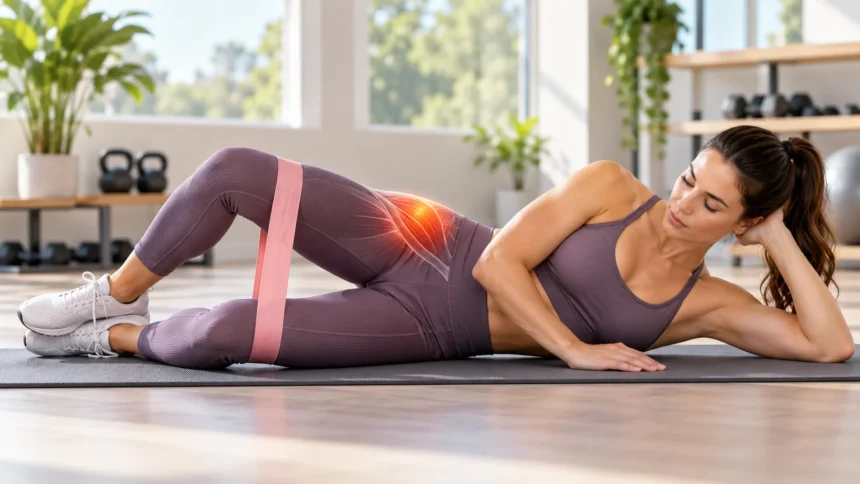
The clamshell workout is a simple yet effective exercise designed to strengthen the muscles around your hips, pelvis, and glutes. It involves lying on your side with your knees bent and lifting your upper knee while keeping your feet together. This controlled movement resembles a clamshell opening, which explains its name and makes the exercise easy to remember.
Although the clamshell exercise looks relatively easy, it targets important stabilizing muscles that support everyday movement. These muscles help maintain proper hip alignment when walking, climbing stairs, running, or performing other physical activities. Strengthening them can improve movement control and support better coordination, particularly when the exercise is included in a balanced fitness routine.
One of the greatest advantages of clamshell workouts is their accessibility to people with different fitness experiences. You can perform them at home without expensive equipment, making them convenient for beginners and experienced exercisers. Whether your goal is improving hip stability, strengthening your glutes, or supporting rehabilitation, learning proper clamshell form is an excellent starting point.
Understanding the Muscles Worked During Clamshell Exercises
The primary muscles targeted during clamshell exercises are the gluteus medius and gluteus minimus, located along the outer portion of your hips. These muscles help move your thighs outward and stabilize your pelvis during single-leg activities. Strong hip stabilizers play an important role in maintaining controlled movement and reducing unnecessary strain on surrounding joints.
The gluteus maximus also contributes to the exercise, particularly its upper fibers involved in hip rotation. Meanwhile, several smaller muscles surrounding the hip joint help coordinate the movement and maintain proper positioning. Although clamshells do not replace larger lower-body exercises, they provide targeted strengthening that complements squats, lunges, walking, and other functional movements.
Your abdominal and pelvic stabilizing muscles also help prevent unwanted movement while performing clamshell repetitions. Keeping your pelvis steady encourages the intended hip muscles to perform the work instead of relying on excessive body rotation. This combination of muscle activation and controlled positioning makes clamshell exercises valuable for developing stability, balance, and lower-body movement awareness.
How to Do a Clamshell Workout With Proper Form
Begin your clamshell workout by lying comfortably on one side with your hips stacked directly above each other. Bend your knees approximately 45 degrees and keep your feet aligned with your body. Rest your head on your lower arm or a small pillow, allowing your neck and shoulders to remain relaxed throughout the movement.
Keeping your feet touching, slowly lift your upper knee without allowing your pelvis to roll backward. Raise your knee only as far as you can while maintaining comfortable hip positioning and controlled movement. Pause briefly at the highest comfortable position, then slowly lower your knee until your legs return to their starting alignment.
Complete a manageable number of repetitions before turning over and repeating the exercise on your opposite side. Beginners may start with eight to twelve controlled repetitions per side, adjusting according to comfort and technique. Focus on smooth movement rather than lifting your knee as high as possible, since proper positioning is more important than achieving excessive range.
Key Benefits of Adding Clamshell Workouts to Your Routine
One of the most significant clamshell workout benefits is improved strength in the muscles responsible for stabilizing your hips. These muscles contribute to controlled lower-body movement during walking, standing, and recreational activities. Developing stronger hip stabilizers may make everyday tasks feel more manageable while supporting a well-rounded approach to physical fitness and movement quality.
Clamshell exercises can also improve awareness of pelvic positioning and lower-body coordination. Because the movement requires you to keep your torso relatively still, it encourages better control of the hip joint. This control can be especially useful when progressing toward more demanding movements, including single-leg balance exercises, step-ups, and other strength-training activities.
Another advantage is that clamshells require very little space and can easily fit into a home workout. They are generally low-impact and can be modified according to individual strength and mobility levels. When performed consistently alongside other exercises, clamshells can contribute to stronger hips, better movement confidence, and improved muscular endurance over time.
How Clamshell Exercises Support Hip Stability and Balance
Hip stability refers to the ability of the muscles surrounding your hip joint to control movement and maintain proper alignment. The gluteus medius plays a particularly important role because it helps keep the pelvis level during walking and standing on one leg. Clamshell exercises strengthen part of this muscle’s function through controlled hip rotation.
When hip muscles lack sufficient strength or coordination, other body regions may compensate during movement. This does not automatically cause pain or injury, but improving hip control can help support more efficient movement patterns. Clamshell workouts provide a practical way to build muscular awareness before progressing toward standing exercises requiring greater balance and coordination.
However, balance depends on several systems, including vision, sensation, strength, and nervous system function. Clamshell exercises address only part of this process, so they work best alongside standing balance activities and functional strengthening. Combining these approaches creates a more complete fitness routine that supports stability during everyday tasks and recreational activities.
Clamshell Workouts for Glute Strength and Activation
Clamshell workouts are frequently included in glute activation routines because they emphasize smaller muscles surrounding the outer hips. These muscles assist with controlling thigh movement and keeping the pelvis stable during many lower-body activities. Performing clamshells before a workout can help you practice engaging these muscles and become more aware of their contribution to movement.
To improve glute engagement, maintain a comfortable knee bend and keep your pelvis from rolling backward. Move slowly enough to notice the effort around your outer hip without forcing your knee upward. If the movement primarily causes discomfort elsewhere, reduce the range, check your alignment, or seek guidance from a qualified fitness professional.
Although clamshell exercises activate important glute muscles, they should not be considered a complete glute-strengthening program. Exercises such as bridges, squats, step-ups, and hip hinges train the muscles through different movement patterns. Combining several exercises allows you to develop strength across multiple hip functions instead of relying on one isolated movement.
Common Clamshell Workout Mistakes and How to Avoid Them
One common mistake is rotating the entire pelvis backward while lifting the upper knee. This compensation can make the movement appear larger without effectively challenging the intended muscles. Keeping your hips stacked and limiting the lift to a controlled range helps maintain exercise quality and reduces unnecessary movement through your lower back.
Another frequent problem involves performing repetitions too quickly or using momentum to raise the knee. Rushing can reduce muscular control and make it harder to recognize whether your hips remain properly aligned. Instead, lift your knee gradually, pause briefly, and lower it smoothly while maintaining natural breathing and a comfortable pace.
Some people also place a resistance band around their thighs before mastering the basic technique. Excessive resistance may encourage twisting, shorten the available range, or create unnecessary strain around the hips. Begin with the bodyweight version and introduce additional resistance only when you can complete repetitions comfortably with consistent positioning and control.
How Many Clamshell Repetitions and Sets Should You Perform?
The appropriate number of clamshell repetitions depends on your current strength, exercise experience, and overall training goals. For beginners, one or two sets of eight to twelve repetitions per side can provide a manageable starting point. Prioritize maintaining proper form and finishing each set without discomfort rather than reaching an arbitrary repetition target.
As your strength and endurance improve, you may gradually progress toward two or three sets of twelve to fifteen repetitions. This range is a general guideline rather than a strict requirement, and different individuals may benefit from different training volumes. A controlled pace and consistent technique remain more valuable than simply completing a larger number of repetitions.
Clamshell exercises can fit into a lower-body routine several times per week, allowing recovery between more challenging sessions. People following rehabilitation programs should use the frequency and repetitions recommended by their healthcare professional. If you experience persistent soreness, joint discomfort, or declining exercise quality, reduce the workload and reassess your technique before progressing.
Best Clamshell Workout Variations for Different Fitness Levels
The standard bodyweight clamshell is usually the most suitable variation for beginners learning controlled hip rotation. It allows you to focus on positioning without worrying about additional resistance or complicated movements. Once you can maintain steady hips throughout the exercise, you can explore other variations that challenge your muscles in slightly different ways.
Resistance band clamshells involve placing a suitable exercise band just above your knees to increase the effort required during the lift. A light band is generally preferable when first introducing resistance because it allows better control. Keep your feet together, maintain a comfortable range of motion, and avoid twisting your pelvis to overcome the added challenge.
Another variation involves holding the upper knee open briefly before lowering it to the starting position. This isometric pause increases the time your muscles spend maintaining the position without requiring additional equipment. You can also experiment with slower repetitions, although any variation should remain comfortable and allow you to preserve proper hip alignment.
Using Resistance Bands During Clamshell Workouts
Resistance bands can make clamshell exercises more challenging by creating additional resistance as the upper knee moves outward. This added effort may help increase the strengthening stimulus when bodyweight repetitions become easy. However, the effectiveness of a band depends on selecting appropriate resistance and maintaining controlled technique throughout the movement rather than simply choosing the strongest available option.
Start with a light, comfortable loop band positioned around your thighs slightly above your knees. Lie on your side in the standard clamshell position and perform a few slow repetitions to assess the difficulty. The band should offer noticeable resistance without causing pain, restricting your movement excessively, or forcing your pelvis to rotate backward.
As you develop strength, you may progress to a slightly firmer band while keeping your technique consistent. Resistance should increase gradually instead of changing dramatically between training sessions. If you cannot complete repetitions without compensating or losing control, return to a lighter band and focus on rebuilding smooth, comfortable movement before attempting further progression.
Clamshell Workouts for Runners and Active Individuals
Runners often incorporate clamshell exercises into their strength routines because hip stabilizers contribute to controlling the pelvis during repeated single-leg movements. Running places alternating demands on each leg, requiring coordinated muscular support around the hips and trunk. Strengthening these muscles may complement running mechanics when combined with an appropriate overall conditioning program.
Clamshell workouts may also benefit people participating in hiking, cycling, recreational sports, or general fitness activities. These activities require different combinations of hip movement, muscular endurance, and lower-body coordination. Although clamshells primarily target hip rotation, they can serve as one component of a broader routine designed to support varied physical demands.
For active individuals, clamshell exercises are often convenient during warm-ups, accessory strength sessions, or lower-intensity training days. They should complement rather than replace movements that develop strength under functional loads. Step-ups, split squats, lateral movements, and progressive resistance training can help build additional capacity beyond what isolated clamshell exercises provide.
Can Clamshell Exercises Help With Hip or Knee Discomfort?
Clamshell exercises are sometimes included in physical therapy programs for certain hip and knee conditions because they strengthen muscles involved in controlling lower-body movement. Improved hip muscle function may contribute to managing symptoms in some individuals. However, the effectiveness of clamshells depends on the underlying condition, exercise tolerance, and the broader rehabilitation approach being used.
For some people experiencing kneecap-related discomfort, rehabilitation programs may include hip strengthening alongside exercises targeting the quadriceps and other supporting muscles. Clamshells can form one part of this approach when appropriate. They are not a guaranteed solution, and pain around the knee can arise from several causes requiring different treatment strategies.
If you experience ongoing hip pain, knee discomfort, or symptoms that interfere with daily activities, consider consulting a qualified healthcare professional. A physiotherapist can assess your movement and recommend exercises suited to your needs. Stop any clamshell variation that produces sharp pain, worsening symptoms, or significant discomfort rather than attempting to push through it.
How to Include Clamshell Exercises in a Weekly Workout Plan
Clamshell workouts can be incorporated into a routine without requiring major changes to your existing exercise schedule. Many people perform them after a general warm-up or alongside other accessory strengthening exercises. Their low equipment requirements make them practical for home workouts, gym sessions, and short movement breaks when appropriate.
A simple lower-body routine might combine clamshells with glute bridges, bodyweight squats, and controlled step-ups. Each exercise challenges different aspects of hip and leg function, creating a more balanced strength-training session. Start with a manageable workload that allows you to maintain good form and avoid unnecessary fatigue during the remaining exercises.
Consistency matters more than performing difficult clamshell variations every day. Choose a training frequency that fits your schedule and provides adequate recovery, particularly when combining the exercise with demanding workouts. Gradually adjusting repetitions, resistance, and complementary movements can help maintain progress while keeping the routine practical, varied, and enjoyable over time.
Best Practices for Getting Better Results From Clamshell Workouts
The first best practice is to prioritize positioning before increasing repetitions or resistance. Keep your hips stacked, maintain gentle abdominal engagement, and move your upper knee through a comfortable range. Practicing consistent technique helps direct the exercise toward the intended muscles and minimizes compensations that can reduce its effectiveness.
Another important habit is paying attention to how your body responds during and after each workout. Mild muscular effort is expected, but sharp pain or worsening joint symptoms should not be ignored. If your muscles fatigue quickly and your pelvis begins rotating, finish the set or reduce the difficulty instead of continuing with poor technique.
Finally, remember that long-term fitness improvements come from combining exercise variety, appropriate recovery, and gradual progression. Clamshell workouts are useful for targeted hip strengthening but cannot address every aspect of strength or mobility alone. Pair them with functional movements, regular physical activity, and sensible training habits to build a sustainable approach to lower-body fitness.
When Should You Modify or Avoid Clamshell Exercises?
Clamshell exercises are generally accessible, but they are not appropriate for every person or situation. Individuals recovering from hip surgery, experiencing significant joint pain, or following specific movement restrictions should obtain professional guidance before beginning. Certain medical conditions and rehabilitation stages may require modifications or alternative exercises that place different demands on the hip.
If lying directly on your side causes discomfort, placing a small cushion beneath your head or between sensitive contact points may improve comfort. You can also reduce the knee lift or perform fewer repetitions while maintaining controlled movement. However, modifications should not be used to push through persistent pain or override restrictions provided by your clinician.
Watch for symptoms such as sharp hip pain, worsening discomfort, unusual weakness, or difficulty bearing weight during daily activities. These signs may indicate that further assessment is needed rather than additional strengthening exercises. Seeking personalized guidance helps ensure that your workout supports your needs without aggravating an existing problem or delaying appropriate care.
How to Track Progress With Your Clamshell Workout
Tracking progress can help you understand whether your clamshell routine is becoming more manageable over time. Rather than focusing entirely on repetition counts, pay attention to your ability to keep your pelvis stable throughout each movement. Improved control, smoother repetitions, and greater comfort with an appropriate exercise range are useful signs of developing coordination.
You can keep a simple training record showing your sets, repetitions, resistance level, and perceived difficulty. Recording these details makes it easier to identify gradual improvements without dramatically increasing your workload. If a particular variation becomes too easy while your technique remains consistent, you may consider a small progression suited to your overall routine.
Remember that better clamshell performance does not automatically mean every aspect of hip strength or balance has improved. Functional progress also depends on how you perform walking, climbing, running, and other relevant movements. Evaluating clamshell exercises alongside broader fitness goals provides a more realistic picture of your development and helps guide future training choices.
Conclusion
The clamshell workout is an accessible hip-strengthening exercise that targets important muscles involved in stability and controlled lower-body movement. Its simple side-lying position and minimal equipment requirements make it a convenient addition to many exercise programs. With proper technique, clamshells can support glute strength, pelvic control, and overall movement awareness.
To get the most from this exercise, concentrate on maintaining stacked hips, lifting your knee slowly, and avoiding excessive rotation. Begin with manageable repetitions before gradually introducing more challenging variations or light resistance bands. Consistent technique and appropriate progression can help you build strength without placing unnecessary demands on your joints.
Whether you are new to exercise or adding variety to an established routine, clamshell workouts offer a practical way to train your hip stabilizers. Combine them with other lower-body movements for a more complete approach to strength and fitness. If you are managing an injury or persistent discomfort, seek professional guidance to ensure the exercise is suitable for your needs.
Frequently Asked Questions (FAQs)
1. What muscles does the clamshell workout target?
Clamshell workouts primarily target the gluteus medius, gluteus minimus, and muscles involved in hip rotation. These muscles support pelvic stability, controlled thigh movement, and coordination during everyday lower-body activities.
2. How many clamshell exercises should beginners do?
Beginners can generally start with one or two sets of eight to twelve controlled repetitions on each side. Adjust the number according to comfort, muscular fatigue, and your ability to maintain proper technique.
3. Can I do clamshell workouts every day?
Light clamshell exercises may be appropriate on consecutive days for some people, but challenging strengthening sessions require adequate recovery. Your ideal frequency depends on workout intensity, fitness experience, and individual rehabilitation needs.
4. Are clamshell exercises good for improving hip strength?
Yes, clamshell exercises can strengthen muscles involved in hip rotation and pelvic stabilization. However, they work best when combined with other movements that challenge the hips through different positions and resistance levels.
5. Should I use resistance bands for clamshell workouts?
Resistance bands are optional and can increase the difficulty once bodyweight clamshells become manageable. Start with a light band, maintain steady hip positioning, and avoid resistance that causes discomfort or excessive body rotation.