Quantum computing can sound like a subject reserved for physicists, mathematicians, and science-fiction writers. Words such as qubits, superposition, entanglement, and quantum mechanics make the technology appear far more mysterious than an ordinary computer. The basic idea, however, can be explained without advanced mathematics or a degree in physics.
In simple words, quantum computing is a new method of processing information. A traditional computer stores information in bits that represent either zero or one. A quantum computer uses quantum bits, known as qubits, which follow the unusual rules of quantum physics and can represent information in more flexible ways during a calculation.
This does not mean that a quantum computer simply tries every possible answer at the same time and immediately selects the correct one. A useful quantum algorithm carefully controls qubits so that unwanted possibilities become less likely and promising possibilities become more likely. The computer then measures the qubits to produce an ordinary result that people can read.
Quantum computers are still at an early stage, but research is progressing rapidly. Scientists are improving qubit quality, developing error-correction methods, building larger processors, and investigating applications in chemistry, materials science, cybersecurity, energy, and physics. The technology is promising, although it is not yet ready to replace everyday laptops, smartphones, or conventional data centres.
What Is Quantum Computing?
Quantum computing is a form of computation that uses the principles of quantum mechanics. Quantum mechanics is the branch of physics that explains how extremely small objects, including atoms, electrons, and particles of light, behave. At that scale, nature does not always follow the intuitive rules people observe in ordinary objects.
A quantum computer controls physical systems that behave according to these quantum rules. Depending on the hardware, a qubit might be created from a tiny superconducting circuit, a trapped atom, an ion, a particle of light, an electron, or another controllable quantum system. Each approach has different strengths, engineering requirements, and limitations.
The computer applies carefully designed operations called quantum gates to its qubits. These gates change the quantum state of one or more qubits in a controlled sequence. A complete sequence of gates is called a quantum circuit, which plays a role similar to a program or logical process inside a classical computer.
At the end of the circuit, the system measures the qubits and converts their quantum states into ordinary zero-and-one results. Because quantum measurement is probabilistic, researchers often run the same circuit many times. They study the pattern of results to estimate the answer produced by the quantum algorithm.
How Is a Quantum Computer Different From a Normal Computer?
A normal computer uses bits as its basic units of information. Each bit has one definite value at a given moment: either zero or one. By arranging billions of bits and rapidly changing their values, classical computers can run websites, display videos, manage databases, train artificial intelligence models, and operate almost every modern digital service.
A quantum computer uses qubits instead. A qubit can be measured as zero or one, but before measurement it can exist in a quantum combination of both possibilities. This property gives quantum algorithms a different way to represent and manipulate information, especially when several qubits interact with one another.
The difference is not simply that quantum computers store more ordinary data. A collection of qubits describes a quantum state with many possible components, but users cannot directly read every component. Measurement produces only limited classical information, so an algorithm must be designed to make the useful result appear with a high probability.
Classical and quantum computers are therefore not direct replacements for one another. Traditional systems remain better for browsing the internet, writing documents, managing accounts, processing routine business information, and running most software. Quantum processors are being developed as specialized tools for particular calculations that are unusually difficult for classical machines.
What Is a Qubit in Simple Words?
A qubit is the basic unit of quantum information. It performs a role similar to the bit inside a traditional computer, but its behaviour is governed by quantum mechanics. When a qubit is measured, the result is zero or one, just as a classical bit would be.
Before measurement, the qubit can be prepared in a combination of the zero and one states. The amounts associated with these states determine the probability of each possible measurement result. Quantum gates change these amounts, allowing an algorithm to reshape the probabilities during a calculation.
A common explanation compares a bit to a coin lying flat on a table. It clearly shows either heads or tails. A qubit is sometimes compared to a spinning coin because its final result is not fixed until it is measured. The comparison is useful for beginners, although a real qubit follows mathematical rules that are more precise than a spinning object.
Different companies and research laboratories create qubits in different ways. IBM and Google, for example, work extensively with superconducting circuits, while other systems use trapped ions, neutral atoms, photons, or semiconductor technologies. There is not yet one universally accepted hardware design for building a large fault-tolerant quantum computer.
What Does Superposition Mean?
Superposition means that a quantum system can exist in a combination of possible states before it is measured. For a qubit, those states are usually labelled zero and one. Instead of holding only one definite value during the calculation, the qubit can contain a controlled mixture of both possibilities.
With two classical bits, a computer holds one of four combinations at a time: 00, 01, 10, or 11. Two qubits can represent a quantum state involving all four combinations. Three qubits can involve eight combinations, and each additional qubit doubles the number of components needed to describe the complete quantum state.
This exponential growth is one reason quantum computing attracts so much interest. However, it does not allow a user to measure all possible combinations and receive an enormous list of answers. Measuring the qubits produces only one classical outcome, causing the delicate superposition to disappear.
The real skill of quantum algorithm design is controlling the superposition before measurement. Gates and interference are used to strengthen patterns associated with useful answers while weakening the others. Superposition provides the space in which quantum information is processed, but it must be combined with other quantum effects to create a practical advantage.
What Is Quantum Entanglement?
Entanglement is a strong relationship that can form between two or more qubits. When qubits are entangled, their quantum states must be described together rather than as completely separate pieces of information. Measuring one can reveal correlations with the result obtained from another.
Imagine two ordinary coins that have been programmed always to produce opposite results. Whenever the first coin shows heads, the second shows tails. Entanglement is more unusual because the correlated quantum outcomes do not behave like values that were simply decided and hidden in advance.
Quantum algorithms use entanglement to create structured relationships across a processor. These relationships allow the state of one part of a calculation to depend on other parts in ways that ordinary bits cannot reproduce efficiently. Entanglement is therefore one of the resources that distinguishes quantum processing from conventional digital computation.
Entanglement does not allow people to send useful messages faster than light. Although measurements can show powerful correlations, a person cannot control the random result in a way that transmits information instantly. This is an important distinction because popular explanations sometimes give entanglement abilities that established physics does not support.
Why Is Quantum Interference Important?
Quantum interference occurs when different parts of a quantum state combine. It resembles the way waves can reinforce or cancel one another. When two waves meet in step, they can create a stronger wave; when they meet out of step, they can weaken or cancel each other.
Quantum algorithms use this principle to reshape the probabilities of different outcomes. Paths leading toward useful answers can be made to reinforce one another, while paths associated with incorrect results can be made to interfere destructively. The final measurement is then more likely to return a useful result.
This is why describing a quantum computer as a machine that tests every answer simultaneously is incomplete. Exploring many possible states is not enough. Without controlled interference, measurement may simply produce an unhelpful or nearly random answer from among the available possibilities.
IBM describes interference as the engine of quantum computation because it converts quantum possibilities into useful output patterns. Superposition creates a collection of possible components, entanglement establishes relationships between them, and interference helps the algorithm direct probability toward the desired outcome.
How Does a Quantum Calculation Work?
A quantum calculation usually begins by preparing the qubits in a known starting state. The processor may then apply a gate that creates superposition, giving the algorithm access to a wider quantum state. Additional gates transform the qubits according to the problem being solved.
Some gates act on individual qubits, while others connect two or more qubits and may create entanglement. The exact order matters. A quantum circuit is carefully designed so that every operation contributes to the interference pattern required by the algorithm.
The processor eventually measures the qubits and returns a string of classical zeros and ones. Because one measurement does not normally reveal the complete answer, the circuit is repeated many times. Conventional software collects the results and calculates their frequency or another useful statistical quantity.
Modern quantum workflows are therefore hybrid. Classical computers prepare data, select circuit parameters, control the quantum hardware, analyse measurements, and display results. The quantum processing unit handles only the part of the problem that can benefit from quantum behaviour, while conventional computing supports the surrounding workflow.
Is Quantum Computing Faster Than Normal Computing?
A quantum computer is not automatically faster at every calculation. It will not necessarily load a webpage more quickly, improve a spreadsheet, or make an ordinary email application more efficient. Classical processors have been refined for decades and perform everyday digital tasks extremely well.
Quantum speed depends on the algorithm and the structure of the problem. Researchers must discover a method that uses superposition, entanglement, and interference to reduce the required computational work. Without an appropriate quantum algorithm, using a quantum processor may provide no advantage and may even be slower or less accurate.
Some quantum algorithms offer mathematically proven advantages under the right conditions. Shor’s algorithm can factor large integers much more efficiently than the best known classical methods on a sufficiently capable fault-tolerant quantum computer. Grover’s algorithm offers a smaller but meaningful speed improvement for certain unstructured search problems.
These algorithms do not mean that today’s machines can immediately solve every large factoring or search problem. Shor’s algorithm would require a far larger, more reliable quantum computer than those currently available for breaking widely used encryption. Hardware quality and error correction remain crucial parts of any real-world speed advantage.
What Problems Could Quantum Computers Solve?
Quantum computers may be particularly useful for simulating nature. Molecules and materials follow quantum-mechanical rules, making their detailed behaviour difficult to calculate with ordinary machines as systems become larger. A quantum processor may eventually represent some of these interactions more naturally.
Better simulations could support research into catalysts, batteries, fertilizers, medicines, superconductors, and industrial materials. Scientists hope to understand how electrons interact inside molecules and solids, allowing them to predict useful properties before conducting every experiment physically. These applications remain active research areas rather than guaranteed commercial outcomes.
Optimization is another frequently discussed possibility. Optimization involves selecting a good or best solution from an enormous number of alternatives, such as arranging delivery routes, scheduling resources, or designing networks. Quantum methods may help with certain optimization structures, although classical algorithms are also improving rapidly.
Quantum computers could also contribute to particle physics, plasma science, nuclear science, and other areas involving complex quantum systems. The U.S. Department of Energy continues to fund application research in chemistry and materials science, with programs requiring projects to demonstrate clear improvements over leading classical methods rather than relying only on theoretical promise.
Could Quantum Computing Help Discover New Medicines?
Medicine discovery often requires scientists to understand how molecules interact, how chemical bonds form, and how candidate compounds behave. These calculations can become extremely complicated because electrons themselves follow quantum rules. Conventional computers use approximations to make the calculations manageable.
A sufficiently advanced quantum computer could improve selected molecular and electronic-structure calculations. Researchers may use those results to investigate chemical reactions, compare potential compounds, or understand biological mechanisms. The benefit would most likely appear as part of a larger scientific workflow rather than as a machine instantly inventing a medicine.
Quantum technology would not remove laboratory experiments, clinical trials, safety testing, or regulatory review. A promising calculation is only an early step. A potential medicine must still be manufactured, tested for toxicity, evaluated in patients, and compared with existing treatments before it can be approved.
Near-term research often combines quantum processors with classical simulation, machine learning, and high-performance computing. This hybrid approach acknowledges that current quantum devices are limited while exploring whether they can contribute something valuable to a specific part of chemistry or drug-development research.
Why Are Current Quantum Computers So Error-Prone?
Qubits are extremely sensitive to their surroundings. Heat, electromagnetic radiation, vibrations, control imperfections, and unwanted interactions can disturb their quantum states. This loss of useful quantum behaviour is known as decoherence, and it limits how long a calculation can continue.
Quantum gates also introduce small errors. One operation may be highly accurate, but a useful algorithm could require thousands, millions, or eventually billions of operations. Small error probabilities can accumulate until the final result becomes unreliable, particularly as circuits grow deeper and involve more qubits.
Engineers try to protect qubits through low temperatures, vacuum systems, shielding, careful materials, precise lasers, and sophisticated control electronics. Superconducting processors, for example, are often operated at temperatures close to absolute zero so that thermal activity does not overwhelm their fragile quantum states.
Error mitigation can sometimes improve results from today’s noisy processors by estimating and reducing the effects of noise. However, mitigation is not a complete substitute for quantum error correction. Large, dependable applications are expected to require logical qubits that actively detect and correct faults throughout a calculation.
What Is Quantum Error Correction?
Quantum error correction protects information by distributing one logical qubit across several physical qubits. The system repeatedly checks for signs of errors without directly measuring and destroying the protected quantum information. It can then identify likely faults and update its interpretation of the logical state.
The idea is challenging because quantum information cannot simply be copied like an ordinary computer file. Error-correction codes must extract information about whether an error occurred without revealing the complete state being protected. This requires additional qubits, gates, measurements, and fast classical processing.
A major objective is to operate below an error threshold. Below this threshold, increasing the size of an error-correcting code should reduce the logical error rate rather than create more problems. Google’s Willow research demonstrated below-threshold surface-code memories, with the larger code showing lower logical error than the smaller version.
That result was an important research milestone, but it was not a complete universal fault-tolerant computer. Useful systems will need many logical qubits performing long sequences of reliable operations. Researchers must also reduce the enormous physical-qubit and control resources required to support each protected logical qubit.
What Is a Fault-Tolerant Quantum Computer?
A fault-tolerant quantum computer is designed to continue operating correctly even when some of its physical components experience errors. It uses quantum error correction, reliable control procedures, and carefully designed operations to prevent individual faults from spreading through the complete computation.
Fault tolerance does not mean that the hardware never makes mistakes. Instead, it means the error rate is controlled well enough for the system to detect and correct faults faster than they damage the logical information. This would make much longer and more complicated quantum algorithms possible.
Current quantum processors are generally not fully fault-tolerant. They can perform valuable experiments and test new algorithms, but noise limits the depth and reliability of their calculations. This stage is often described as the noisy intermediate-scale quantum, or NISQ, era.
Technology companies have published ambitious development plans. IBM stated in 2025 that it aims to build a fault-tolerant system called Starling by 2029, targeting 200 logical qubits and 100 million quantum gates. Such roadmaps describe planned engineering milestones, however, and should not be treated as guaranteed delivery dates.
What Is the Current State of Quantum Computing?
As of 2026, working quantum processors exist in research laboratories and cloud computing services. Universities, companies, and individual learners can write small quantum programs and submit them to real hardware remotely. This access has helped develop programming tools, educational resources, and experimental algorithms.
Today’s systems can carry out scientific demonstrations that would have been impossible on earlier hardware. Researchers have improved qubit coherence, gate accuracy, connectivity, circuit depth, and error-correction performance. Progress is real, but the capabilities vary substantially between hardware platforms and individual machines.
There is not yet broad agreement that quantum computers provide a commercially useful advantage across routine industrial problems. Claims of quantum advantage must define the task, accuracy, cost, hardware, classical comparison, and verification method. A machine may excel at a specialized benchmark without being useful for everyday business calculations.
The field is moving from simply counting physical qubits toward measuring the quality of complete computations. Error rates, connectivity, logical-qubit performance, circuit depth, execution speed, and the ability to verify results are often more informative than the headline number of qubits alone.
What Do Quantum Computers Look Like?
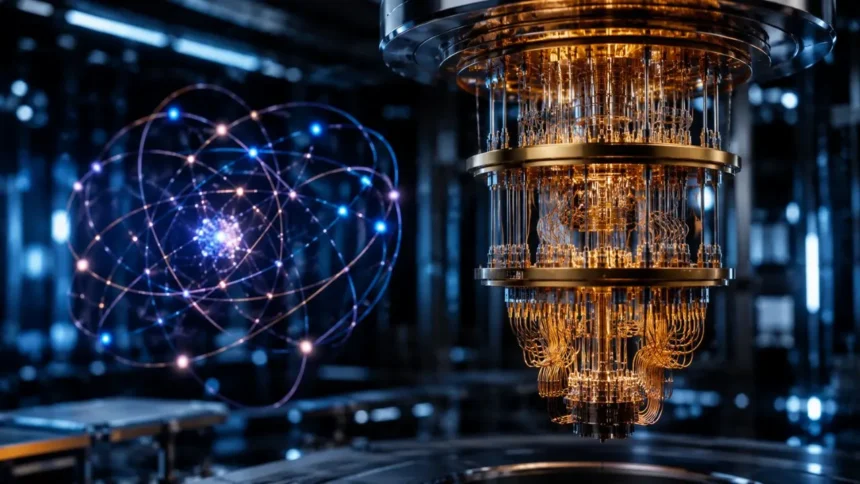
Many quantum computers do not resemble desktop computers. A superconducting quantum processor may sit at the bottom of a large cylindrical refrigeration system. The hanging structure contains multiple temperature stages, wiring, filters, amplifiers, and shielding required to keep the chip cold and control it accurately.
Trapped-ion systems use electromagnetic fields to hold electrically charged atoms in place. Lasers prepare, control, connect, and measure the ions. These qubits can provide high-quality operations, although engineers must continue improving execution speed, control complexity, and scaling.
Neutral-atom quantum computers arrange uncharged atoms using focused laser beams called optical tweezers. Photonic systems encode quantum information in particles of light and guide them through optical components. Semiconductor approaches attempt to apply experience from established chip manufacturing to quantum devices.
Each approach faces different trade-offs involving qubit quality, connectivity, operating temperature, manufacturing, gate speed, measurement, and error correction. The industry may eventually favour one dominant design, or future quantum data centres may use several types of processors for different applications.
Will Quantum Computers Replace Laptops and Smartphones?
Quantum computers are not intended to replace personal computers. A laptop is highly efficient at running an operating system, storing files, displaying graphics, managing a browser, and responding instantly to ordinary user commands. A quantum processor would add complexity without improving most of these tasks.
The more likely future is quantum-centric or hybrid computing. Conventional supercomputers will manage data, storage, networking, user interfaces, artificial intelligence, and large parts of the calculation. Quantum processing units will be called only when a particular algorithm can use their specialized capabilities.
This arrangement resembles the use of graphics processing units. A computer does not send every calculation to a GPU; it uses the accelerator for workloads suited to highly parallel graphics or numerical processing. A quantum processor may similarly become one specialized component within a larger computing environment.
Most people may therefore benefit from quantum computing without owning a quantum machine. Researchers, businesses, and digital services could access quantum processors through secure data centres. The final user may see a better material, scientific model, or industrial process without directly interacting with a qubit.
How Could Quantum Computing Affect Cybersecurity?
Some widely used public-key encryption systems rely on mathematical problems that are difficult for classical computers. Shor’s algorithm could solve important versions of these problems efficiently on a sufficiently large fault-tolerant quantum computer, threatening encryption methods used to protect communications and digital identities.
No publicly known quantum computer currently has the scale and reliability required to break modern internet encryption in practical use. Nevertheless, security transitions can take many years. Information encrypted today may also remain sensitive long enough for an attacker to store it and attempt decryption when stronger quantum hardware becomes available.
Post-quantum cryptography uses new mathematical algorithms designed to resist attacks from both classical and future quantum computers. It runs on ordinary computers and should not be confused with quantum cryptography, which uses quantum-physical systems for security-related communication methods.
NIST finalized its first three principal post-quantum cryptography standards in August 2024 and selected the HQC algorithm as an additional backup in March 2025. NIST encourages organizations to begin migration rather than waiting for a cryptographically relevant quantum computer to be completed.
Is Quantum Computing Connected to Artificial Intelligence?
Quantum computing and artificial intelligence are different technologies. AI systems learn patterns from data and use those patterns to generate predictions, classifications, recommendations, or content. Quantum computers process information according to quantum-mechanical rules and require specially designed algorithms.
Researchers are investigating whether quantum processors could accelerate selected parts of machine learning, such as optimization, sampling, or linear-algebra operations. These possibilities remain active research topics, and practical improvements must be compared against highly optimized classical AI hardware and algorithms.
AI may also help build and operate quantum computers. Machine-learning systems can assist with calibrating qubits, identifying noise, optimizing control signals, discovering circuit designs, and searching for new quantum algorithms. In this direction, AI supports the engineering of quantum technology rather than being replaced by it.
The most realistic future may combine AI, quantum processors, and classical high-performance computing. Each system would handle the work that suits it best. Claims that quantum computing will automatically make every AI model exponentially faster should be treated cautiously unless they identify a specific algorithm and credible comparison.
Common Myths About Quantum Computing
One common myth is that a qubit is simply both zero and one in the ordinary sense. A qubit exists in a quantum superposition described by probability amplitudes. When measured, it produces one classical result, and the original superposition is generally lost.
Another myth is that quantum computers evaluate every answer and allow users to read all of them. The complete state may contain many components, but measurement does not reveal an entire list. Quantum algorithms must use interference so that helpful outcomes appear more frequently.
A third misconception is that quantum computers will immediately solve every difficult problem. Some problems may receive dramatic speedups, others may receive modest improvements, and many will gain no known benefit. Computational difficulty does not automatically make a task suitable for quantum acceleration.
Finally, quantum computing should not be treated as magic. Its predictions are based on well-tested physical theories and precise mathematics. The engineering is extraordinarily difficult, but the machines still follow controllable rules that researchers can test, measure, and improve.
Why Quantum Computing Matters Even Before It Is Fully Mature
Quantum computing research is already improving understanding of physics, materials, measurement, refrigeration, control electronics, and error correction. Building precise quantum systems requires innovations that may also benefit sensing, communications, scientific instruments, and semiconductor engineering.
The technology is also changing cybersecurity planning. Governments and businesses are beginning the move toward post-quantum encryption years before a code-breaking quantum computer exists. This demonstrates how the expected future capabilities of one technology can influence current digital infrastructure.
Quantum education is expanding as well. Cloud access allows students to experiment with real processors instead of learning only from theory. Programming frameworks such as Qiskit and Cirq make it possible to create circuits, test algorithms on simulators, and submit suitable programs to supported hardware.
Most importantly, current research is revealing which expectations are realistic. Experiments can distinguish genuine computational opportunities from attractive but unsupported claims. The field will progress more responsibly when success is measured through verified performance, useful applications, and transparent comparison with classical alternatives.
What Could the Future of Quantum Computing Look Like?
In the near term, researchers will continue improving physical qubits, control systems, error mitigation, and small error-corrected memories. Quantum processors will operate alongside classical supercomputers, while scientists test whether hybrid algorithms can deliver useful results in carefully selected applications.
The next major stage would involve several dependable logical qubits. These qubits would support longer circuits and allow researchers to test algorithms that cannot run accurately on today’s noisy hardware. Scaling them will require major advances in fabrication, decoding, cryogenic systems, software, and system integration.
A mature fault-tolerant computer could eventually transform parts of chemistry, materials research, and cryptanalysis. Its impact would depend on the actual cost and performance of the complete system as well as the progress of competing classical methods.
The timetable remains uncertain. Company roadmaps provide useful engineering goals, but scientific obstacles do not always follow product schedules. Quantum computing is best understood as a serious long-term technology with important recent progress—not as a finished machine waiting to replace conventional computing next year.
Conclusion
Quantum computing is a new way of processing information using the laws that govern extremely small physical systems. Its basic unit is the qubit, which can exist in superposition and become entangled with other qubits during a calculation.
A quantum algorithm applies gates that control these states and use interference to make valuable outcomes more likely. Measurement then converts the quantum information into ordinary zeros and ones. This process can provide major advantages for selected problems, but not for every kind of calculation.
Current quantum computers remain noisy and limited. Scientists must improve qubit reliability, error correction, hardware scaling, software, and result verification before the technology can support its most ambitious applications.
Quantum computing will probably complement rather than replace conventional computers. Its future role may be similar to a specialized scientific accelerator—rarely visible to ordinary users but potentially powerful for problems involving molecules, materials, physics, optimization, and secure communication.
Frequently Asked Questions
What is quantum computing in one sentence?
Quantum computing is a way of processing information with qubits that use quantum properties such as superposition, entanglement, and interference.
Is a quantum computer faster than a normal computer?
It can be much faster for certain problems with suitable quantum algorithms. It is not faster for every task and will not improve most everyday computing activities.
Do quantum computers exist today?
Yes, real quantum processors are available in laboratories and through cloud platforms. However, current machines remain noisy and are not yet large enough for many proposed applications.
What is the main purpose of quantum computing?
Its main purpose is to tackle selected calculations that are extremely difficult for classical systems, particularly in quantum simulation, chemistry, materials science, and cryptography.
Can quantum computers break passwords?
A sufficiently powerful fault-tolerant quantum computer could threaten some public-key encryption methods. Today’s machines cannot do this, but organizations are already adopting quantum-resistant security standards.