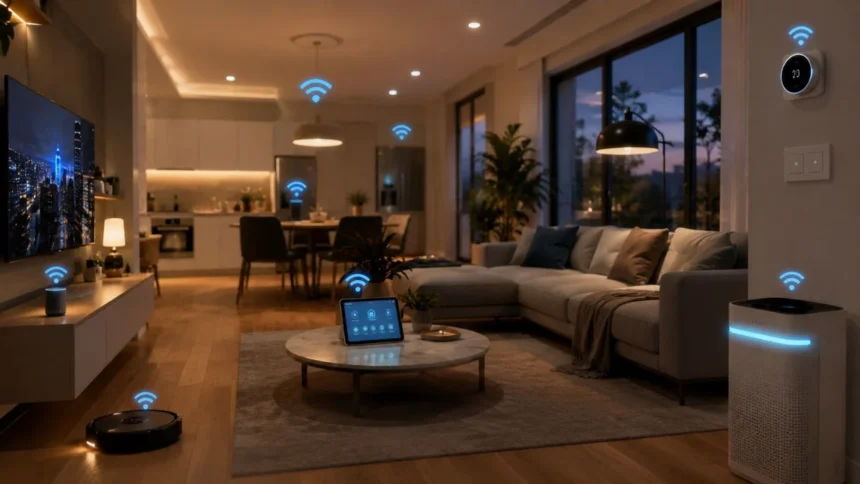
Smart home technology is gradually changing the home from a collection of separate appliances into a responsive living environment. Connected lights, thermostats, cameras, door locks, sensors, speakers, appliances and energy systems can now communicate with mobile applications and automation platforms. Instead of waiting for instructions, an intelligent home can respond to schedules, occupancy, environmental conditions and household preferences.
This transformation is not only about switching lights on with a voice command. Smart home automation can help people reduce repetitive tasks, identify water leaks, manage heating and cooling, monitor an empty property and support relatives who live independently. The most meaningful benefits appear when technology solves an everyday problem rather than adding another screen or notification.
The industry is also moving toward better compatibility. Matter, the smart home connectivity standard supported by major technology companies, is designed to improve communication between products and ecosystems. Matter 1.6, released in June 2026, focuses on easier setup, improved coordination across platforms and more context-aware device control.
Smart homes will not change every life in the same way. A parent may value door alerts and energy monitoring, while an older adult may benefit from voice-controlled lighting and emergency assistance. This article examines how connected home technology may influence convenience, safety, energy use, healthcare, accessibility, privacy and family life over the coming years.
How Will Smart Home Technology Change Our Lives?
Smart home technology will make everyday routines more automatic and responsive. Lights may adjust according to occupancy, thermostats may follow household schedules, and appliances may send alerts when maintenance is required. These small improvements can remove repeated decisions from the day and make homes easier to manage for people with busy schedules, limited mobility or multiple responsibilities.
The technology will also make household information more visible. Instead of discovering a leaking pipe through a damaged ceiling, a homeowner may receive an early moisture or water-flow alert. Instead of waiting for an unusually high electricity bill, residents may see which appliances are using energy and change their routines before the billing period ends.
Homes will increasingly respond to situations rather than isolated commands. A “leaving home” routine could lock doors, lower heating or cooling, switch off selected lights and arm security sensors. A nighttime routine could dim hallways, close compatible coverings and keep essential pathways illuminated without requiring several separate actions.
The biggest change will be a shift from device control to household assistance. People will spend less time opening individual applications and more time setting goals such as reducing energy use, improving security or making a home easier to navigate. The quality of this change will depend on reliability, thoughtful design and the resident’s control over automation.
Everyday Tasks Will Become Easier
Smart lighting is one of the simplest examples of useful home automation. Motion sensors can illuminate stairs, entrances and hallways when someone approaches, while schedules can turn unnecessary lights off. Voice or app control can also help a person switch off several rooms without walking through the entire property before leaving or going to bed.
Connected door locks and video doorbells can simplify access management. A resident may confirm that a door is locked, provide temporary access to a trusted visitor or view an entrance without immediately opening it. These systems are especially helpful when homeowners travel, receive frequent deliveries or need to coordinate access with cleaners, relatives and maintenance workers.
Smart appliances can reduce uncertainty around household tasks. A connected washing machine may report that a cycle has ended, while an oven may provide status information or a reminder that it is still operating. These features do not remove the need for responsible use, but they can make it easier to notice unfinished tasks during a busy day.
The long-term benefit is not any single command; it is the reduction of routine mental effort. When repetitive actions are combined into reliable scenes and schedules, the home becomes easier to manage. The most successful automations will remain simple, understandable and easy to override whenever a household member wants manual control.
Smart Homes Could Reduce Energy Bills
Heating and cooling represent a major opportunity for home energy management. Smart thermostats can apply schedules, respond to occupancy and help residents avoid heating or cooling an empty home unnecessarily. ENERGY STAR-certified smart thermostats are independently evaluated using field data to confirm that they deliver energy savings.
The amount saved will depend on climate, insulation, equipment efficiency and household behavior. The U.S. Department of Energy states that adjusting a thermostat by 7°F to 10°F for eight hours per day can save as much as 10% annually on heating and cooling. Smart controls can make these temperature changes easier to apply consistently.
Connected plugs, energy monitors and intelligent appliances can also reveal hidden electricity use. Residents may discover that an old refrigerator, entertainment system or standby device consumes more power than expected. Clear usage information can help households decide which behavior or appliance replacement will produce a meaningful saving instead of relying on guesswork.
Future connected homes may coordinate air conditioning, water heating, batteries, solar panels and electric vehicle charging according to energy prices and grid conditions. The Department of Energy is studying grid-interactive buildings that combine efficiency with flexible demand to improve affordability, comfort and electric-grid performance.
Smart Technology Will Make Homes Safer
Smart security systems can combine cameras, motion sensors, entry sensors, lighting and connected locks. A homeowner may receive an alert when a door opens unexpectedly or when movement is detected around an empty property. Remote access can provide reassurance, although alerts and recordings must be configured carefully to avoid unnecessary surveillance or notification overload.
Safety technology also extends beyond crime prevention. Connected smoke alarms, environmental sensors and appliance monitors can help residents notice hazards earlier. A well-designed system might illuminate an exit route, issue an audible warning and send an alert to a resident’s phone, giving the household more opportunities to respond to a developing problem.
Water monitoring is becoming another important part of the smart home. EPA WaterSense guidance explains that leak-detection and flow-monitoring devices can identify unexpected moisture, unusual water use or consumption patterns that indicate a leak. Early detection can reduce water waste and may limit damage to floors, walls, furniture and electrical systems.
However, smart safety devices should support rather than replace approved alarms, physical security and responsible maintenance. A camera cannot strengthen a weak door, and an application notification is not a substitute for a properly installed smoke alarm. The safest smart home combines connected intelligence with dependable physical protections and clear emergency procedures.
Older Adults May Live Independently for Longer
Smart home technology could make aging in place safer and more practical. Voice-controlled lights, automated blinds, video communication, door alerts and simplified entertainment systems may reduce the physical effort required to complete daily tasks. These features are especially useful when switches, controls or doorways are difficult for a resident to reach.
Sensors may also help families notice changes without continuously watching a loved one through cameras. With consent, motion or activity patterns could indicate whether a person has entered the kitchen, opened a medicine cabinet or followed a normal daily routine. The purpose should be supportive awareness rather than intrusive monitoring.
Interest in this area is already significant. AARP reports that half of surveyed adults aged 50 and older use at least one form of smart home technology, including security cameras or lighting. Its research also finds continuing interest in technology that supports home safety, independence and health management.
Technology cannot replace caregivers, healthcare professionals, accessible construction or human companionship. Systems must be affordable, dependable and easy to understand, particularly during an emergency. AARP notes that many older adults still feel technology is not designed with them in mind, showing why inclusive design must improve alongside technical capability.
Accessibility Will Become Part of Home Design
For people with mobility limitations, the ability to control doors, lights, temperature and appliances without reaching a physical switch can provide meaningful independence. A voice command, accessible button or automated routine can reduce unnecessary movement and make frequently used parts of the home easier to operate.
Smart interfaces may also support residents with visual or hearing impairments. Spoken confirmations, flashing light alerts, screen captions and wearable notifications can present the same information in different ways. A visitor notification, for example, could produce a sound, illuminate a lamp and appear as a vibration on a connected wearable.
Context-aware automation could make accessibility more personal. One household member might need brighter hallway lighting, while another prefers reduced brightness at night. Future smart homes may recognize these different needs through profiles, presence information or manually selected modes instead of applying one setting to every person.
The important principle is choice. Residents should be able to use voice, touch, switches, applications or automatic routines according to their abilities and preferences. A home becomes less accessible when an essential function works only through a complex application or stops operating normally when the internet connection fails.
Healthcare Will Move Further Into the Home
Connected health devices are becoming more relevant as healthcare providers expand remote monitoring and virtual care. Blood pressure monitors, medical alert systems, connected scales and other approved devices can help people collect information at home. Used appropriately, this information may support conversations with healthcare professionals between in-person appointments.
Smart speakers and displays can also assist with communication, reminders and telehealth access. A resident may receive a medication reminder, join a video consultation or contact a family member using a simplified voice command. These functions can be particularly valuable for people who find conventional smartphones or computer interfaces difficult to navigate.
AARP research shows strong interest among older adults in connected medical alerts, digital hearing technology and home health-monitoring devices. AARP also notes that AI and smart home systems could support care at home and reduce some of the organizational pressure placed on family caregivers.
Health-related smart home technology requires greater care than ordinary lighting automation. Incorrect alerts, missing data or misunderstood information can create anxiety or unsafe decisions. Medical information must also receive stronger privacy protection, and smart home devices should never be treated as replacements for qualified diagnosis, treatment or emergency services.
Artificial Intelligence Will Make Automation More Personal
Traditional home automation follows fixed rules: when a sensor detects motion, switch on a light. AI-powered smart homes may consider more context, including time, household routines, weather, energy prices and recent behavior. This could allow the system to recommend or perform actions that better reflect what residents are actually doing.
A home energy assistant might identify that electricity use rises after a particular appliance starts operating. A maintenance system could notice an unusual pattern from a heating unit or water pump and recommend inspection. These predictive functions may help residents address inefficiency or equipment problems before they become more expensive.
Voice assistants are also likely to become more conversational. Instead of memorizing exact commands, residents may be able to express a goal such as making the house comfortable for sleeping or reducing electricity use during peak hours. The assistant could then coordinate several compatible devices while explaining the changes it intends to make.
Personalization must remain transparent. Residents should know why an automation happened, what information influenced it and how to stop it from happening again. AI that silently changes household settings may feel intrusive, especially when several people share a home and do not have identical preferences.
Home Robots Will Handle More Physical Work
Robotic vacuum cleaners have already demonstrated how a connected device can automate a repetitive physical task. Newer home robotics are expanding into lawn care, pool maintenance, security patrols and other specialized jobs. These products are gradually becoming better at mapping spaces, avoiding obstacles and coordinating with home automation platforms.
The next stage will involve robots that understand more of the household environment. A cleaning robot may respond to an occupancy sensor, avoid a room where someone is sleeping and return after the space becomes available. Connected appliances and robots may also share information instead of each operating according to a separate schedule.
General-purpose household robots remain more difficult than single-task devices because real homes are unpredictable. Stairs, pets, children, fragile objects and constantly changing layouts create complicated safety challenges. For this reason, the immediate future is more likely to involve several capable specialist robots than one machine that performs every household chore.
Even limited robotics could change how people allocate their time. Automating floor cleaning, lawn maintenance or routine inspection may give residents more time for work, rest and family activities. The real value will depend on whether the machine is reliable enough to save effort rather than creating a new maintenance task.
Matter Could Make Connected Devices Easier to Combine
One of the biggest smart home frustrations has been ecosystem incompatibility. A product may work with one mobile platform or voice assistant but not another, forcing buyers to check logos and compatibility lists before every purchase. Matter was created to improve interoperability through an IP-based standard for connected home devices.
Matter 1.5, released in November 2025, expanded the standard to additional categories such as cameras, closures and soil sensors while improving energy-management capabilities. Matter 1.6 followed in June 2026 with improvements focused on setup, multi-ecosystem management and more context-aware control.
This progress could make it easier to move between ecosystems or allow household members to use different platforms. A compatible device may eventually be controlled through more than one major smart home system without complicated workarounds. That flexibility can reduce dependence on a single manufacturer and make purchasing decisions less confusing.
Matter does not guarantee that every feature will appear in every application immediately. Device makers and platforms still need to adopt each specification version and implement supported functions properly. Consumers should continue checking the exact capabilities of a product rather than assuming that a Matter logo makes all devices and ecosystems identical.
Family and Household Management Will Change
Smart home technology can make coordination easier in a busy household. Shared routines may remind family members about open doors, unfinished laundry, unusual energy use or scheduled maintenance. A central home display could present calendars, deliveries, weather, tasks and security information without requiring each person to search through separate applications.
Parents may use automations to create more predictable routines. Lights could gradually dim before bedtime, internet-connected entertainment devices could follow household schedules, and entry notifications could confirm that an older child has arrived home. These tools should support communication and trust rather than becoming instruments for excessive monitoring.
Remote access can also help people manage a second property, rental unit or family home. A trusted person may check temperature, detect a leak or confirm that a door is secure without travelling immediately. This could be particularly useful during severe weather, holidays or periods when a property is temporarily empty.
Shared technology will also require shared rules. Household members should agree on which cameras are acceptable, who can view recordings, what information is retained and which actions can occur automatically. A technically advanced home can still create conflict when one person values convenience and another feels continuously observed.
Smart Homes Could Support Cleaner, More Resilient Energy
The future smart home will increasingly connect with solar panels, home batteries, electric vehicles and variable electricity pricing. Instead of operating each system separately, home energy software may decide when to charge a battery, run an appliance or draw electricity from the grid according to household priorities.
Managed charging can move electric vehicle demand away from the most expensive or congested hours. Compatible bidirectional vehicles may also provide power to a building when paired with suitable equipment. The Department of Energy describes bidirectional EVs as mobile storage that can offer resilience and demand-response benefits to connected buildings.
Connected homes could also become participants in a more flexible electric grid. Smart thermostats, water heaters, batteries and appliances may adjust their timing without substantially changing household comfort. DOE research treats these buildings as flexible energy resources that can combine efficiency, affordability and grid support.
These systems must protect the homeowner’s priorities. Residents should understand whether a utility or third party can adjust equipment, what financial benefit they receive and how to leave a program. Energy automation will gain trust only when it remains transparent, voluntary and easy to override.
Privacy and Cybersecurity Will Become Essential
Every connected device creates another potential source of household data. Cameras may capture entrances, speakers may process voice requests, thermostats may reveal occupancy patterns and locks may record entry activity. This information can improve automation, but it can also expose sensitive details when collected, shared or protected poorly.
NIST research confirms that smart home users have privacy and cybersecurity concerns across device categories such as lighting, sensors, thermostats, voice assistants and security systems. These concerns do not mean people must avoid smart technology, but they do show why security should be part of the buying decision rather than an afterthought.
NIST recommends practical measures including unique passwords, two-factor authentication, regular software updates and careful purchasing decisions. It also suggests placing smart home devices on a separate network from computers containing sensitive information when the router and household setup make that practical.
Manufacturers also have responsibilities. Products should receive security updates for a clearly stated period, use secure default settings and explain what happens to personal data. NIST has warned that unsupported connected devices may remain in homes even after security patches stop, potentially creating long-term safety and privacy risks.
Smart Home Technology Will Still Have Limitations
Cost remains a major barrier. A single connected bulb may be affordable, but a complete system involving locks, cameras, sensors, thermostats, hubs, subscriptions and professional installation can become expensive. The financial value is strongest when devices solve a clear problem or reduce a measurable expense.
Reliability is another challenge. A smart device may depend on electricity, Wi-Fi, cloud servers, mobile applications and continued manufacturer support. Essential functions such as lighting, locks and heating should therefore retain safe manual controls and reasonable operation during an internet outage.
Subscription fees can also change the real price of ownership. Some cameras, alarms and monitoring systems require monthly payments for cloud recordings, advanced alerts or professional response. Buyers should calculate several years of fees and confirm which functions remain available without a paid plan.
Technology can also become unnecessarily complicated. Multiple applications, duplicate notifications and poorly designed routines may create more work instead of less. A truly intelligent home is not the one with the most connected devices; it is the one that quietly solves useful problems without demanding constant attention.
How to Prepare for the Smart Home Future
Start with a specific household problem rather than purchasing technology simply because it is new. A smart thermostat may help manage heating costs, while a leak sensor may protect a basement or kitchen. Solving one practical problem makes it easier to evaluate whether the device is genuinely improving daily life.
Choose products that support widely used standards and ecosystems. Look for Matter compatibility where it is relevant, but confirm that the specific function you need is supported by your chosen platform. Also investigate update policies, warranty coverage, replacement parts and whether important features require a subscription.
Protect the network before adding many connected devices. Use a strong router password, enable automatic updates, activate two-factor authentication and avoid reusing account passwords. Consider a separate guest or IoT network when the router supports it, particularly for cameras, speakers and inexpensive devices from less familiar manufacturers.
Finally, create automations gradually. Test one routine, explain it to everyone in the household and confirm that it behaves safely under unusual conditions. Reliable simplicity will produce more long-term value than dozens of complicated rules that nobody understands or knows how to disable.
Final Verdict: Will Smart Home Technology Improve Our Lives?
Smart home technology has the potential to make daily life safer, easier and more efficient. Connected devices can reduce repetitive work, improve control over energy, identify household problems earlier and make essential functions more accessible. These benefits are already available, although their quality varies between products and platforms.
The greatest social impact may appear in homes supporting older adults, people with disabilities and family caregivers. Voice control, remote monitoring, activity alerts and connected health services could help more people live independently. These systems must be designed with consent, dignity, affordability and human support at their center.
AI, robotics and standards such as Matter will make future smart homes more capable. Devices are likely to understand context, cooperate across brands and manage energy with less manual input. However, the transition will be gradual because compatibility, reliability, security and cost still require improvement.
Smart homes will improve lives when the technology remains under human control. The goal should not be to connect every object or automate every decision. It should be to create a home that saves time, protects resources, supports independence and responds helpfully without compromising privacy or personal choice.
Frequently Asked Questions
What is smart home technology?
Smart home technology includes internet-connected devices that monitor, control or automate household functions. Examples include smart lights, thermostats, locks, cameras, speakers, appliances, sensors and energy systems.
How will smart homes change daily life?
Smart homes will automate repetitive routines, improve remote control and provide earlier warnings about security, water leaks or energy waste. They may also make homes easier to use for older adults and people with disabilities.
Can smart home technology save money?
It can reduce expenses when used to manage heating, cooling, lighting, water leaks and appliance schedules. Savings depend on the home, local energy prices, device cost and whether the household uses the automation consistently.
Are smart home devices safe from hackers?
No connected product is completely risk-free. Unique passwords, two-factor authentication, software updates, secure Wi-Fi and products with clear security-support policies can significantly reduce the risk of unauthorized access.
What is the future of smart home technology?
The future will include more AI-based automation, home robots, energy management, health support and cross-brand compatibility. Homes will increasingly respond to context and household needs instead of waiting for individual commands.