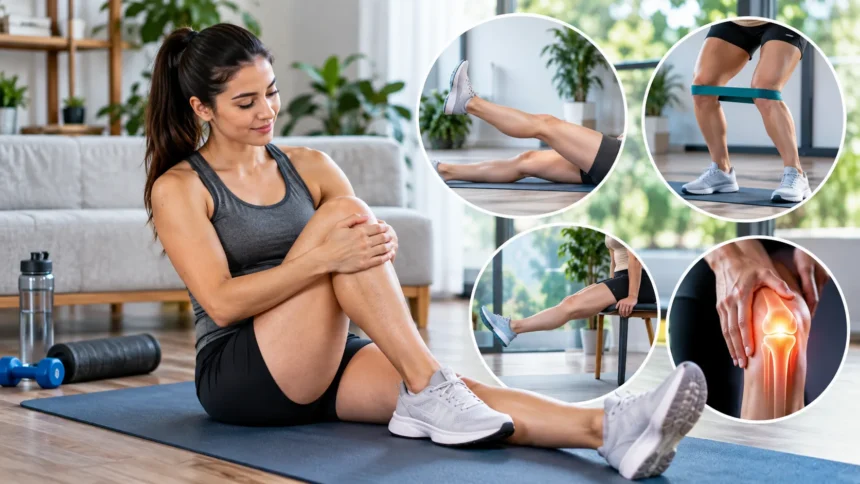
Knee mobility plays an important role in walking, squatting, climbing stairs, exercising, and performing everyday movements comfortably. When the knee feels stiff or restricted, even simple activities can become awkward. Gentle mobility exercises can help maintain movement, reduce stiffness, and support better function when they are performed correctly and within a comfortable range.
The knee does not work alone. Hip mobility, ankle movement, calf flexibility, muscle strength, and previous injuries can all influence how freely the knee moves. A good knee mobility routine therefore focuses on controlled movement rather than forcing the joint into deeper positions, especially if you are returning to exercise after inactivity or discomfort.
What Is Knee Mobility?
Knee mobility refers to your ability to bend and straighten the knee through a comfortable, controlled range of motion. Healthy mobility allows the joint to move smoothly during activities such as walking, sitting, getting up from a chair, and climbing stairs. Limited movement may feel like stiffness, tightness, pressure, or difficulty fully bending or straightening the leg.
Mobility differs slightly from flexibility because it involves active control of movement, not only how far tissues can stretch. Your muscles, tendons, ligaments, joint surfaces, and nervous system all contribute to how well the knee moves. Improving mobility therefore involves gentle movement, strength, coordination, and sometimes attention to nearby joints.
A mobile knee is not necessarily one that bends as far as possible. The goal is to achieve the range you need without pain, instability, or excessive compensation elsewhere in the body. Some people naturally have greater movement than others, so exercises should be adapted to individual comfort, health history, and activity level.
Why Knee Mobility Matters
Good knee mobility helps the lower body move efficiently during everyday activities. When the knee bends and straightens comfortably, you can distribute force more naturally across the hips, knees, ankles, and feet. Restrictions may cause you to compensate by changing how you walk, squat, or climb stairs, which can place extra stress on surrounding areas.
Mobility is also important for exercise technique. Movements such as squats, lunges, step-ups, cycling, and running require repeated knee bending and straightening. When range of motion is limited, you may shorten movements, shift your weight unevenly, or rely more heavily on the hips or ankles to complete the activity.
Maintaining knee movement can be especially helpful after periods of inactivity. Sitting for long hours, reducing exercise because of illness, or recovering from a minor problem may leave the knee feeling stiff. Gentle mobility work can gradually reintroduce movement without immediately placing the joint under heavy resistance or demanding training loads.
Heel Slides for Gentle Knee Flexion
Heel slides are one of the simplest exercises for improving knee bending. Lie on your back with both legs extended, then slowly slide one heel toward your body while allowing the knee to bend. Move only as far as feels comfortable, pause briefly, and slide the foot back until the leg is straight again.
Keep the movement smooth instead of pulling the heel aggressively toward your body. You can perform the exercise on a bed, exercise mat, or another comfortable surface where your foot can slide easily. Beginners may start with 8 to 12 controlled repetitions on each side while paying attention to how the knee feels.
Heel slides can be useful when the knee feels stiff after prolonged sitting or reduced activity. However, you should not force the joint through sharp pain, significant swelling, or a blocked sensation. If the knee cannot bend normally after an injury or surgery, follow the movement limits provided by your healthcare or rehabilitation professional.
Seated Knee Extensions for Range of Motion
Seated knee extensions provide a simple way to practice straightening the knee. Sit upright in a stable chair with both feet on the floor, then slowly extend one leg forward until the knee reaches a comfortable straight position. Pause briefly before lowering the foot back down with control and repeating the movement.
Avoid swinging the lower leg or using momentum. The goal is to move the knee smoothly while maintaining a relaxed upper body and stable thigh position. If straightening the leg completely feels uncomfortable, work within the range that feels manageable and gradually increase the movement as stiffness improves.
This exercise can be particularly convenient for people who spend much of the day sitting. A few gentle repetitions can restore movement after the joint has remained in one position for a long time. If the exercise causes increasing pain, clicking accompanied by pain, or significant swelling, stop and consider getting the knee evaluated.
Knee Flexion Stretch Using a Chair
A chair-assisted knee flexion stretch can help you gently work on bending the knee. Sit near the front of a stable chair and slide one foot backward underneath the seat. Keep the foot planted and allow the knee to bend until you feel mild tension, then hold the position briefly without forcing it.
The stretch should feel controlled rather than painful. You can gradually slide the foot farther backward as mobility improves, but avoid bouncing or pushing through strong resistance. Keeping your hips level and your foot facing forward can help you focus the movement on the knee rather than twisting through the leg.
This exercise may be useful before lower-body activity when the knee feels stiff. Perform several slow repetitions or hold each comfortable position for a short period. People with recent surgery, significant arthritis, or a fresh knee injury should follow individualized medical guidance before attempting deeper bending exercises.
Calf and Ankle Mobility for Better Knee Movement
Ankle movement can strongly influence knee mobility because the knee often needs to travel forward over the foot during squats, stairs, and lunges. Restricted ankle dorsiflexion may cause your heel to lift or your body to shift awkwardly. Improving ankle control can therefore make many knee movements feel smoother and more natural.
A simple ankle mobility drill involves standing near a wall with one foot forward and gently moving the knee toward the wall while keeping the heel down. The movement should remain comfortable and controlled. If you regularly experience tight calves, addressing lower-leg stiffness may also improve how freely the knee moves during exercise.
Do not force your knee far beyond the toes simply to achieve a larger range. Focus instead on keeping the foot stable and the heel in contact with the floor. Gradual ankle mobility work combined with calf flexibility and lower-leg strength can support better mechanics throughout the entire lower-body movement chain.
Standing Knee Bends for Everyday Mobility
Standing knee bends provide a functional way to practice bending and straightening the joint while bearing body weight. Stand behind a sturdy chair or near a wall for support, then slowly bend both knees slightly while keeping your feet flat. Return to standing by straightening the knees without locking them aggressively.
Start with a shallow range and gradually increase the depth as your comfort and control improve. Keep your knees generally tracking in the same direction as your toes instead of allowing them to collapse inward. Your hips may move slightly backward as you lower, creating a movement similar to a small supported squat.
This exercise can help prepare you for daily tasks such as sitting down, standing up, and using stairs. It also introduces light strength demands alongside mobility. If bodyweight knee bends cause sharp pain, instability, or significant swelling afterward, reduce the range or seek professional advice before continuing.
Straight-Leg Raises to Support Knee Control
Straight-leg raises are not primarily a mobility exercise, but they can support the muscles that help control the knee. Lie on your back with one knee bent and the other leg straight. Tighten the thigh of the straight leg, then slowly lift it several inches from the floor while keeping the knee extended.
Pause briefly at the top before lowering the leg with control. The movement should come from the hip while the quadriceps help maintain a straight knee. Start with a small number of repetitions and avoid lifting so high that your lower back arches or you lose control of the movement.
Stronger thigh muscles can help support knee function during walking, stairs, and mobility exercises. Strength and mobility often work together because having more control through a range can make movement feel safer and more stable. Progress gradually rather than adding heavy resistance before you can perform the basic exercise comfortably.
Hip Mobility Exercises That Support the Knees
The hips influence how your knees track during many lower-body movements. Limited hip rotation, weakness, or poor control may cause the knees to move inward or compensate during squats and stairs. Including gentle hip mobility exercises can therefore support better knee mechanics even though the movement does not occur directly at the knee.
One simple option is seated hip rotation. Sit on a chair with your knees bent and gently move one lower leg inward and outward while allowing the hip to rotate within a comfortable range. Keep the motion controlled and avoid twisting your knee aggressively to create a larger range at the hip.
You can also use gentle hip flexor and glute mobility exercises as part of your routine. Better hip movement can make lower-body exercises feel less restricted and reduce the need for the knee to compensate. If certain hip movements reproduce knee pain, stop and reassess your technique or seek professional guidance.
How Often Should You Do Knee Mobility Exercises?
Mild knee mobility exercises can often be performed regularly because they use low resistance and controlled movement. Many people benefit from short sessions once or twice a day, particularly if stiffness develops after sitting. However, frequency should depend on your symptoms, activity level, medical history, and how the knee responds afterward.
A routine does not need to be long to be useful. Five to ten minutes of heel slides, knee extensions, ankle mobility, and gentle bending may be enough to keep the joint moving. Consistency usually matters more than performing an exhausting mobility session only once every few weeks.
Your knee should generally feel similar or better after gentle mobility work, not significantly worse. Mild stretching sensations can be normal, but increasing swelling or prolonged pain suggests that the session may have been too demanding. Reduce the range, repetitions, or frequency if symptoms consistently increase after exercise.
Common Mistakes During Knee Mobility Exercises
One common mistake is assuming that greater range always means better mobility. Forcing your knee deeply into flexion or extension can irritate sensitive tissues, particularly when the joint is already swollen or injured. Mobility should develop gradually through controlled repetition rather than aggressive pushing, bouncing, or using external force to overcome pain.
Another mistake is ignoring the hips, ankles, and feet. Knee movement depends on the entire lower-body chain, so repeatedly stretching only the knee may not address the actual limitation. Restricted ankle motion, weak hips, or tight calf muscles can all change how the knee moves during functional activities.
People also sometimes perform mobility exercises too quickly. Rushing makes it difficult to notice how the joint is moving and whether compensation is occurring. Slow repetitions allow you to monitor alignment, discomfort, and control while giving the muscles and nervous system time to become comfortable with the available range.
When Knee Mobility Exercises May Not Be Appropriate
Gentle mobility is helpful in many situations, but there are times when self-directed exercise may not be appropriate. A knee that is suddenly very swollen, severely painful, or unable to bear weight may require medical evaluation before you begin stretching or strengthening. Continuing to exercise through significant symptoms can sometimes aggravate an underlying injury.
Seek medical attention after trauma if your knee appears deformed, repeatedly gives way, locks completely, or you cannot fully straighten it. A sudden popping sensation followed by swelling or instability can also indicate an injury that needs professional assessment. Mobility exercises should not be used to delay evaluation when serious damage is possible.
Redness, warmth, fever, or rapidly increasing swelling also deserves medical attention. These symptoms can sometimes indicate infection or another inflammatory problem rather than simple stiffness. A physical therapist or healthcare professional can determine when movement is appropriate and recommend exercises that match your specific condition.
Conclusion
Knee mobility exercises can help maintain comfortable bending and straightening while supporting everyday activities such as walking, squatting, and climbing stairs. Heel slides, seated extensions, supported knee bends, and ankle mobility drills are simple options that can be adjusted to different ability levels. The key is moving slowly and staying within a comfortable range.
Good knee mobility also depends on the muscles and joints around the knee. Hip control, ankle movement, calf flexibility, and thigh strength all influence how the knee functions during exercise and daily life. A balanced routine that addresses the entire lower body is often more useful than repeatedly stretching the knee by itself.
Mobility work should never require you to push through sharp pain, major swelling, or instability. If symptoms persist, worsen, or follow a significant injury, get professional guidance before continuing. When performed appropriately and consistently, simple mobility exercises can help your knees move more comfortably and confidently.
FAQs
What is the best exercise for knee mobility?
Heel slides are a simple starting option because they gently practice knee bending and straightening. The best exercise ultimately depends on your specific restriction, symptoms, and health history.
Can I do knee mobility exercises every day?
Gentle mobility exercises can often be performed daily if they do not increase pain or swelling. Adjust the frequency according to how your knee responds and any medical guidance you have received.
How long does it take to improve knee mobility?
Improvement varies depending on the cause of stiffness, activity level, injury history, and consistency. Mild restriction may improve relatively quickly, while significant limitations can require weeks or longer.
Should knee mobility exercises hurt?
No. Mild stretching or muscular effort may be expected, but sharp, increasing, or lingering pain is a sign to reduce the movement or stop and seek appropriate advice.
Can tight calves affect knee mobility?
Yes. Tight or restricted calf muscles can limit ankle movement, which may change how the knee travels during squatting, walking, and lunging. Improving lower-leg mobility may support smoother knee movement.