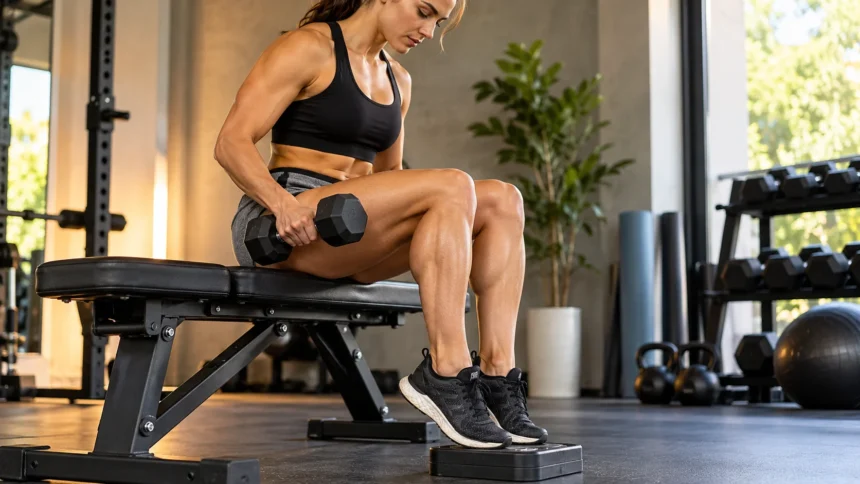
Unlike the larger gastrocnemius muscle, the soleus works particularly well when the knee is bent. This makes exercises such as seated calf raises and bent-knee heel raises useful for targeting the muscle. Understanding proper exercise technique, common mistakes, and recovery strategies can help you strengthen your soleus safely and effectively.
What Is the Soleus Muscle and Where Is It Located?
The soleus is a broad, flat muscle located in the lower leg, underneath the larger gastrocnemius muscle. Together, these muscles form an important part of the calf complex. The soleus connects through the Achilles tendon to the heel bone and helps control movements around the ankle during walking, standing, and other weight-bearing activities.
Its primary function is plantar flexion, which means pointing the foot downward or lifting the heel away from the ground. This movement occurs when walking, climbing stairs, or rising onto your toes. The soleus also helps stabilize the ankle and supports posture by controlling the forward movement of the lower leg.
One distinctive feature of the soleus is its high proportion of fatigue-resistant muscle fibers. These fibers allow it to remain active for extended periods during standing and walking. Because the muscle contributes to both endurance and stability, strengthening it can support comfortable everyday movement and improve lower-leg muscular function.
Why Are Soleus Muscle Exercises Important?
Soleus strengthening exercises help develop the muscular endurance needed for prolonged standing, walking, and repeated ankle movements. Since the soleus works continuously during many daily activities, maintaining its strength can support lower-leg function. A well-conditioned soleus also contributes to controlled movement when transitioning between different surfaces or changing walking speeds.
The soleus plays an important role in supporting the ankle and managing forces transmitted through the lower leg. Improving calf strength may help prepare the muscles and tendons for activities involving repeated weight-bearing movements. However, strengthening one muscle alone cannot guarantee injury prevention, and balanced training remains important for overall physical resilience.
Regular soleus exercises can complement a broader fitness routine that includes mobility, balance, and other lower-body strengthening activities. These exercises are useful for general fitness enthusiasts and people who want better calf endurance. Selecting suitable movements and progressing gradually helps ensure that exercise remains comfortable and appropriate for individual abilities.
1. Seated Calf Raises for Soleus Strength
Seated calf raises are among the most effective exercises for emphasizing the soleus muscle. Sitting with the knees bent reduces the contribution of the gastrocnemius, allowing the soleus to perform more of the work. This makes the exercise a practical option for developing controlled ankle movement and lower-leg strength.
Begin by sitting upright on a stable chair or bench with both feet flat on the floor. Keep your knees bent comfortably and slowly raise your heels while maintaining contact between your toes and the ground. Pause briefly at the top, then lower your heels with control until your feet return to the starting position.
Focus on smooth movement instead of lifting your heels as quickly as possible. Avoid bouncing or allowing your ankles to collapse inward during the exercise. Beginners can start with body weight, while experienced individuals may eventually use appropriate resistance after mastering technique and ensuring the movement remains pain-free.
2. Bent-Knee Standing Calf Raises
Bent-knee standing calf raises emphasize the soleus while also challenging balance and ankle control. Unlike traditional straight-leg calf raises, this variation keeps the knees slightly flexed throughout the movement. The bent-knee position reduces the mechanical advantage of the gastrocnemius, encouraging greater relative involvement from the deeper soleus muscle.
Stand with your feet approximately hip-width apart and lightly hold a stable surface for balance. Bend both knees slightly while keeping your torso upright, then slowly raise your heels away from the floor. Maintain the knee bend as you lift, pause briefly, and lower your heels without abruptly dropping your body weight.
Avoid straightening your knees completely during the lifting phase because doing so changes the emphasis of the exercise. Keep your ankles aligned and distribute pressure evenly across the front of your feet. If balancing feels difficult, increase hand support and prioritize controlled movement rather than attempting additional repetitions.
3. Wall-Supported Soleus Raises
Wall-supported soleus raises provide a convenient way to strengthen the lower legs without specialized equipment. The wall offers additional stability, making this exercise suitable for people learning proper calf-raising technique. Keeping the knees gently bent helps emphasize the soleus while maintaining control over the movement.
Stand facing a wall and place your hands against it at approximately shoulder height. Position your feet comfortably beneath your body, bend your knees slightly, and lift both heels while maintaining balance. Lower your heels slowly until they reach the ground, then repeat the movement with steady breathing and controlled ankle alignment.
Keep your weight balanced rather than leaning heavily into the wall or pushing your hips backward. The wall should provide support without replacing the work performed by your calf muscles. This variation can be incorporated into home workouts, although individuals with ankle injuries or persistent discomfort should seek appropriate guidance first.
4. Single-Leg Bent-Knee Calf Raises
Single-leg bent-knee calf raises challenge each lower leg individually and can reveal differences in strength or balance. Performing the exercise on one foot increases the amount of work required from the supporting calf muscles. However, this variation is more demanding than bilateral calf raises and should be introduced only when basic movements feel comfortable.
Stand beside a stable wall or railing and place one hand against it for support. Shift your weight onto one foot, slightly bend the supporting knee, and lift your opposite foot away from the floor. Slowly raise the heel of the standing foot, pause briefly, and lower it with control.
Avoid twisting your ankle or allowing your knee to move excessively inward during the exercise. If maintaining balance becomes difficult, return to a two-legged variation until your control improves. The goal is consistent, comfortable movement rather than forcing extra repetitions or attempting advanced variations before developing adequate stability.
5. Seated Soleus Raises With Resistance
Adding resistance to seated calf raises can help strengthen the soleus as body-weight movements become easier. This variation is commonly performed with a dedicated seated calf raise machine or other appropriately supported resistance. The resistance should allow controlled ankle movement without creating uncomfortable pressure on the knees or surrounding tissues.
Sit comfortably with your knees bent and your feet positioned securely on the platform. Keep your upper body stable and lift your heels by pressing through the front of your feet. Pause briefly before lowering your heels slowly, maintaining a comfortable movement range without forcing your ankles into an uncomfortable position.
Choose resistance that allows you to complete each repetition without bouncing or using momentum. Increasing resistance too quickly may overload the calf muscles or Achilles tendon, particularly after a period of inactivity. Gradual progression and adequate recovery are more useful than attempting the heaviest possible weight during every session.
6. Resistance Band Soleus Exercises
Resistance bands offer a portable option for training ankle plantar flexion and supporting general calf strength. They can be useful when gym equipment is unavailable or when a person prefers simple home exercises. However, a seated resistance-band movement is not identical to a weight-bearing calf raise, so combining different exercises may provide broader benefits.
Sit on a stable surface with one knee bent comfortably and your foot positioned where it can move freely. Loop a suitable resistance band around the front of your foot and hold the ends securely. Slowly point your toes against the resistance, then return to the starting position without letting the band snap backward.
Maintain steady tension throughout the movement and avoid pulling the band excessively tight. Check the band for damage before use and keep it positioned securely to prevent slipping. This exercise can complement more traditional calf raises, particularly when focusing on controlled ankle movement and general lower-leg conditioning.
7. Soleus Stretching for Better Ankle Mobility
Soleus stretching focuses on improving flexibility in the deeper calf muscles while the knee remains bent. It differs from a traditional straight-leg calf stretch, which places greater emphasis on the gastrocnemius. Including gentle stretching in a balanced routine may support comfortable ankle movement and reduce feelings of muscular tightness.
Stand facing a wall with one foot slightly behind the other and place your hands against the wall for support. Bend the back knee gently while keeping the heel in contact with the floor. Shift your weight forward until you feel a mild stretch in the lower calf, avoiding sharp pain or excessive ankle pressure.
Keep the movement gentle and breathe normally while maintaining a comfortable position. Stretching should create mild tension rather than a painful pulling sensation. Although flexibility exercises can support mobility, they do not replace strength training, and excessive stretching may aggravate certain calf or Achilles tendon injuries.
8. How to Perform Soleus Exercises With Proper Form
Correct exercise technique helps ensure that the intended muscles perform the movement while unnecessary stress is minimized. During bent-knee calf raises, maintaining consistent knee flexion is particularly important for emphasizing the soleus. Smooth heel movement, stable ankle alignment, and appropriate balance support are useful across most soleus-focused exercises.
The lifting portion of each repetition should be deliberate rather than explosive, especially while learning the movement. Lowering the heel slowly helps maintain muscular control throughout the exercise. Avoid excessive bouncing, sudden direction changes, or forcing the ankle beyond a comfortable range simply to achieve a larger movement.
Breathing should remain natural during each repetition, without unnecessary breath-holding or excessive muscular tension. If your technique deteriorates, reduce the difficulty or take a rest rather than continuing with poor control. Exercise quality is more important than performing additional repetitions that place unnecessary stress on the lower legs.
9. Common Mistakes to Avoid During Soleus Training
One common mistake is allowing the knees to straighten during exercises intended to emphasize the soleus. Straightening the knees changes calf muscle mechanics and increases the relative involvement of the gastrocnemius. Maintaining a comfortable, consistent knee bend throughout the movement helps preserve the intended exercise emphasis.
Another frequent error involves using momentum instead of controlled muscular effort. Quickly bouncing through repetitions may reduce movement control and create unnecessary stress on the Achilles tendon. Similarly, using resistance that is too challenging can encourage compensatory movements, including ankle rolling, excessive leaning, or incomplete heel movement.
Ignoring discomfort is another mistake that can interfere with safe exercise progression. Mild muscular effort is expected during strengthening, but sharp pain, sudden weakness, or increasing tendon discomfort should not be treated as normal. Adjusting exercise difficulty and allowing suitable recovery helps support consistent training without unnecessary overloading.
10. Benefits of Strengthening the Soleus Muscle
A stronger soleus can improve the lower leg’s ability to generate and control force during daily movement. Because the muscle contributes to ankle plantar flexion, it plays an important role in walking and climbing stairs. Strengthening exercises may help improve muscular endurance and support comfortable participation in routine physical activities.
Soleus training also contributes to overall calf strength and ankle stability. Balanced lower-leg conditioning can support activities that involve maintaining posture, changing direction, or moving across uneven surfaces. However, ankle stability depends on several muscles, tendons, and sensory systems, so comprehensive training should include more than isolated calf exercises.
Another important benefit involves improved tolerance for repeated muscular work. The soleus contains many fatigue-resistant fibers, making endurance-oriented activities especially relevant to its function. Gradually improving strength and conditioning may support physical confidence and movement efficiency, although results vary depending on individual health, training consistency, and activity levels.
11. Soleus Muscle Exercises for Runners and Athletes
Running places repeated demands on the calf muscles and Achilles tendon as the body absorbs and generates forces during each stride. The soleus contributes significantly to controlling ankle movement under these conditions. Including appropriate calf strengthening within an overall training program may help runners develop the capacity needed for repeated lower-leg loading.
Bent-knee calf raises and seated calf raises can complement broader strength exercises for runners. These movements allow athletes to train calf muscles through controlled ankle motion while adjusting the difficulty to their abilities. However, training should also address the hips, thighs, feet, and overall movement mechanics rather than focusing exclusively on the soleus.
Athletes should consider their existing training volume before introducing additional lower-leg exercises. Sudden increases in calf loading can contribute to muscular soreness or Achilles tendon irritation. Gradual progression, recovery, and appropriate technique help make soleus strengthening a useful component of an athletic conditioning routine.
12. How Often Should You Train Your Soleus Muscle?
The appropriate frequency of soleus training depends on exercise experience, current strength, recovery, and overall physical activity. Beginners may benefit from introducing strengthening exercises on two nonconsecutive days per week. This provides opportunities to practice movement technique while allowing time for the muscles to recover between challenging sessions.
Individuals who already perform regular resistance training can incorporate soleus-focused movements into existing lower-body workouts. Seated calf raises, bent-knee raises, and other appropriate variations may be alternated according to individual needs. Exercise difficulty should increase gradually, with attention to soreness, movement quality, and any discomfort around the Achilles tendon.
Training the soleus every day with challenging resistance is not necessary for most people. Although the muscle supports frequent everyday movement, resistance training creates additional demands that require appropriate recovery. Consistency, comfortable progression, and balanced lower-body training are more important than attempting intense calf workouts as frequently as possible.
13. How Many Repetitions Are Best for Soleus Exercises?
Repetition ranges should reflect your training goals, current ability, and the difficulty of the selected exercise. Beginners can often start with a manageable number of controlled repetitions using body weight. The priority should be learning the movement correctly while maintaining steady ankle alignment and avoiding excessive fatigue.
Both moderate and higher repetition ranges can be used to train the soleus, depending on resistance and exercise experience. Lighter resistance may allow more repetitions, while greater resistance generally requires fewer repetitions. Neither approach is automatically superior for everyone, and a varied, progressive strengthening program can support muscular development.
Rather than chasing a specific number, choose a workload that allows comfortable control from the first repetition to the last. Stop or adjust the exercise when technique becomes inconsistent or pain develops. Over time, gradual increases in resistance or repetitions may help build strength without creating unnecessary strain.
14. Soleus Exercises for Beginners at Home
Beginners can strengthen the soleus at home using simple movements that require little or no specialized equipment. Seated calf raises are a practical starting point because the chair provides stability and reduces balance demands. Wall-supported bent-knee raises can be introduced once basic ankle movement feels comfortable and controlled.
A simple routine may begin with a brief period of comfortable walking or gentle ankle movement. Follow this with seated calf raises and, if appropriate, supported standing raises using smooth repetitions. Finish with a gentle bent-knee calf stretch if stretching feels comfortable and does not aggravate existing symptoms.
As coordination and strength improve, the exercises can become gradually more challenging through additional repetitions or suitable resistance. There is no need to progress quickly or perform difficult single-leg variations immediately. People recovering from injuries or managing significant ankle discomfort should seek individualized advice before starting a new strengthening routine.
15. Soleus Muscle Recovery and Injury Prevention Tips
Recovery is an important part of any strengthening routine because muscles and surrounding tissues need time to adapt to exercise demands. Mild soreness may occur after introducing unfamiliar calf movements, particularly when resistance increases. However, severe pain, unusual swelling, or persistent difficulty walking should not be considered a normal training response.
Adequate sleep, balanced nutrition, and regular hydration support general recovery and physical well-being. Alternating challenging training sessions with lighter movement or rest can help manage overall exercise demands. Gentle walking may be comfortable during recovery, but activities that aggravate calf or Achilles tendon pain should be reduced until properly assessed.
Gradual training progression is especially important for people returning to exercise after inactivity. Increasing resistance, exercise volume, and athletic activity simultaneously can place unnecessary stress on lower-leg tissues. Anyone experiencing sudden calf swelling, warmth, redness, or unexplained significant pain should seek medical assessment rather than attempting to stretch or massage the affected area.
Conclusion
Soleus muscle exercises are a useful part of lower-body strengthening because they support ankle movement, stability, and muscular endurance. Seated calf raises, bent-knee standing raises, and controlled resistance exercises can help emphasize this important calf muscle. Understanding its function makes it easier to select suitable movements and perform them with proper technique.
Effective soleus training involves maintaining appropriate knee positioning, controlling each repetition, and gradually progressing exercise difficulty. Combining strengthening with comfortable mobility work and adequate recovery can support balanced lower-leg conditioning. Avoiding excessive resistance and paying attention to discomfort are important for maintaining a sustainable exercise routine.
Whether you are improving everyday mobility or developing general fitness, strengthening the soleus can contribute to better lower-leg function. Start with exercises that match your current abilities and focus on consistent technique rather than rapid progression. With sensible training habits, soleus exercises can become a valuable addition to a balanced physical activity routine.
Frequently Asked Questions (FAQs)
1. What is the best exercise for the soleus muscle?
Seated calf raises are particularly effective for emphasizing the soleus because the knees remain bent. Bent-knee standing calf raises are another useful option for developing calf strength and controlled ankle movement.
2. How do you strengthen the soleus muscle at home?
You can perform seated calf raises, wall-supported bent-knee raises, and suitable resistance-band ankle exercises. Begin with comfortable movements, maintain proper technique, and gradually increase difficulty as strength improves.
3. Should soleus exercises be performed every day?
Challenging soleus strengthening does not need to be performed daily. Many beginners can start with two nonconsecutive sessions weekly, adjusting their routine according to recovery, comfort, and overall activity levels.
4. What is the difference between the soleus and gastrocnemius muscles?
The soleus sits beneath the gastrocnemius and primarily supports ankle plantar flexion and postural control. The gastrocnemius crosses both the knee and ankle, while the soleus acts only across the ankle.
5. Can soleus exercises help with ankle stability?
Yes, strengthening the soleus can contribute to ankle control and overall lower-leg function. However, improving stability also requires appropriate training of other muscles, balance, coordination, and movement patterns.