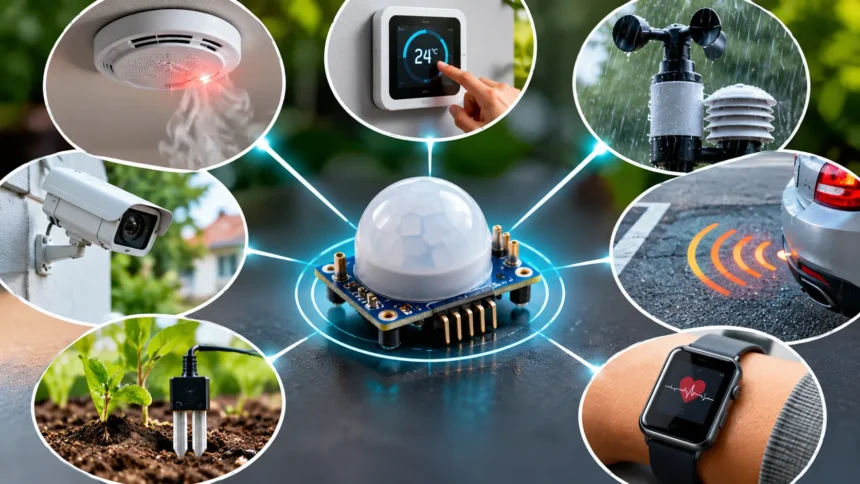
Sensing is the process of detecting changes in the physical world and converting them into useful information. Sensors make this possible by measuring conditions such as temperature, pressure, light, movement, and humidity. These small electronic or mechanical components help devices understand what is happening around them. Without sensing technology, many modern machines would struggle to respond automatically to changing conditions.
You interact with sensors throughout your day, often without noticing them. Your smartphone adjusts screen brightness using a light sensor, while a thermostat monitors room temperature. Cars use sensors to track speed, engine conditions, and nearby objects. These everyday examples demonstrate how sensing helps electronic systems collect information and make decisions.
Understanding the sensing definition is useful for anyone interested in technology, electronics, automation, or modern engineering. Sensors play important roles in healthcare, transportation, manufacturing, agriculture, and smart home technology. Although different sensors operate in different ways, they share the basic purpose of detecting measurable changes. This guide explains how sensing works, its main types, applications, benefits, and limitations.
What Is Sensing? Simple Definition and Meaning
Sensing is the ability to detect or measure physical, chemical, or environmental conditions using specialized components. In electronic systems, sensors collect information about the surrounding environment and convert it into signals that other devices can interpret. These signals may represent temperature, movement, pressure, sound, or light intensity. The collected information helps electronic equipment monitor conditions and respond appropriately.
The sensing definition also applies to biological organisms, including humans and animals. People use their eyes, ears, skin, nose, and tongue to detect information about their surroundings. Electronic sensors perform comparable detection functions through engineered materials and components. However, electronic sensing usually focuses on particular measurable properties rather than the broad sensory experiences of living organisms.
Sensing becomes especially valuable when devices need to operate without constant human attention. A temperature sensor can monitor changing conditions inside a refrigerator, while a motion sensor can detect movement near a doorway. The connected system processes this information and performs a programmed action. This relationship between detection, processing, and response forms the foundation of many automated technologies.
How Does Sensing Work in Electronic Devices?
The sensing process begins when a physical condition interacts with a sensitive component. This interaction produces a measurable change in an electrical, optical, mechanical, or other property. For example, some temperature sensors change their electrical resistance as the surrounding temperature changes. Electronic circuits measure that variation and convert it into information the device can use.
After detecting a change, the system processes the resulting sensor signal. Analog sensors may produce continuously varying voltages or currents, while digital sensors provide information in a digital format. A microcontroller or processor can interpret these readings according to programmed instructions. Depending on the application, the device may display a measurement, store information, or activate another component.
Consider an automatic lighting system as a practical example of sensing technology. A light sensor measures the amount of surrounding illumination and sends information to a controller. When the light level falls below a configured threshold, the controller switches on the connected lights. This process demonstrates how electronic sensing allows equipment to respond automatically to changing environmental conditions.
Main Components of a Sensing System
A sensing system usually includes a sensor element, signal-processing components, and an output interface. The sensing element responds directly to the physical property being measured. Supporting circuits condition or convert the resulting signal into a usable form. Together, these components allow the system to collect information and communicate measurements to other electronic devices.
Signal conditioning improves the quality and usefulness of sensor readings. It may involve amplification, filtering, electrical isolation, or conversion between analog and digital signals. These operations help reduce unwanted noise and prepare measurements for processing. Not every sensor requires the same circuitry, because its design depends on the sensing principle and intended application.
A controller often receives sensor information and determines what happens next. It may compare readings with predefined limits, calculate values, or communicate information to another system. Some modern sensors integrate processing and communication functions directly into a compact package. These integrated designs can simplify product development while supporting efficient data collection and monitoring.
Different Types of Sensors and Their Functions
Temperature sensors detect thermal conditions and help equipment monitor heating or cooling processes. Common examples include thermistors, resistance temperature detectors, and thermocouples. Each technology uses a different physical principle to measure temperature. These sensors appear in refrigerators, heating systems, manufacturing equipment, and medical instruments where dependable temperature measurements are necessary.
Pressure sensors measure the force applied over a particular area, often through changes in a sensing element. They are used in automotive systems, industrial equipment, and various electronic instruments. Light sensors detect illumination or optical energy, while humidity sensors measure moisture conditions in the air. These devices help systems respond to important environmental changes.
Motion and proximity sensors identify movement or the presence of nearby objects. Accelerometers measure acceleration, while gyroscopes measure angular velocity and support motion tracking. Proximity sensors may use infrared light, capacitance, inductance, or ultrasonic waves to detect objects. Their applications include smartphones, automatic doors, industrial machinery, robotics, and vehicle assistance systems.
How Sensors Detect Temperature Changes
Temperature sensing involves measuring a physical property that changes with thermal conditions. For example, a thermistor changes its electrical resistance when its temperature increases or decreases. The connected circuit measures this variation and estimates the corresponding temperature. This method allows electronic equipment to monitor thermal conditions without requiring someone to check them manually.
Thermocouples use a different sensing principle involving two dissimilar conductors. When their junctions experience a temperature difference, a small electrical voltage develops. Measuring this voltage helps determine the temperature difference under suitable conditions. Thermocouples are commonly used in industrial environments because certain designs can tolerate very high temperatures and demanding operating conditions.
Digital temperature sensors often integrate sensing elements with electronic processing circuits. They provide temperature readings in formats that microcontrollers and other digital devices can interpret. These sensors can support temperature control in appliances, computers, and monitoring equipment. Accurate results still depend on proper installation, calibration, sensor selection, and surrounding environmental conditions.
How Motion and Proximity Sensing Works
Motion sensing detects changes related to movement, position, or acceleration. Passive infrared sensors, commonly used in security systems, detect changes in infrared radiation patterns from their surroundings. When a warm object moves across the sensor’s detection zones, the changing signal may trigger an alert. Such systems are useful for automatic lighting and basic movement detection.
Accelerometers provide another method of measuring motion by detecting acceleration along one or more axes. Smartphones use these sensors to support screen orientation, activity tracking, and motion-based interactions. Gyroscopes measure angular velocity, helping devices recognize rotational movement. When combined, these sensors can provide useful information for navigation, stabilization, and motion analysis.
Proximity sensing determines whether an object is near a detecting component. Ultrasonic sensors send sound pulses and measure returning echoes to estimate distance. Infrared proximity sensors may detect reflected light, while inductive sensors identify nearby metallic objects. The best technology depends on factors such as detection range, surface properties, environmental conditions, and required measurement accuracy.
Light and Optical Sensing Explained
Light sensing measures optical energy to determine illumination levels or detect changes in a scene. A photodiode produces an electrical response when light reaches its sensitive surface. Electronic circuits process that response to estimate the amount of incoming light. This principle supports applications ranging from simple automatic lighting controls to advanced optical measurement equipment.
Smartphones commonly use ambient light sensors to adjust display brightness according to surrounding conditions. When the environment becomes darker, the device may reduce brightness to improve viewing comfort and conserve energy. In brighter surroundings, the display may become more visible through automatic adjustment. These changes depend on the device’s software settings and sensor measurements.
Optical sensors are also valuable in industrial automation and communication technology. Photoelectric sensors can detect objects moving along conveyor belts by monitoring light beams. Image sensors convert incoming light into electronic information that forms digital photographs or video. Fiber-optic sensing systems can detect selected physical changes using variations in light traveling through optical fibers.
Sensing in Smartphones and Smart Devices
Modern smartphones combine several sensors to support everyday functions. Accelerometers and gyroscopes help detect movement and changes in orientation. Ambient light sensors support automatic display brightness, while proximity sensors may help manage screen behavior during calls. These components operate alongside software that interprets measurements and delivers a smooth user experience.
Many smartphones also include positioning technologies that combine satellite signals with other available information. Some devices use barometric pressure sensors to estimate relative altitude changes. Biometric sensors may support secure authentication through fingerprint recognition or related technologies. Each sensing method collects a particular type of information that contributes to the device’s overall functionality.
Wearable technology extends sensing applications into everyday activity monitoring. Smartwatches may contain optical heart-rate sensors, accelerometers, and other monitoring components. Their software processes collected measurements to estimate selected activity or wellness indicators. However, measurement accuracy varies by device, conditions, and intended use, so consumer wearables should not automatically be treated as medical instruments.
Sensing Applications in Smart Homes
Smart home systems use sensing technology to monitor household conditions and automate selected functions. Smart thermostats measure indoor temperature and adjust connected heating or cooling equipment. Some systems also use occupancy information to improve scheduling and energy management. By combining sensor measurements with programmed settings, these devices make household operations more convenient and responsive.
Security equipment provides another familiar example of smart home sensing. Motion detectors may identify activity around entrances, while contact sensors detect changes in door or window positions. Some connected alarms combine several sensor signals before triggering notifications. These systems can improve awareness of household conditions, although their effectiveness depends on installation, configuration, and reliable operation.
Water leak sensors and smoke alarms also demonstrate the value of environmental detection. A leak sensor may identify the presence of water near plumbing equipment and activate an alert. Smoke alarms use specialized sensing technologies to detect conditions associated with smoke. Suitable safety devices require correct placement, maintenance, and compliance with applicable safety requirements to work as intended.
Role of Sensing in Automotive Technology
Vehicles rely on sensors to monitor operating conditions and support electronic control systems. Engine management systems use measurements such as temperature, pressure, airflow, and oxygen levels. Electronic controllers interpret these signals to help manage fuel delivery, combustion, and emissions-related functions. This continuous monitoring supports efficient operation and provides information useful for vehicle diagnostics.
Safety-related technologies also depend on accurate sensor information. Anti-lock braking systems use wheel-speed sensors to identify conditions associated with wheel lockup. Electronic stability control systems combine information from several sensors to support vehicle stability. Airbag systems use specialized sensing components and control logic to evaluate conditions that may require safety equipment deployment.
Modern driver assistance systems often combine radar, cameras, ultrasonic sensors, and other technologies. These devices help vehicles detect nearby objects, estimate distances, and interpret selected road conditions. Their capabilities vary significantly between manufacturers and vehicle models. Environmental conditions, sensor limitations, and software performance can affect detection accuracy, so driver attention remains essential.
Sensing in Healthcare and Medical Equipment
Medical sensing technology supports the measurement and monitoring of important physiological conditions. Digital thermometers use temperature sensors to provide body temperature readings. Pulse oximeters use optical measurements to estimate blood oxygen saturation. Medical monitors may combine several sensing components to display information used by healthcare professionals during patient assessment and treatment.
Electrocardiogram equipment uses electrodes to detect electrical activity associated with the heart. Specialized circuits amplify and process these small signals to produce useful recordings. Blood pressure monitors use pressure sensing and measurement techniques appropriate to their design. These instruments require suitable accuracy, testing, and maintenance because incorrect measurements can affect healthcare decisions.
Wearable medical sensors can also support remote monitoring in selected healthcare settings. Some devices collect measurements and transmit information to systems used by healthcare providers. This approach may help clinicians review changes between appointments when the technology is appropriate for the patient. Medical sensing devices should be used according to their intended purpose and professional guidance.
Industrial Sensing and Automation
Industrial facilities use sensors to monitor machinery, production conditions, and equipment performance. Temperature sensors can track heating processes, while pressure sensors monitor fluid or gas systems. Position sensors help machines identify component locations during operation. By collecting these measurements, industrial controllers can coordinate automated tasks and respond to changes in operating conditions.
Quality control systems also depend on reliable sensing technology. Optical sensors can identify certain product characteristics as items move along production lines. Weight sensors help verify measured quantities, while proximity sensors confirm object presence or positioning. Automated inspection systems may combine several sensor types to collect information that supports consistent manufacturing processes.
Condition monitoring is another important application of industrial sensing. Vibration sensors can help detect changes in machinery behavior, while temperature measurements may reveal unusual operating conditions. Monitoring platforms analyze these signals to identify potential maintenance concerns. This approach can support predictive maintenance strategies, although accurate fault identification requires suitable data, analysis, and engineering expertise.
Sensing in Agriculture and Environmental Monitoring
Agriculture uses sensing technology to monitor growing conditions and support resource management. Soil moisture sensors estimate water conditions within the soil and help inform irrigation decisions. Temperature and humidity sensors provide useful information about greenhouse environments. These measurements can support more informed decisions about watering, ventilation, and crop management.
Precision agriculture combines sensors with positioning systems, communication networks, and data analysis. Farmers may use equipment that collects measurements across different parts of a field. This information can help identify variations in soil conditions or crop-related factors. However, results depend on sensor accuracy, placement, calibration, and appropriate interpretation of local agricultural conditions.
Environmental monitoring systems also use sensors to measure changes in air, water, and weather conditions. Air quality sensors may detect selected pollutants or estimate particulate concentrations. Weather stations combine instruments that measure temperature, rainfall, humidity, and wind conditions. These measurements support environmental research, monitoring programs, and practical decisions related to changing surroundings.
Benefits and Limitations of Sensing Technology
One major benefit of sensing technology is its ability to provide continuous information about changing conditions. Sensors help equipment monitor environments without requiring constant manual measurements. They also support automation by providing the information needed for programmed decisions. This capability can improve convenience, operational efficiency, and awareness across many electronic and mechanical applications.
Sensing technology also has limitations related to accuracy and environmental conditions. Electrical noise, temperature variation, contamination, and physical damage can affect sensor readings. Some devices require regular calibration to maintain suitable measurement performance. Selecting the right sensor for each application is important because no single sensing technology works equally well under every condition.
Cost, maintenance, and data security can create additional challenges for sensing systems. Connected sensors may transmit information that requires suitable protection against unauthorized access. Large monitoring networks can also produce substantial amounts of data that must be processed and managed. Effective sensing solutions balance measurement quality, reliability, energy consumption, security, and overall system requirements.
Future of Sensing Technology
Sensing technology continues to develop as electronic components become smaller and more capable. Miniaturized sensors allow manufacturers to integrate measurement functions into compact products. Improvements in materials, microelectronics, and manufacturing methods support new sensor designs. These advances are especially useful in portable electronics, wearable devices, robotics, and equipment with limited installation space.
Artificial intelligence is also influencing how sensing systems interpret collected information. Machine learning software can analyze patterns from cameras, microphones, and other sensors. This may help devices recognize certain conditions or identify unusual changes in measurement data. However, successful applications depend on suitable training data, reliable sensor inputs, and careful testing under realistic conditions.
Connected sensing systems are becoming increasingly important in smart infrastructure and automated environments. Devices can exchange measurements through communication networks and support coordinated monitoring activities. Edge computing also allows some information to be processed near the sensors themselves. Together, these developments may support faster responses, more efficient data handling, and improved automation in suitable applications.
Conclusion
Sensing is the process of detecting measurable changes in physical, chemical, or environmental conditions. Electronic sensors convert these changes into signals that other components can interpret and use. From temperature monitoring to motion detection, sensing forms an important part of modern technology. It helps electronic devices collect information and respond to conditions in their surroundings.
Different sensors use different physical principles depending on the properties they need to measure. Temperature, pressure, light, motion, and proximity sensors support countless everyday applications. Their usefulness extends across smartphones, smart homes, vehicles, healthcare equipment, agriculture, and industrial automation. Reliable sensing depends on appropriate sensor selection, accurate measurements, and effective signal processing.
As technology advances, sensing systems are becoming more compact, connected, and capable. Improvements in electronic design and data processing are expanding their potential applications. Understanding the sensing definition and basic operating principles provides a useful foundation for learning about modern electronics. Sensors will continue playing an essential role in how machines monitor and interact with the physical world.
Frequently Asked Questions (FAQs)
What is the simple definition of sensing?
Sensing is the process of detecting or measuring changes in the surrounding environment. Electronic sensors identify properties such as temperature, light, movement, and pressure, then convert them into information that devices can process.
How does a sensor detect changes?
A sensor responds to a physical or chemical condition through a measurable change in one of its properties. Electronic circuits process the resulting signal and convert it into useful measurement information.
What are five common types of sensors?
Five common sensor types are temperature sensors, pressure sensors, light sensors, motion sensors, and proximity sensors. Each detects a particular property and helps electronic systems monitor conditions or perform automatic functions.
What is the difference between sensing and detection?
Sensing involves measuring or responding to a physical or chemical property. Detection focuses on identifying whether a particular event, object, or condition is present. The two processes often work together.
Why is sensing important in modern technology?
Sensing allows electronic devices to monitor conditions, collect information, and respond automatically to changes. It supports applications in healthcare, transportation, manufacturing, smart homes, and environmental monitoring, making many technologies more responsive and useful.