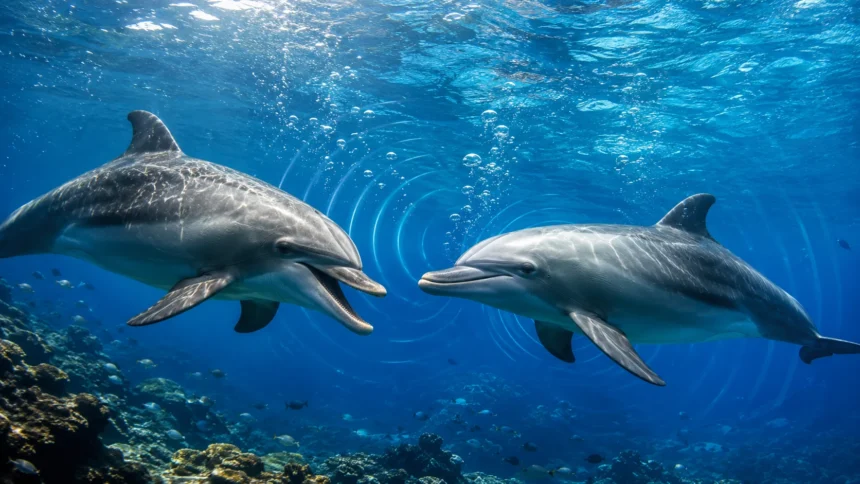
How Do Dolphins Communicate?
Dolphins are among the most socially complex animals in the ocean, and communication plays a major role in how they live. They use whistles, clicks, pulsed sounds, body movements, touch, and other signals to stay connected with members of their group. These communication methods help dolphins coordinate behavior, maintain relationships, recognize individuals, and respond to potential threats.
One of the most fascinating things about dolphin communication is that it works across several channels at once. A dolphin may produce a whistle while changing its body posture, swimming alongside another dolphin, or making physical contact. This combination of sound and movement allows dolphins to communicate effectively even in an environment where visibility may be limited.
Scientists have spent decades studying dolphin sounds and social behavior, yet many details remain unresolved. Dolphins clearly exchange meaningful information, but researchers have not demonstrated that their communication system works exactly like human language. It is therefore more accurate to describe dolphins as sophisticated communicators rather than claiming they speak a language identical to ours.
Understanding how dolphins communicate also helps researchers learn more about animal intelligence, social relationships, and marine conservation. From signature whistles that may function like individual identifiers to echolocation clicks used to explore their surroundings, dolphin communication reveals just how adapted these marine mammals are to life underwater.
Why Communication Is So Important to Dolphins
Dolphins often live in fluid social groups where individuals may join, separate, and reunite over time. Communication helps them recognize one another and maintain relationships even when the surrounding environment makes visual contact difficult. Sound travels efficiently through water, making acoustic signals especially valuable in the ocean.
Social communication can help dolphins coordinate movement, foraging, mating behavior, parental care, and group defense. When several dolphins work together, signals may help them synchronize their actions or respond to changing situations. Communication therefore supports both everyday social life and survival.
Dolphins also form long-term social bonds. Some individuals associate closely for years, and maintaining these relationships requires ways to identify companions and respond appropriately to them. Vocal signals, physical contact, and body movements all appear to contribute to this complex social network.
Because dolphin societies are dynamic, communication is not limited to a single purpose. The same individual may need to call a calf, recognize an ally, warn another dolphin, coordinate hunting, or manage conflict. This variety helps explain why researchers observe such a diverse range of dolphin vocalizations and behaviors.
Dolphins Communicate Through Whistles
Whistles are among the best-known dolphin sounds and are especially important in social communication. Unlike the short clicks used heavily during echolocation, whistles are tonal sounds that can vary in pitch, duration, and contour. Dolphins use them in many social situations.
Researchers have observed that whistles can occur when dolphins are separated, reunited, excited, stressed, or interacting closely with other members of their group. Different whistle patterns may carry different social information, although scientists are still working to determine exactly what many of these signals mean.
Whistles are particularly useful because sound can travel beyond visual range underwater. A dolphin that cannot see another member of its group may still hear a vocalization and respond. This ability helps dolphins remain socially connected while traveling or foraging in the open ocean.
Not every dolphin whistle should be interpreted as a word. Researchers generally study patterns, contexts, responses, and repetition before suggesting a possible function. Dolphin vocal communication is complex, and many whistle types may communicate emotional, social, or individual information rather than fixed dictionary-like meanings.
What Are Signature Whistles?
Signature whistles are one of the most remarkable discoveries in dolphin communication research. Many bottlenose dolphins develop a distinctive whistle contour that is strongly associated with that individual. Researchers often compare this function to an acoustic identity signal.
A dolphin may produce its signature whistle more frequently when separated from companions, which suggests the sound can help maintain contact. Other dolphins can also recognize familiar signature whistles, allowing individuals to identify who is calling even when they cannot see one another.
Studies indicate that dolphins may sometimes copy another individual’s signature whistle when addressing or interacting with that dolphin. This behavior has led scientists to explore whether signature whistles function somewhat like names, although the comparison should not be taken too literally.
The idea is especially interesting because individual vocal labels are uncommon in the animal kingdom. Signature whistles demonstrate that dolphins possess sophisticated vocal recognition abilities and can maintain individual identities within complex social groups.
Do Dolphins Have Names for Each Other?
Dolphins do not have names in exactly the same way humans assign spoken names, but signature whistles may perform a related social function. Each dolphin develops a characteristic whistle pattern that can help other dolphins identify that individual.
When researchers play recordings of familiar signature whistles, dolphins can respond differently compared with unfamiliar sounds. This provides evidence that they recognize the vocal identity of companions rather than simply reacting to any whistle they hear.
Some dolphins have also been observed imitating the signature whistle of another individual. Researchers believe this copying can sometimes be directed toward the dolphin whose whistle is being reproduced, making the behavior especially significant for studies of animal communication.
However, scientists remain careful when comparing dolphin signals with human words. A signature whistle may act as an individual identifier, but that does not automatically mean dolphins have a human-like naming system with grammar and vocabulary.
Dolphins Use Clicks to Explore Their World
Dolphins produce rapid clicking sounds that are strongly associated with echolocation. These clicks are short sound pulses that travel through the water, strike an object, and return as echoes. Dolphins can analyze those returning echoes to gather information about their surroundings.
Echolocation allows dolphins to estimate properties such as the distance, position, size, shape, and sometimes internal characteristics of nearby objects. This ability is particularly useful in dark, deep, or murky water where eyesight alone may not provide enough information.
Dolphins can adjust their clicking behavior depending on what they are investigating. As they approach an object or prey item, click patterns may become faster, helping them receive increasingly detailed information during the final stages of an approach.
Although echolocation is primarily a sensory system rather than ordinary conversation, clicks can still be part of social situations. Scientists therefore distinguish between sounds used mainly for environmental sensing and those used primarily for communication.
How Dolphin Echolocation Works
A dolphin produces echolocation clicks using specialized structures associated with its nasal passages. The sounds are directed forward through the melon, a fatty structure in the forehead that helps focus sound energy into the surrounding water.
When the clicks reach an object, some of the sound energy reflects back toward the dolphin. The returning echoes are received largely through specialized tissues in the lower jaw and transmitted toward the middle and inner ear for processing.
The dolphin’s brain interprets the tiny differences in timing and sound characteristics within these echoes. This allows the animal to build an acoustic picture of objects that may be difficult or impossible to see clearly.
Echolocation is so precise that dolphins can detect surprisingly small differences between objects under controlled conditions. This sophisticated biological sonar system demonstrates how strongly dolphin senses have evolved around the acoustic properties of the marine environment.
Burst-Pulsed Sounds and Emotional Communication
Dolphins also produce sounds often described as burst-pulsed vocalizations. These consist of rapidly repeated pulses occurring so closely together that they can sound like squeaks, squawks, buzzes, or other continuous noises to human listeners.
Researchers frequently observe these sounds during intense social interactions. They may occur during competition, aggression, excitement, courtship, play, or situations involving dominance and close physical contact between individuals.
Because burst-pulsed sounds appear in emotionally charged contexts, scientists believe some may communicate motivation or emotional state. A dolphin could potentially signal agitation, excitement, submission, or social tension depending on the circumstances.
The exact meaning of individual pulsed sounds is still being investigated. Dolphin communication should therefore not be reduced to simple translations such as one sound meaning anger and another meaning friendship, because context usually matters.
Dolphins Communicate With Body Language
Sound is only one part of dolphin communication. Dolphins also use body posture, movement, swimming direction, jaw movements, fin positions, and other visible behaviors to communicate during close social interactions.
A dolphin may approach another individual slowly, swim alongside it, change direction suddenly, slap the water, or alter its posture. These actions can carry information about social interest, play, aggression, courtship, or willingness to interact.
Body language is especially useful when dolphins are close enough to see one another. A physical display can reinforce information conveyed through whistles or other vocalizations, creating a communication system that involves several signals at once.
Researchers often study dolphin body movements together with sound rather than examining them separately. Looking at the full behavioral context makes it easier to understand whether a particular signal is associated with play, conflict, cooperation, or another social situation.
What Do Tail Slaps and Leaps Mean?
Dolphins sometimes strike the water with their tails, producing a loud sound that can travel through the surrounding environment. Tail slaps may occur during social displays, excitement, aggression, group coordination, or other situations depending on context.
Leaping completely or partly out of the water is another highly visible dolphin behavior. Dolphins may leap while traveling quickly, playing, socializing, avoiding obstacles, or participating in coordinated movements with other group members.
Breaching and splashing also create both visual and acoustic signals. A dolphin at the surface can potentially attract attention through a movement that other dolphins may see or hear from some distance.
It is tempting to assign a single meaning to each dramatic behavior, but dolphin body language is highly context-dependent. A tail slap during play may have a different function from a similar movement during an aggressive encounter.
Touch Is an Important Social Signal
Physical contact plays an important role in dolphin relationships. Dolphins frequently rub against one another, swim in close contact, touch with their fins, and engage in other tactile behaviors with familiar companions.
One particularly common behavior involves rubbing another dolphin with a pectoral fin. This type of contact is often associated with affiliation and social bonding, somewhat like grooming behavior in some land mammals.
Mothers and calves also maintain frequent physical contact, especially during early development. Touch can help reinforce the close relationship between them while young dolphins learn to move, feed, communicate, and navigate within their social group.
Physical interaction can also occur during competition or aggression, so touch should not always be interpreted as affection. Scientists examine posture, sound, direction of movement, and the relationship between individuals to understand the likely meaning of tactile behavior.
How Dolphin Mothers Communicate With Calves
Communication begins early in a dolphin’s life. Mothers and calves remain closely associated after birth, and young dolphins gradually learn the vocal and social patterns necessary to function within their group.
Dolphin mothers use whistles to maintain acoustic contact with their calves. A calf may also begin developing its own characteristic signature whistle during early life, creating an individual vocal identity.
Calves learn by listening to and interacting with their mothers and other dolphins. Social experience may help young dolphins understand when to vocalize, how to respond to particular signals, and which behaviors are appropriate in different situations.
This learning period demonstrates that dolphin communication is not entirely automatic. Although biology provides the ability to produce and perceive sounds, social development and experience appear to shape how those abilities are used.
Do Dolphins Learn Sounds From Each Other?
Dolphins are capable vocal learners, meaning they can modify or learn sounds through experience rather than relying entirely on genetically fixed calls. This ability makes their communication particularly interesting to scientists studying animal cognition.
Young dolphins develop signature whistles that become individually distinctive. Their vocal development can be influenced by the sounds around them while still resulting in a whistle pattern that identifies the individual.
Dolphins can also imitate artificial sounds and some vocalizations produced by other dolphins. This flexibility has been demonstrated in research settings and supports the idea that dolphins have substantial control over sound production.
Vocal learning is relatively uncommon compared with basic vocal production in animals. Its presence in dolphins helps explain how complex communication patterns can develop within groups and remain socially meaningful over long periods.
Do Different Dolphin Groups Have Dialects?
Researchers have found that dolphin vocal behavior can vary between populations, communities, and social groups. Differences may develop because dolphins learn sounds socially and interact regularly with particular companions.
These variations are sometimes described informally as dialects, although the term should be used carefully. Dolphin communication does not necessarily contain dialects in exactly the same linguistic sense as regional forms of human language.
Different communities may show distinctive whistle characteristics, call usage, or socially learned behaviors. Such differences can provide scientists with information about population structure and the social traditions shared within particular dolphin groups.
Studying regional vocal variation also helps researchers understand dolphin culture. Behaviors that spread through social learning rather than genetics alone demonstrate that dolphins can maintain traditions within communities across generations.
How Dolphins Communicate While Hunting
Dolphins often use cooperative strategies to capture prey, and communication may help groups coordinate these activities. Depending on the species and location, dolphins can work together to surround fish, herd prey, or take turns feeding.
Echolocation is particularly important while hunting because it helps dolphins locate and track prey. Rapid clicks can provide detailed information about a fish’s location even when visibility is poor.
Social signals may also help maintain group organization during cooperative feeding. Dolphins need to respond quickly to the movement of both prey and companions, making sensory awareness and communication extremely important.
Not every cooperative hunt depends on obvious vocal instructions. Dolphins can also use visual cues, movement patterns, prior experience, and predictable responses from familiar partners to coordinate complex behavior.
How Dolphins Communicate Over Distance
Underwater sound travels farther and faster than it does through air, making acoustic communication particularly effective in marine environments. Dolphins can use whistles to maintain contact when group members are temporarily separated.
The effective range of a dolphin call depends on several factors, including sound frequency, volume, water depth, temperature, background noise, and local ocean conditions. There is therefore no single distance that applies to every vocalization.
Dolphins may produce louder or more frequent calls in noisy environments or when companions are farther away. Researchers study these changes to understand how dolphins adapt their communication to varying acoustic conditions.
Long-distance communication is particularly valuable for highly mobile animals. Dolphins may travel considerable distances during feeding or migration, so sound gives them a way to remain socially connected when visual contact is impossible.
Can Dolphins Understand Each Other?
Dolphins clearly respond to the sounds and behavior of other dolphins in ways that demonstrate meaningful communication. They recognize familiar individuals, react to social calls, coordinate activities, and change their behavior according to context.
Signature whistle recognition provides some of the strongest evidence. Dolphins can distinguish familiar individual-specific signals, showing that they are not simply responding to sound without understanding who produced it.
Their communication also appears flexible. Dolphins can alter vocal behavior depending on social circumstances and can learn new sounds, suggesting a level of cognitive control beyond simple automatic calling.
However, researchers cannot directly experience what a dolphin understands. Scientific conclusions therefore rely on experiments, behavioral responses, acoustic analysis, and long-term observations rather than assuming human-like meanings.
Do Dolphins Have a Language?
Whether dolphins possess “language” depends heavily on how language is defined. Dolphins certainly have complex communication systems, vocal learning, individual recognition, social signals, and the ability to associate particular sounds with objects or actions in experimental settings.
Human language, however, includes features such as elaborate grammar, syntax, generative vocabulary, and the ability to create an essentially unlimited number of new meanings. Scientists have not established that wild dolphin communication possesses all these properties.
Popular claims that researchers have completely translated dolphin speech or discovered full dolphin sentences generally go beyond the evidence. Scientists can identify the functions of some signals, but large portions of dolphin communication remain poorly understood.
For this reason, describing dolphins as highly sophisticated communicators is more scientifically accurate than saying they speak exactly like humans. Future research may reveal additional complexity, but current evidence still leaves many important questions unanswered.
Can Dolphins Communicate With Humans?
Dolphins can learn to respond to human-generated signals, especially in carefully controlled research environments. Experiments have shown that some dolphins can understand artificial gestures, symbols, or sound commands associated with particular objects and actions.
They can also imitate certain sounds and behaviors, demonstrating advanced learning abilities. This flexibility has provided researchers with valuable insights into dolphin memory, cognition, and understanding of symbolic information.
Wild dolphin-human interactions are more difficult to interpret. A dolphin approaching a boat or swimmer does not necessarily mean it is attempting to communicate in a human-like conversational sense.
Responsible research avoids projecting human intentions onto dolphin behavior. Although meaningful two-way signaling can occur under certain conditions, scientists have not developed a universal translator capable of holding ordinary conversations with dolphins.
How Scientists Study Dolphin Communication
Researchers use underwater microphones called hydrophones to record dolphin vocalizations. These recordings can then be analyzed using spectrograms, which visually display sound frequency, duration, and other acoustic characteristics.
Scientists often combine acoustic recordings with video, behavioral observations, and individual identification. Knowing which dolphin produced a sound and what was happening at that moment is essential for understanding its possible function.
Modern research increasingly uses automated recording systems, machine learning, tracking technologies, and large acoustic databases. These tools can help scientists identify recurring sound patterns within enormous collections of dolphin recordings.
Artificial intelligence may eventually help researchers discover relationships that humans would struggle to detect manually. However, finding acoustic patterns is not the same as translating them, so behavioral experiments remain essential for determining what particular signals actually communicate.
How Ocean Noise Affects Dolphin Communication
The ocean is naturally filled with sound from waves, marine animals, weather, and geological activity. Human activities add additional noise from commercial shipping, construction, sonar, offshore development, and recreational vessels.
Because dolphins depend heavily on sound, excessive underwater noise can interfere with their ability to hear important signals. This process is called acoustic masking and can make communication or echolocation more difficult.
Some dolphins respond by changing their whistle frequency, duration, repetition rate, or loudness. These adjustments may help their signals remain detectable, but constantly communicating in noisy environments can still create challenges.
Understanding underwater noise is an important part of dolphin conservation. Protecting important habitats from excessive acoustic disturbance may help dolphins maintain communication, locate prey, navigate, and perform other essential behaviors.
Why Studying Dolphin Communication Matters
Dolphin communication research provides insights into intelligence and social complexity outside the human species. It helps scientists investigate how communication systems develop and why sophisticated cognition evolved in different animal groups.
The research also improves our understanding of dolphin societies. Vocal recognition, cooperation, alliances, parental care, and social learning reveal relationships that can remain stable for years.
Communication studies have practical conservation value as well. Passive acoustic monitoring can help researchers locate dolphins, study population movements, identify important habitats, and measure the effects of human-generated noise.
Perhaps most importantly, studying dolphins reminds us that communication can evolve in many forms. Human speech is only one solution to the challenge of sharing information; dolphins have developed an acoustic and social system beautifully adapted to life in the ocean.
Final Thoughts on How Dolphins Communicate
Dolphins communicate through an impressive combination of whistles, clicks, burst-pulsed sounds, body movements, physical touch, and socially learned behavior. Rather than relying on a single signal, they use multiple communication channels depending on the situation.
Signature whistles are especially fascinating because they can help dolphins identify individuals and maintain social contact. Echolocation clicks serve a different but equally remarkable purpose, enabling dolphins to explore their surroundings through sound.
Their communication also reflects their highly social nature. Mothers communicate with calves, companions maintain long-term relationships, groups coordinate behavior, and individuals learn from one another throughout their lives.
Scientists still have much to discover about what dolphin signals mean. What we already know, however, shows that dolphin communication is sophisticated, flexible, and deeply connected to the complex social lives these marine mammals lead beneath the ocean’s surface.
Frequently Asked Questions
How do dolphins communicate with each other?
Dolphins communicate using whistles, clicks, burst-pulsed sounds, body movements, and touch. They often combine vocal and visual signals depending on the social situation.
Do dolphins actually talk to each other?
Dolphins exchange meaningful information, but scientists have not proven that they use language exactly like humans. Their communication system is nevertheless highly sophisticated and socially flexible.
Why do dolphins whistle?
Whistles are mainly associated with social communication. Dolphins use them to maintain contact, interact with companions, and sometimes identify themselves through distinctive signature whistles.
What is a dolphin signature whistle?
A signature whistle is an individually distinctive whistle pattern produced by many dolphins. Other dolphins can recognize these sounds, allowing them to identify familiar individuals acoustically.
How do dolphins use echolocation?
Dolphins send out rapid clicks and listen to the returning echoes. By analyzing those echoes, they can estimate the location, distance, shape, and other properties of nearby objects or prey.