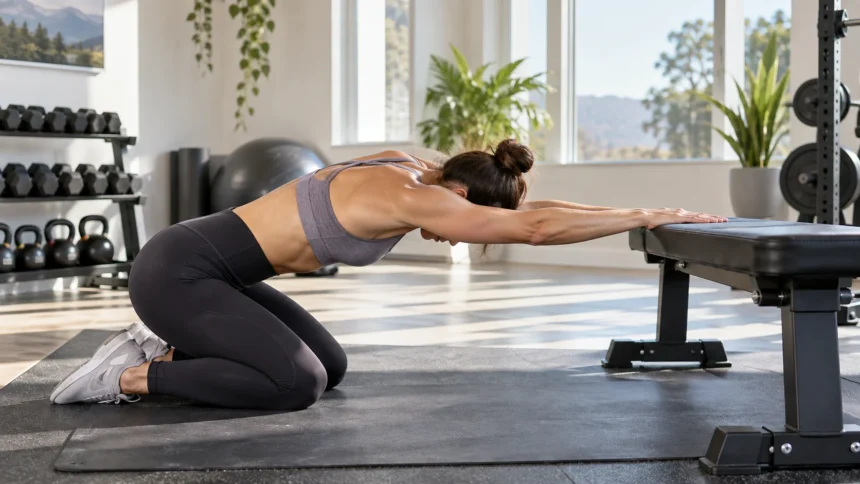
Tightness through the sides of your back can make everyday movements such as reaching overhead, exercising, or even sitting comfortably feel harder than they should. A good lat stretch targets the latissimus dorsi, the large muscles running from your upper arms down toward your lower back. Keeping these muscles flexible can support comfortable shoulder and upper-body movement.
Your lats work during pulling, climbing, rowing, swimming, and many strength-training exercises. They also influence how freely your shoulders move overhead and how your upper body feels during activities such as lifting or throwing. When these muscles become stiff, you may notice tension along the sides of your back, shoulders, or rib cage.
The good news is that stretching your lats does not require complicated equipment. Several effective lat stretches can be performed at home using a wall, chair, floor, resistance band, or simply your own body weight. Learning proper technique can help you stretch comfortably while avoiding unnecessary strain on your shoulders or lower back.
What Is a Lat Stretch?
A lat stretch is any movement designed to lengthen the latissimus dorsi muscles along the sides of your back. These broad muscles connect parts of your upper arm, spine, pelvis, and rib area, allowing them to influence several upper-body movements. Stretching them typically involves reaching your arm overhead while creating space through the side of your torso.
The latissimus dorsi muscles help pull your arms downward and backward, rotate your shoulders, and stabilize your upper body during exercise. Activities such as pull-ups, rows, swimming, climbing, and lifting rely heavily on these muscles. Because they are regularly involved in both exercise and daily movement, they can sometimes feel tight or overworked.
A proper lat stretch should usually create gentle tension along the outer upper back, beneath the armpit, and sometimes down the side of your ribs. You should not feel sharp pain, pinching, or numbness. Moving slowly and controlling your breathing helps you distinguish a productive stretch from excessive strain.
What Muscles Does a Lat Stretch Target?
The primary muscle targeted during a lat stretch is the latissimus dorsi, commonly called the lats. These large, fan-shaped muscles cover much of the middle and lower back and attach to the upper arm. Their size and positioning allow them to play an important role in shoulder extension, internal rotation, and pulling movements.
Many lat stretching positions also affect nearby muscles and connective tissues. Depending on the technique, you may feel the stretch around the teres major, triceps, obliques, upper back, shoulders, or rib cage. This is one reason lat stretches can feel like they open an entire side of the body rather than one isolated muscle.
The exact location of the sensation varies depending on your anatomy, mobility, and positioning. For example, rotating your chest slightly during an overhead stretch may increase tension through the side of your torso. Small adjustments can help you target the lats more effectively without forcing your shoulder into an uncomfortable range.
How to Do a Basic Standing Lat Stretch
Begin by standing upright with your feet approximately hip-width apart and your knees relaxed. Raise one arm overhead, keeping your shoulder comfortable instead of forcing it toward your ear. Reach upward before slowly leaning your torso toward the opposite side until you feel gentle tension running beneath your raised arm and along your side.
Keep your chest facing forward as much as possible rather than twisting aggressively. Your hips should remain relatively centered so the movement comes primarily from your upper body and side. Hold the stretch for approximately 20 to 30 seconds while breathing slowly, then return to the starting position and repeat on the opposite side.
Avoid bouncing or pulling your arm forcefully during the stretch. The goal is to gradually lengthen the muscle rather than push your body to its maximum range immediately. If your shoulder feels pinched, lower your arm slightly or change the angle until the movement produces comfortable tension instead of joint discomfort.
How to Do a Kneeling Lat Stretch
Start on your hands and knees with a chair, bench, or stable surface positioned in front of you. Place both hands or elbows on the surface and gradually move your hips backward while lowering your chest. As your upper body sinks between your arms, you should begin feeling a stretch through your lats and upper back.
Keep your abdominal muscles gently engaged so your lower back does not excessively arch. Let your head remain relaxed between your arms instead of forcing your neck upward. You can hold the position for around 20 to 40 seconds while taking slow breaths and allowing the muscles to gradually relax.
For a deeper stretch, place your palms together or bend your elbows while maintaining control through your spine. You can also move your hands slightly toward one side to emphasize the opposite lat. Make small adjustments instead of aggressively pushing downward, especially if your shoulders are already tight or sensitive.
How to Do a Wall Lat Stretch
Stand facing a wall or another stable vertical surface and place both hands against it slightly above shoulder height. Walk your feet backward while keeping your hands planted, then hinge forward at your hips. Lower your chest between your arms until you feel a comfortable stretch through your upper back, shoulders, and lats.
Keep your spine relatively long rather than rounding your back excessively. Your hips should move backward as your chest gently drops, creating length from your hands through the sides of your torso. Bending your knees slightly can make the position more comfortable if your hamstrings or lower back feel tight.
The wall lat stretch is particularly useful because the amount of intensity is easy to control. Moving your feet farther away generally deepens the stretch, while stepping closer reduces tension. It is a convenient option for office workers, gym users, or anyone who wants to stretch without getting down onto the floor.
How to Do a Child’s Pose Lat Stretch
Begin on your hands and knees before gently sitting your hips back toward your heels. Extend your arms forward along the floor while allowing your chest to move downward. This familiar child’s pose position naturally creates length through the back, shoulders, and lats while also offering a relaxed position for slow breathing.
To target one lat more strongly, walk both hands toward the opposite side. For example, move your hands slightly to the right to increase the stretch along your left side. Keep your hips as centered as comfortably possible so you create length through the side of the torso instead of simply rotating your entire body.
Hold the position for 20 to 40 seconds before slowly switching sides. You can place a cushion underneath your hips or chest if the position feels uncomfortable on your knees or lower back. The stretch should remain relaxing and controlled rather than becoming a competition to reach as far forward as possible.
Key Benefits of Stretching Your Lats
Regular lat stretching can help maintain comfortable shoulder and upper-body mobility. Because the lats connect to the upper arm and influence shoulder movement, excessive tightness may make reaching overhead feel restricted. Stretching helps maintain muscle length and may make movements used in exercise, sports, and daily life feel smoother and less stiff.
Lat stretches can also be useful after activities involving repeated pulling or upper-body strength work. Exercises such as pull-ups, rows, lat pulldowns, swimming, and climbing place considerable demand on these muscles. Gentle stretching afterward may help reduce the feeling of muscular tightness that sometimes develops after strenuous training.
Another benefit is that stretching can simply feel relaxing, particularly after long periods of sitting or working at a desk. Combining a lat stretch with slow breathing can create a useful transition into a calmer evening routine. Gentle practices such as bedtime yoga can also include similar mobility movements to help the body unwind before sleep.
Can Lat Stretches Improve Shoulder Mobility?
Your lats attach to the upper arm, which means tightness can influence how easily your shoulders move overhead. When the muscle becomes stiff, some people compensate by arching their lower back or changing their rib position while raising their arms. Improving lat flexibility may help make overhead movement feel more natural and controlled.
Stretching alone, however, is not the only factor involved in shoulder mobility. Your upper-back movement, chest muscles, shoulder joint, rotator cuff, and overall strength also influence how your arms move. For this reason, improving mobility usually involves a combination of stretching, controlled movement, and appropriate strengthening rather than relying on one exercise.
If your shoulder consistently feels blocked, painful, or unstable, forcing deeper lat stretches is unlikely to solve the problem. Start with comfortable ranges and observe how your body responds. Persistent mobility restrictions or pain may be worth discussing with a physiotherapist or another qualified healthcare professional who can assess the underlying cause.
When Should You Stretch Your Lats?
You can perform gentle lat stretching at several points during the day depending on your goals. Before exercise, dynamic movements that gradually take the shoulders through a comfortable range are generally more suitable than long, intense static holds. This can help prepare your upper body for activities involving reaching, pulling, lifting, or overhead movement.
Longer static stretches often fit well after training when your muscles are already warm. Holding a relaxed lat stretch for around 20 to 40 seconds can help you cool down while addressing areas that feel tight. You can also perform stretches separately during mobility sessions rather than attaching them directly to every workout.
Desk workers may benefit from short stretching breaks throughout the day, especially if they spend hours with their arms and shoulders in similar positions. Evening stretching can also be useful if you prefer a relaxing mobility routine. Consistency usually matters more than choosing one supposedly perfect time to stretch.
How Long Should You Hold a Lat Stretch?
For general flexibility work, holding a comfortable lat stretch for approximately 20 to 30 seconds is a practical starting point. This provides enough time to settle into the position without encouraging excessive force. People who are already comfortable stretching may choose slightly longer holds, provided the sensation remains controlled and pain-free.
One or two rounds on each side may be sufficient for everyday mobility, although your needs depend on your activity level and overall flexibility. Rather than focusing entirely on the clock, pay attention to whether the initial tension gradually decreases. Slow breathing can help you relax and avoid unconsciously tightening your shoulders during the stretch.
More time does not automatically produce better results. Holding an aggressive stretch for several minutes can irritate sensitive muscles or joints, particularly if your technique is poor. Short, regular sessions performed consistently are generally more practical than occasionally forcing yourself through extremely intense stretching routines.
Common Lat Stretching Mistakes to Avoid
One common mistake is arching the lower back excessively while trying to increase your overhead range. This compensation can make it appear that your shoulders are moving farther even though the lats are not actually being stretched effectively. Keeping your ribs controlled and abdominal muscles gently engaged often creates a more targeted stretch.
Another mistake is using momentum or bouncing to reach farther into the position. Stretching should usually involve slow, controlled movement that allows your muscles to adapt gradually. Sudden force can make the body tighten defensively and may place unnecessary stress on the shoulder joint or surrounding tissues.
You should also avoid assuming that stronger discomfort means a better stretch. Mild to moderate tension is usually enough to work on flexibility without overwhelming the muscle. Sharp pain, tingling, numbness, burning, or joint pinching are signals to stop and change your position rather than continuing to push deeper.
How Often Should You Stretch Your Lats?
For general mobility, stretching your lats several times each week can be enough to maintain flexibility. People who regularly perform heavy pulling exercises or spend long periods sitting may prefer shorter daily sessions. A few minutes of controlled stretching is easier to maintain consistently than an occasional complicated mobility routine.
Your training schedule should also influence stretching frequency. If you perform several back workouts each week, gentle post-workout stretching may naturally become part of your routine. On rest days, you can include lat stretches alongside movements for the shoulders, chest, spine, and hips to create a more balanced mobility session.
More frequent stretching is not always necessary if your lats already move comfortably and do not feel restricted. Flexibility goals should support the movements you actually need rather than pursuing maximum range for its own sake. Use your exercise demands, comfort, and movement quality to decide how much stretching fits your routine.
Who Can Benefit From Lat Stretches?
People who regularly lift weights can benefit from lat stretching because exercises such as pull-ups, chin-ups, rows, and pulldowns repeatedly shorten and load these muscles. Swimmers and climbers also rely heavily on their lats during pulling movements. Maintaining comfortable mobility may help these athletes move their shoulders through the ranges required by their activities.
Office workers can benefit as well, especially after sitting with their arms forward for extended periods. Long computer sessions may contribute to feelings of stiffness around the upper back and shoulders. A standing or wall lat stretch can provide a simple movement break without requiring gym clothes, equipment, or a large amount of space.
Anyone experiencing actual pain should be more cautious. Stretching can be useful for normal muscular tightness, but it cannot diagnose or treat every cause of shoulder or back discomfort. If symptoms are severe, persistent, associated with weakness, or accompanied by numbness or tingling, getting professional assessment is more appropriate than repeatedly stretching the painful area.
How to Get More From Your Lat Stretch Routine
Start each stretch gradually instead of immediately moving to your maximum range. Give your muscles several seconds to adapt before making a small adjustment deeper into the position. This approach often creates a more comfortable stretch and makes it easier to maintain good alignment throughout the movement.
Breathing can also improve the experience. Take slow breaths into your rib cage and sides while keeping your shoulders relaxed rather than shrugging them toward your ears. As you exhale, allow unnecessary muscular tension to decrease without deliberately forcing yourself deeper into the stretch.
Finally, combine flexibility work with strength exercises that use your available range of motion. Strong muscles that move comfortably through controlled ranges often support better movement than stretching alone. Rows, pulldowns, shoulder mobility drills, and upper-back strengthening can complement lat stretches when included appropriately in a balanced exercise routine.
Conclusion
A lat stretch is a simple way to create more comfortable movement through the sides of your back, shoulders, and upper body. Several techniques, including standing stretches, child’s pose, wall stretches, and kneeling variations, can target the latissimus dorsi without requiring specialized equipment. The best option is usually the one you can perform comfortably and consistently.
Proper technique matters more than stretching as deeply as possible. Keep your movements slow, avoid excessive lower-back arching, and aim for gentle muscular tension rather than sharp discomfort. Holding each position for around 20 to 30 seconds can provide a practical starting point for most general flexibility routines.
Lat stretching can support mobility, post-workout relaxation, and easier overhead movement, but it should be part of a broader approach to physical fitness. Combine stretching with appropriate strengthening and good movement habits. If your shoulder or back pain persists, seek professional guidance instead of attempting to solve the problem by stretching more aggressively.
FAQs
What is the best stretch for tight lats?
Standing side bends, wall lat stretches, kneeling stretches, and child’s pose variations can all work well. The best choice is whichever creates comfortable tension along your lat without causing shoulder or lower-back pain.
How long should I hold a lat stretch?
A hold of approximately 20 to 30 seconds is a useful starting point for most people. You can repeat the stretch once or twice per side while keeping your breathing slow and relaxed.
Can tight lats cause shoulder stiffness?
Tight lats can contribute to restricted overhead shoulder movement because the muscles attach to the upper arm. However, shoulder stiffness can have several causes, so persistent restriction should not automatically be blamed on the lats.
Should I stretch my lats every day?
Gentle daily stretching may be appropriate if your lats frequently feel tight, although it is not essential for everyone. Several sessions per week may be enough for maintaining comfortable flexibility and upper-body mobility.
Should a lat stretch hurt?
No. You should feel gentle to moderate muscular tension rather than sharp pain, pinching, numbness, or tingling. Stop the stretch and change your position if uncomfortable or unusual symptoms occur.