The banded Pallof press is a simple-looking core exercise that challenges your body in a surprisingly powerful way. Instead of bending, twisting, or performing repeated crunches, you resist rotation while pressing a resistance band away from your chest. This makes the exercise especially useful for building core stability, improving control, and developing strength that transfers to everyday movement.
Because the movement requires minimal equipment, the banded Pallof press can fit easily into home workouts, gym routines, warm-ups, and rehabilitation-style exercise programs. It trains the abdominal muscles without requiring aggressive spinal movement or heavy loads. Beginners can start with light resistance, while experienced lifters can make the exercise much more challenging by increasing band tension or changing their stance.
Learning proper Pallof press form is important because the goal is not simply to push the band forward. Your main job is keeping your torso, hips, and shoulders stable while the resistance attempts to rotate your body. Understanding the technique, muscles worked, benefits, mistakes, and useful variations can help you get much more from this anti-rotation exercise.
What Is a Banded Pallof Press?
A banded Pallof press is a core stability exercise performed with a resistance band anchored beside your body. You hold the band close to your chest and then extend your arms straight forward while preventing your torso from rotating toward the anchor point. The exercise is named after physical therapist John Pallof, who helped popularize this anti-rotation training method.
Unlike traditional abdominal exercises such as sit-ups or crunches, the Pallof press does not rely on repeated spinal flexion. Instead, your abdominal muscles create tension to keep your spine and pelvis stable against sideways rotational force. This makes the movement useful for developing controlled core strength that supports lifting, walking, running, sports, and many everyday activities.
The resistance band creates increasing tension as it stretches, meaning the exercise may become more demanding as your arms move farther from your body. Extending your arms increases the leverage placed on your core, forcing your trunk muscles to work harder. This combination makes the Pallof press simple to learn while still offering plenty of room for progression.
Muscles Worked During the Banded Pallof Press
The banded Pallof press primarily targets the muscles responsible for stabilizing your trunk. Your transverse abdominis, obliques, rectus abdominis, and deeper spinal stabilizers work together to prevent unwanted rotation. Rather than producing large visible movements, these muscles create stiffness and control so your torso remains facing forward throughout each repetition.
Your glutes and hip muscles also contribute because your pelvis needs to remain stable as the band pulls sideways. Maintaining a balanced stance requires the muscles around your hips and legs to support your body. This is one reason the standing Pallof press feels like more than just an abdominal exercise when performed with controlled resistance.
Your shoulders, chest, and arms help hold and press the resistance band, although they should not dominate the exercise. The shoulder stabilizers maintain arm position while the chest and triceps assist during the press. The goal is still core control, so using excessive resistance that turns the movement into an upper-body strength exercise should generally be avoided.
Benefits of the Banded Pallof Press
One of the biggest Pallof press benefits is improved anti-rotation strength. Your body frequently experiences forces that attempt to twist the torso during lifting, carrying objects, changing direction, and playing sports. Training your core to resist these forces may improve your ability to maintain stable positioning during both exercise and everyday movements.
The exercise can also support better coordination between your upper and lower body. Your hips, core, shoulders, and arms must work together while your body remains steady. Developing this coordinated stability may help create a stronger foundation for movements such as squats, deadlifts, overhead presses, rows, running, and recreational athletic activities.
Another advantage is accessibility. The banded Pallof press requires only a resistance band and a stable anchor, making it practical for home gyms, travel workouts, or limited training spaces. Resistance can also be adjusted quickly by changing bands or moving closer to or farther from the anchor, allowing people with different fitness levels to use the exercise.
How to Do a Banded Pallof Press Correctly
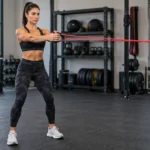
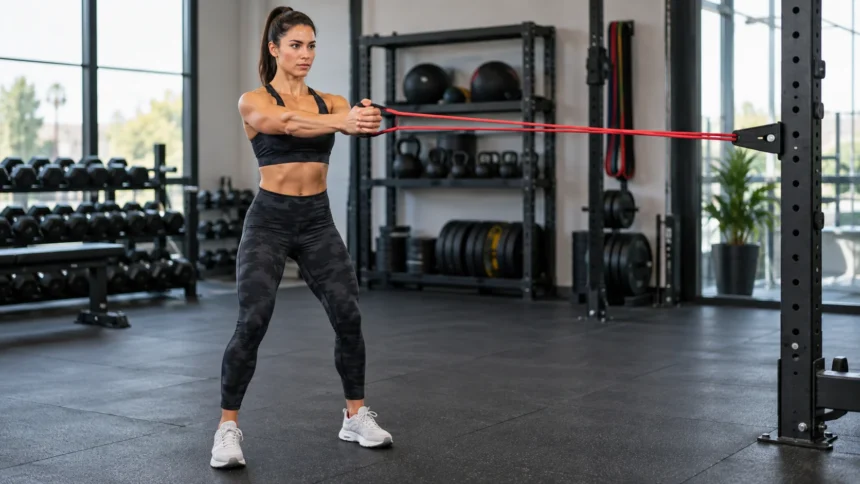
Secure a resistance band to a stable object at approximately chest height, then stand sideways to the anchor point. Hold the band with both hands against the center of your chest and move far enough away to create light-to-moderate tension. Position your feet around shoulder-width apart, soften your knees slightly, and keep your torso tall.
Brace your abdominal muscles as though preparing for someone to gently push against your stomach. Slowly press your hands straight away from your chest until your arms are extended without locking your elbows aggressively. Resist the band pulling your body sideways, keeping your shoulders, ribs, hips, and knees facing straight ahead throughout the movement.
Pause briefly with your arms extended, maintaining steady breathing and full-body control. Slowly bring your hands back toward your chest without allowing the band to rotate you toward the anchor. Complete your desired repetitions before turning around and performing the same number on the opposite side so both directions receive equal training.
Essential Pallof Press Form Tips
Start by creating a stable base with your feet firmly planted on the floor. Your weight should remain relatively even between both legs rather than shifting dramatically toward or away from the resistance band. Keeping your knees slightly bent can make it easier to engage your glutes, maintain balance, and prevent unnecessary movement through your hips.
Keep your rib cage stacked over your pelvis rather than excessively arching your lower back. A gentle abdominal brace should create stability without forcing you to hold your breath. Think about maintaining a tall posture while your hands travel directly forward and backward along the same path during every repetition.
Move slowly enough to notice whether the band is changing your posture. If your shoulders rotate, hips shift, or arms drift toward the anchor, the resistance may be too heavy. Reducing tension and performing controlled repetitions usually produces a stronger core-training effect than fighting a heavy band with poor positioning.
Common Banded Pallof Press Mistakes
One common mistake is choosing a resistance band that is too strong. Heavy resistance may cause your torso to rotate, shoulders to twist, or hips to shift, reducing the intended anti-rotation challenge. Start lighter than you think you need and increase resistance only when you can maintain consistent posture throughout every repetition.
Another mistake is rushing the press. Quickly pushing the band forward and letting it snap back reduces your ability to maintain controlled muscular tension. A smooth press, brief pause, and controlled return keep your core actively engaged while also making it easier to notice unwanted movement through your torso and pelvis.
Some people also lean away from the anchor instead of staying upright. Leaning changes the exercise and allows body weight to compensate for inadequate core stability. Maintain a relatively vertical position and imagine someone looking at you from the front; your head, chest, hips, and lower body should remain controlled rather than drifting sideways.
Choosing the Right Resistance Band
The ideal resistance level should challenge your core without changing your technique. When your arms are fully extended, you should feel strong tension through your abdominal muscles while still being able to keep your torso facing forward. If you immediately rotate toward the anchor, reduce the resistance or move slightly closer to the attachment point.
Beginners often benefit from starting with a lighter resistance band while learning how to brace correctly. More advanced exercisers can gradually increase band tension, extend the pause at full reach, or move farther away from the anchor. Progress should come from greater control and appropriate resistance rather than simply choosing the strongest band available.
Your training goal can also influence resistance selection. A lighter band may work well during warm-ups, movement preparation, or higher-repetition stability training. Moderate resistance may be better during dedicated core sessions, while athletes can experiment with stronger tension provided their hips, shoulders, and spine remain stable throughout the exercise.
Useful Banded Pallof Press Variations
The half-kneeling Pallof press is a popular variation that reduces assistance from the legs and places greater emphasis on trunk and hip stability. Kneel with one knee on the floor while the opposite foot remains planted forward. Keep your hips square and perform the same controlled press while resisting rotation from the resistance band.
Another option is the tall-kneeling Pallof press, performed with both knees on the ground. Removing the wider standing base can increase the stability challenge because you cannot compensate as easily with your legs. Keep your glutes lightly engaged, ribs stacked over your pelvis, and avoid leaning away from the band as your arms extend.
You can also try Pallof press holds, overhead Pallof presses, split-stance presses, or presses combined with controlled steps. These variations increase coordination and challenge your body from slightly different positions. Master the standard standing version first, then introduce variations gradually so increased difficulty does not come at the expense of proper technique.
How to Add the Pallof Press to Your Workout
The Pallof press can be performed near the beginning of a workout as part of a core activation routine. Using moderate resistance for controlled repetitions may help prepare your trunk for compound movements such as squats, deadlifts, rows, and presses. Because it causes relatively little fatigue when performed correctly, it often fits comfortably into a warm-up.
You can also include the exercise during a dedicated core circuit alongside movements such as dead bugs, bird dogs, side planks, and carries. Two or three sets of approximately 8–15 controlled repetitions per side are suitable for many people. Alternatively, hold the extended position for 10–30 seconds to focus more heavily on isometric anti-rotation endurance.
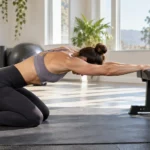
Mobility work can complement your training as well, especially if upper-body stiffness affects comfortable posture during strength exercises. For example, including a simple lat stretch may help address tightness around the upper back and shoulders. Combining mobility exercises with controlled core training can support comfortable, efficient movement throughout your workout.
Banded Pallof Press for Sports and Everyday Movement
Anti-rotation strength is valuable because real-life movement rarely occurs in only one direction. Carrying groceries, lifting an object with one hand, opening a heavy door, or moving something across your body can all create rotational forces. The Pallof press trains your trunk to remain stable while your arms move independently.
Athletes may also benefit from this type of core control during running, throwing, swinging, tackling, and changing direction. These movements often involve transferring force between the lower and upper body while controlling rotation. The Pallof press does not directly replicate every sporting movement, but it can strengthen the stable foundation needed for efficient force transfer.
However, the exercise should usually be treated as one part of a balanced training program rather than a complete core solution. Your routine may also include flexion, extension, lateral stability, loaded carries, hip strengthening, and rotational movements when appropriate. Combining several movement patterns helps develop a more adaptable and capable trunk.
How Often Should You Do Banded Pallof Presses?
For general core strength, performing Pallof presses two or three times per week is often enough. Because the movement usually uses moderate resistance, recovery demands are relatively low compared with heavy compound lifting. However, training frequency should still reflect your overall workout volume, fitness level, and how your body responds between sessions.
Beginners may start with two sets of 8–10 repetitions on each side while focusing mainly on technique. Over time, you can progress toward three sets of 10–15 repetitions, slightly heavier resistance, or longer pauses at full extension. Another option is increasing the distance from the anchor, which adds band tension without changing equipment.
Avoid progressing multiple variables at once. Increasing resistance, repetitions, range, and hold time simultaneously can make your technique deteriorate quickly. Choose one small progression, maintain controlled form for several sessions, and then decide whether another increase is appropriate based on your stability and confidence.
Who Should Be Careful With the Pallof Press?
Most healthy adults can perform a light banded Pallof press when proper technique and suitable resistance are used. However, anyone experiencing active back, abdominal, shoulder, hip, or pelvic pain should avoid forcing the movement through discomfort. Exercise should feel challenging through muscular effort rather than causing sharp, radiating, or worsening pain.
People recovering from surgery or managing a recent injury should follow guidance from an appropriate healthcare or rehabilitation professional before introducing resistance exercises. Individual restrictions can vary significantly depending on the condition and recovery stage. A movement that is comfortable for one person may not be suitable for someone with different symptoms or physical limitations.
Pregnant or postpartum individuals may also need modifications based on comfort, stage of pregnancy, recovery, and professional guidance. Lighter resistance, adjusted stance, or different core exercises may sometimes be more appropriate. The priority should always be controlled movement, comfortable breathing, and avoiding pressure or strain that does not feel appropriate.
Conclusion
The banded Pallof press is an effective anti-rotation exercise that strengthens your core by teaching your body to resist unwanted movement. Rather than relying on repeated bending or twisting, it challenges the abdominal muscles to stabilize your spine and pelvis while your arms move away from your torso.
Proper form matters more than heavy resistance. Keep your feet stable, ribs stacked over your pelvis, core engaged, and shoulders facing forward while pressing the band slowly. Choosing manageable resistance allows you to feel the intended core challenge without compensating through your hips, shoulders, or lower back.
Whether you train at home, in a gym, or for recreational sports, the Pallof press can be a practical addition to your routine. Start with basic standing presses, build consistent control, and gradually explore holds, kneeling variations, or stronger resistance as your stability improves.
FAQs
What does the banded Pallof press work?
The banded Pallof press primarily works the obliques, transverse abdominis, and other deep core stabilizers. Your glutes, shoulders, chest, arms, and hip muscles also assist with maintaining proper positioning.
Is the Pallof press good for beginners?
Yes, the Pallof press can be beginner-friendly when performed with light resistance. Beginners should focus on preventing rotation, maintaining steady breathing, and controlling the band rather than using heavy resistance.
How many Pallof presses should I do?
A common starting point is 2–3 sets of 8–15 repetitions per side. You can also perform timed holds of approximately 10–30 seconds while maintaining proper posture and controlled breathing.
Should you feel the Pallof press in your abs?
You should generally feel your abdominal and side-core muscles working to prevent rotation. If you mainly feel your shoulders or arms, consider reducing resistance and concentrating more on bracing your torso.
Can I do the Pallof press every day?
Light Pallof presses may be tolerated frequently, but daily training is usually unnecessary for building core stability. Two or three sessions per week can provide enough practice while allowing your muscles adequate recovery.