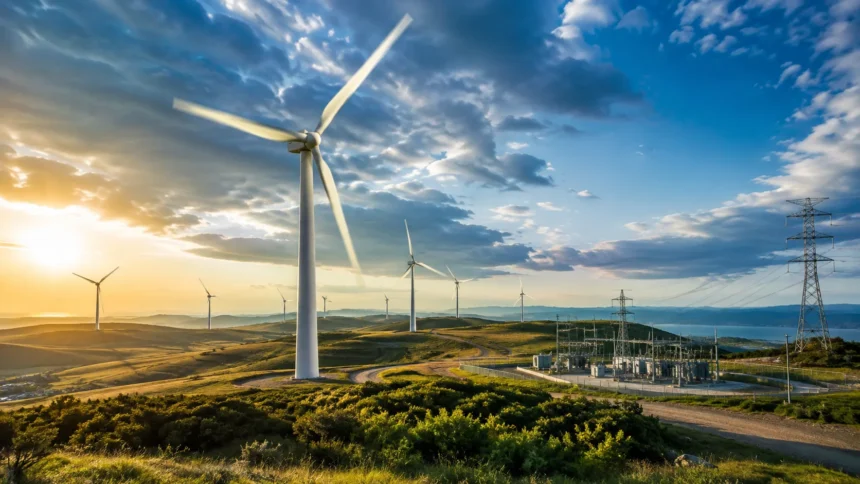
How Do Wind Turbines Generate Electricity?
Wind turbines generate electricity by converting the kinetic energy of moving air into mechanical motion and then into electrical power. When wind pushes against the turbine blades, the blades rotate around a central hub. That rotation drives machinery inside the turbine, where a generator converts mechanical energy into usable electricity.
Although a modern wind turbine may look simple from the ground, it contains an advanced combination of aerodynamic blades, sensors, control systems, electrical equipment, and structural components. Each part works together to capture as much wind energy as possible while keeping the turbine safe during changing weather conditions.
Wind power has become an important part of the global shift toward renewable energy because turbines can generate electricity without burning fuel during normal operation. Wind farms can be built on land or offshore, and individual turbines can supply power to homes, businesses, industries, and electricity grids.
Understanding how wind turbines work makes it easier to see why wind energy is valuable and where its limitations exist. From blade design and generators to transmission lines and energy storage, every stage plays a role in turning moving air into electricity that people can actually use.
What Is a Wind Turbine?
A wind turbine is a machine designed to capture energy from the wind and convert it into electricity. Most modern turbines have three long blades attached to a central hub positioned at the top of a tall tower, allowing them to reach stronger and more consistent winds.
The basic idea is similar to older windmills, but the purpose is different. Traditional windmills often used wind energy directly for mechanical tasks such as grinding grain or pumping water, while modern wind turbines convert that movement into electrical energy.
Wind turbines are available in different sizes. Small wind turbines may support individual properties or remote systems, while utility-scale turbines can produce large amounts of electricity for regional power networks.
Large numbers of turbines are often grouped together in wind farms. These wind farms share electrical infrastructure, allowing the electricity generated by multiple turbines to be collected, transformed, and transmitted efficiently to the wider power grid.
Where Does Wind Energy Come From?
Wind energy ultimately comes from the Sun. Solar radiation heats Earth’s surface unevenly because land, water, vegetation, and different geographic regions absorb and release heat at different rates.
These temperature differences create changes in air pressure. Warmer air tends to rise, while cooler, denser air moves in to replace it, creating the movement of air that we experience as wind.
Earth’s rotation, terrain, coastlines, mountains, and weather systems also influence wind direction and speed. This is why some locations have stronger and more predictable winds than others.
Wind turbines are therefore placed where wind resources are favorable. Coastal regions, open plains, mountain passes, and offshore areas can offer strong winds that allow turbines to generate electricity more consistently.
How Do Wind Turbine Blades Capture Energy?
Wind turbine blades are designed with aerodynamic shapes similar in principle to aircraft wings. As air moves across each blade, differences in pressure create a force that causes the rotor to turn.
The blades do not simply work because wind pushes them from behind. Their carefully shaped surfaces generate lift, which creates a more efficient rotational force around the turbine hub.
Blade length strongly affects how much energy a turbine can capture. Longer blades sweep across a larger circular area, allowing the turbine to intercept more moving air and potentially generate more electricity.
Modern blades are usually made from lightweight but strong composite materials. They must withstand changing wind speeds, rain, temperature variations, repeated loading, and many years of continuous operation.
What Happens When the Blades Start Turning?
When the wind reaches an appropriate speed, the turbine’s control system allows the rotor to begin turning. The blades rotate the central hub, which is connected to a shaft inside the nacelle.
The nacelle is the housing positioned behind the blades at the top of the tower. It contains many of the turbine’s most important mechanical and electrical components, including the generator and control equipment.
The rotational speed of the blades is relatively slow compared with the speed required by some electrical generators. Depending on the turbine design, a gearbox may increase the rotational speed before it reaches the generator.
Some modern turbines use direct-drive technology instead. In these systems, the rotor connects more directly to a specially designed generator, reducing the need for a traditional gearbox.
How Does the Generator Produce Electricity?
The generator is the component that converts mechanical rotation into electrical energy. It works through electromagnetic induction, a fundamental principle of physics used in many types of electricity generation.
Inside the generator, magnets and conductive coils move relative to one another. This movement changes the magnetic field passing through the conductors, creating an electrical current.
The energy therefore changes form several times. Moving air contains kinetic energy, the turbine blades turn that into rotational mechanical energy, and the generator converts that motion into electrical power.
The electricity produced by the generator is then conditioned by power electronics so it meets the electrical requirements of the wind farm and the wider power grid.
What Is the Role of the Gearbox?
In traditional geared wind turbines, the gearbox sits between the low-speed rotor shaft and the higher-speed generator shaft. Its main job is to increase rotational speed.
The blades may rotate relatively slowly, but some generator designs operate more efficiently at much higher rotational speeds. The gearbox uses gears to multiply the speed while transferring mechanical energy.
Gearboxes experience considerable mechanical stress because they operate under changing wind loads for long periods. They therefore require careful engineering, lubrication, monitoring, and maintenance.
Direct-drive wind turbines eliminate this component by using larger generators designed to operate at lower rotational speeds. This can reduce the number of moving parts, although direct-drive systems have their own design and material requirements.
What Is Inside the Nacelle?
The nacelle is essentially the machinery housing of a wind turbine. It sits at the top of the tower directly behind the rotor and protects important mechanical and electrical components.
Depending on the turbine design, the nacelle may contain the main shaft, gearbox, generator, braking system, cooling equipment, control systems, sensors, and power electronics.
Technicians can access the nacelle for inspections and maintenance. Modern turbines also contain remote monitoring systems that constantly track temperature, vibration, wind conditions, power output, and other operating information.
This data helps operators detect potential problems before they become serious. Predictive maintenance can reduce downtime and improve the long-term reliability of a wind farm.
Why Are Wind Turbine Towers So Tall?
Wind turbine towers are tall because winds generally become stronger and more consistent farther above the ground. Buildings, trees, hills, and other surface features create friction and turbulence close to the ground.
Raising the turbine rotor above these obstacles allows the blades to access better-quality wind. Stronger winds contain significantly more energy, making tower height an important part of turbine performance.
A taller tower can also accommodate longer blades without allowing them to come too close to the ground. Larger rotors help turbines capture more wind energy.
However, taller structures require stronger foundations, more materials, specialized transportation, and advanced installation equipment. Engineers must balance increased electricity production against construction and maintenance costs.
How Does a Wind Turbine Face the Wind?
Most large modern wind turbines use a yaw system to keep the rotor facing the wind. Sensors mounted on the turbine measure wind direction and send information to the control system.
When the wind direction changes enough, motors rotate the nacelle around the top of the tower. This movement aligns the rotor with the incoming wind.
Correct alignment helps maximize electricity generation because the blades capture energy most efficiently when they are positioned properly relative to airflow.
Constant small adjustments would create unnecessary mechanical wear, so control systems typically respond only when changes in wind direction become significant enough to affect performance.
What Is Blade Pitch Control?
Pitch control allows each blade to rotate slightly around its own long axis. This changes the angle at which the blade meets the wind.
At moderate wind speeds, the control system adjusts blade pitch to capture energy efficiently. The goal is to maintain strong power production without putting unnecessary stress on the turbine.
When winds become very strong, the blades can be turned to reduce aerodynamic forces. This protects the turbine from excessive loads and helps maintain safe operating conditions.
During extreme weather or maintenance situations, the blades can be positioned so that they capture very little energy. This allows the turbine to slow down or stop when necessary.
How Much Wind Does a Turbine Need?
A wind turbine does not generate electricity at every wind speed. It usually begins producing useful power after the wind reaches a minimum speed known as the cut-in speed.
As wind speed increases, electrical output rises until the turbine reaches its rated power. At that point, the control system limits production to the machine’s designed maximum output.
If wind speeds become dangerously high, the turbine shuts down at its cut-out speed. Continuing to operate in extreme winds could place excessive stress on blades, towers, and mechanical components.
This operating range protects the turbine while allowing it to capture energy efficiently across normal wind conditions. Exact speeds vary depending on turbine design and manufacturer.
Why Wind Speed Matters So Much
The energy available in wind increases very rapidly as wind speed rises. This means a modest increase in wind speed can result in a much larger increase in potential energy.
For this reason, developers carefully measure wind conditions before building a wind farm. Temporary meteorological towers, lidar systems, and long-term weather data can help assess wind resources.
Average wind speed alone is not enough. Developers also consider turbulence, seasonal patterns, wind direction, extreme weather, air density, and how wind conditions change with height.
Choosing the right site can make the difference between a highly productive wind farm and one that generates less electricity than expected.
How Electricity Leaves the Wind Turbine
After the generator produces electricity, power electronics regulate the electrical output. The electricity then travels through cables running down the inside of the tower.
A transformer increases the voltage so electricity can be transported more efficiently. Higher-voltage transmission reduces electrical losses over longer distances.
Within a wind farm, electricity from multiple turbines is collected through an internal network. It then travels to a larger substation where voltage may be increased again.
From there, the electricity can enter the regional transmission grid and travel toward homes, businesses, factories, schools, hospitals, and other electricity users.
How Does Wind Electricity Reach Your Home?
Once wind-generated electricity enters the power grid, it becomes part of the overall electricity supply. Electrons are not normally tracked from a specific turbine directly to a specific house.
Transmission lines carry high-voltage electricity across long distances. Regional substations gradually reduce the voltage as electricity moves closer to communities.
Local distribution systems then deliver electricity through smaller power lines. Transformers near neighborhoods reduce the voltage again to levels suitable for normal household use.
When you turn on a light or appliance, the electricity may come from a mix of wind, solar, nuclear, hydroelectric, natural gas, and other sources depending on the regional grid.
What Is a Wind Farm?
A wind farm is a collection of wind turbines installed within the same general area and connected through shared electrical infrastructure. Wind farms can contain a few turbines or hundreds of machines.
Engineers carefully plan turbine spacing because one turbine can affect the wind reaching another. Air passing behind a turbine becomes more turbulent and contains less usable energy.
This reduced-wind area is called a wake. Turbines are therefore arranged to minimize wake losses while making efficient use of available land or ocean space.
Wind farms also require roads, electrical cables, substations, monitoring systems, and grid connections. Designing these supporting systems is a major part of developing a wind-energy project.
Onshore vs Offshore Wind Turbines
Onshore wind turbines are installed on land, often in open plains, agricultural areas, ridges, or other locations with favorable wind conditions. They are generally easier to access for construction and maintenance.
Offshore wind turbines are located in oceans or large bodies of water. Offshore areas can provide stronger and more consistent winds, allowing developers to use very large turbines.
Building offshore wind farms is more complex because foundations, cables, ships, weather conditions, and marine environments increase construction and maintenance challenges.
Despite those challenges, offshore wind can produce large amounts of renewable electricity close to major coastal population centers. New floating technologies may also expand development into deeper waters.
How Do Floating Wind Turbines Work?
Traditional offshore turbines are usually fixed to foundations attached to the seabed. This approach becomes more difficult and expensive as water depth increases.
Floating wind turbines solve this challenge by placing turbines on buoyant platforms anchored to the ocean floor with mooring lines.
The turbine still generates electricity using the same basic aerodynamic and electromagnetic principles. The main difference is the floating support structure beneath it.
Floating wind technology may open large areas of deep ocean to renewable energy development. However, cost, maintenance, grid connections, and environmental impacts will influence how widely these systems are adopted.
How Efficient Are Wind Turbines?
Wind turbines cannot capture all the kinetic energy contained in moving air. If a turbine removed every bit of energy, the air behind the rotor would stop completely and prevent more wind from passing through.
Physics therefore places a theoretical limit on the fraction of wind energy a turbine can extract. Real turbines operate below that theoretical maximum because of aerodynamic, electrical, and mechanical losses.
Efficiency should not be confused with capacity factor. Efficiency describes how effectively available wind energy is converted, while capacity factor compares actual electricity production with the maximum possible output over time.
A well-positioned turbine can generate large amounts of electricity even though the wind does not blow at the same speed constantly. Location and turbine design are therefore critical to overall productivity.
What Is Capacity Factor?
Capacity factor measures how much electricity a power source actually produces compared with how much it could generate if it operated at maximum output continuously.
For example, a wind turbine rated at a certain capacity will not operate at that maximum level every hour because wind conditions constantly change.
Wind farms in locations with stronger and steadier winds generally achieve higher capacity factors. Offshore wind projects often perform particularly well because ocean winds can be more consistent.
Capacity factor is useful when comparing energy systems, but it does not tell the entire story. Costs, reliability, construction time, environmental impact, and grid compatibility must also be considered.
Can Wind Turbines Generate Electricity Without Wind?
A wind turbine cannot generate meaningful electricity when there is no wind because its energy source is moving air. Without sufficient wind, the rotor will not produce usable mechanical power.
This variability is one of the main differences between wind energy and power sources that can operate whenever fuel is available.
Electricity grids manage this challenge by combining wind with other power sources, energy storage, flexible demand, and connections between different geographic regions.
Wind forecasting has also improved significantly. Grid operators can use weather models to predict expected wind generation and plan other electricity supplies around those forecasts.
How Is Wind Energy Stored?
Wind turbines themselves usually send electricity directly to the grid rather than storing it internally. Separate energy-storage systems can capture excess electricity for later use.
Lithium-ion batteries are commonly used because they can charge and discharge quickly. They are useful for short-duration grid balancing and smoothing fluctuations in renewable generation.
Other storage technologies include pumped-storage hydropower, flow batteries, compressed air, thermal storage, and potentially hydrogen produced using excess renewable electricity.
Different storage technologies serve different purposes. Some respond within seconds, while others are designed to store larger amounts of energy for hours, days, or longer periods.
What Happens When Wind Produces Too Much Electricity?
Sometimes wind farms can generate more electricity than the grid needs or can transport at a particular moment. Grid operators must maintain a constant balance between supply and demand.
Excess electricity can sometimes charge batteries, pump water into hydroelectric reservoirs, produce hydrogen, or supply flexible industrial processes.
When these options are unavailable, wind farms may be instructed to reduce their output. This practice is known as curtailment.
Better transmission infrastructure, energy storage, demand flexibility, and coordination between electricity markets can reduce unnecessary curtailment and allow more renewable power to be used.
What Happens When the Wind Stops?
When wind generation falls, other resources must compensate to keep electricity supply stable. Electricity grids are designed to continuously balance changes in production and demand.
Solar power, hydroelectricity, nuclear energy, natural gas plants, battery storage, or electricity imported from neighboring regions may help fill temporary gaps.
Geographically distributed wind farms can also reduce variability. Wind may be weak in one area while remaining strong hundreds of kilometers away.
A reliable renewable-energy system therefore depends on diversity. Combining multiple energy sources with storage, transmission, and forecasting provides greater stability than relying on wind alone.
Are Wind Turbines Environmentally Friendly?
Wind turbines produce electricity without burning fossil fuels during normal operation, which means they generate extremely low direct greenhouse gas emissions and air pollution.
However, turbines still require raw materials, manufacturing, transportation, foundations, roads, electrical equipment, and eventual decommissioning. These activities create environmental impacts that should be considered.
Wind farms may also affect birds, bats, landscapes, marine ecosystems, or local communities depending on where and how they are developed.
Careful site selection, environmental assessment, improved turbine design, wildlife monitoring, and responsible planning can significantly reduce many of these impacts.
Do Wind Turbines Harm Birds?
Bird collisions with wind turbines can occur, and the risk varies considerably by species, location, turbine placement, migration routes, and surrounding habitat.
Certain locations can create greater concerns, particularly when turbines are placed near important migration corridors, nesting areas, or habitats used by vulnerable species.
Developers can reduce risks through wildlife surveys, better siting, monitoring, and operational strategies that temporarily slow or stop turbines when vulnerable species are particularly active.
Environmental decisions should compare wind-power impacts with wider threats to wildlife, including habitat destruction, climate change, buildings, transportation infrastructure, and other human activities.
What Happens to Old Wind Turbine Blades?
Wind turbines eventually reach the end of their operating lives, making recycling and responsible disposal increasingly important as the industry expands.
Many turbine components, including steel towers, copper wiring, and certain electrical materials, can already be recovered and recycled relatively effectively.
Blades are more difficult because they are commonly made from composite materials that combine fibers and resins for strength and low weight.
Manufacturers and researchers are developing recyclable blade materials, improved processing methods, and ways to reuse old blades in construction or other applications.
How Long Do Wind Turbines Last?
Modern wind turbines are generally designed to operate for decades when properly maintained. Their actual service life depends on engineering quality, location, maintenance, weather conditions, and component wear.
Regular inspections help identify issues involving blades, bearings, generators, electrical systems, and other critical parts before major failures occur.
Sensors and digital monitoring now allow operators to track performance continuously. Changes in vibration, temperature, or power output can provide early warning signs of developing problems.
At the end of a turbine’s life, the site may be decommissioned or repowered with newer machines. Repowering can increase electricity generation because modern turbines are often larger and more efficient.
Why Wind Energy Is Growing
Wind power has expanded because it can generate large amounts of electricity without fuel combustion. Once a project is operating, wind itself does not need to be purchased.
Technology improvements have also made modern turbines larger, more productive, and capable of operating effectively in a wider range of wind conditions.
Renewable-energy policies, climate goals, energy-security concerns, corporate clean-energy demand, and improvements in electricity-grid technology have supported additional development.
Wind energy also complements solar power in many regions because wind conditions may be stronger at night or during seasons when solar generation is lower.
Challenges Facing Wind Power
The variability of wind remains one of the biggest technical challenges. Power systems must remain reliable even when wind conditions change quickly or remain weak for extended periods.
Transmission infrastructure can also be a limitation because some of the best wind resources are located far from major cities and industrial centers.
Permitting, community acceptance, visual impacts, wildlife concerns, supply-chain constraints, and construction costs can delay new wind projects.
These challenges do not make wind energy impractical, but they show why successful development requires good engineering, careful planning, community involvement, and coordinated grid investment.
The Future of Wind Turbine Technology
Future wind turbines are likely to become more powerful and digitally sophisticated. Larger rotors and taller towers can access more consistent wind and capture more energy.
Offshore turbines are especially likely to continue increasing in size because ocean sites can accommodate very large machines without many of the transportation limits faced on land.
Artificial intelligence, predictive maintenance, improved sensors, and advanced forecasting may help operators increase reliability and reduce downtime.
Floating offshore wind, recyclable blades, smarter electrical systems, and advanced materials could also expand where turbines can operate and reduce the environmental footprint of future wind projects.
Final Thoughts on How Wind Turbines Generate Electricity
Wind turbines generate electricity through a relatively simple principle supported by sophisticated engineering. Moving air turns aerodynamic blades, which rotate machinery connected to an electrical generator.
The electricity then passes through power electronics, transformers, cables, substations, and transmission networks before becoming part of the electricity used by homes and businesses.
Modern wind power also depends on much more than the turbine itself. Accurate forecasting, energy storage, transmission infrastructure, grid management, and careful wind-farm design all help maximize its value.
As renewable energy systems expand, wind turbines are likely to remain an important part of electricity generation. Their ability to transform naturally moving air into usable power makes wind energy one of the most significant technologies in the transition toward lower-carbon electricity.
Frequently Asked Questions
How do wind turbines generate electricity in simple terms?
Wind turns the turbine blades, which rotate a shaft connected to a generator. The generator uses electromagnetic induction to convert that mechanical movement into electricity.
Do wind turbines work when there is no wind?
No. Wind turbines need moving air above a minimum speed to generate useful electricity. When wind is unavailable, other power sources or energy-storage systems help supply the grid.
How fast do wind turbine blades spin?
Blade speed varies depending on turbine size and wind conditions. Large modern turbines generally rotate relatively slowly, while the tips of their long blades can still travel very quickly.
How does electricity from wind turbines reach homes?
Electricity travels from turbines through cables and transformers to a wind-farm substation. It then enters transmission and distribution networks that deliver power to homes and businesses.
Are wind turbines a renewable energy source?
Yes. Wind energy is renewable because atmospheric movement is continuously replenished by solar heating, weather systems, and Earth’s natural processes.