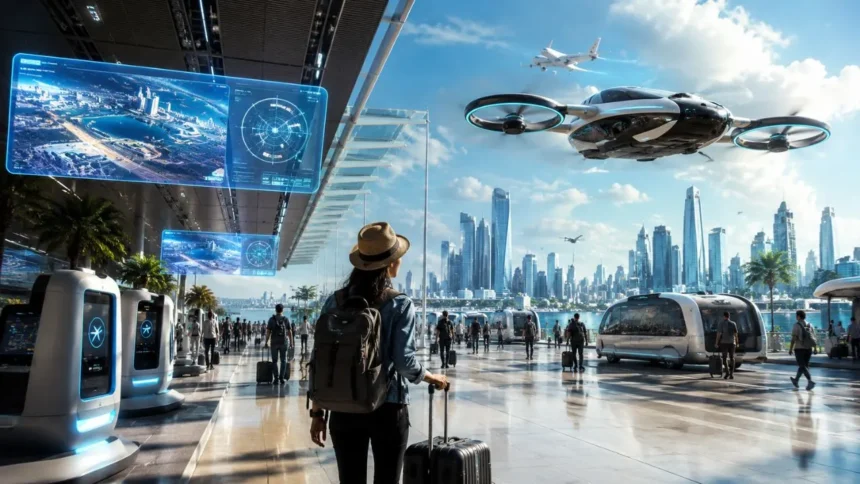
Travel has always evolved alongside technology. Railways made distant cities reachable, commercial aviation connected continents, and smartphones placed maps, tickets, reviews, and translation tools in travellers’ pockets. The next stage could be even more significant because several technologies are developing at the same time, including artificial intelligence, biometric identification, autonomous transport, augmented reality, robotics, and cleaner aviation systems.
The future of travel will not only be about reaching a destination faster. Technology could influence how people choose places, compare prices, cross borders, navigate unfamiliar streets, check into hotels, communicate with local residents, and respond to disruptions. A journey may eventually feel like one connected experience rather than a collection of separate bookings, documents, queues, apps, and customer-service conversations.
Many of these changes are already moving beyond experimental ideas. Biometric border systems are operating in some regions, airlines are testing reusable digital identities, tourism organisations are examining responsible AI adoption, and aviation authorities are developing frameworks for electric vertical-take-off aircraft. However, widespread adoption will depend on affordability, regulation, public trust, accessibility, safety, and strong data protection.
Technology could make travel smoother, safer, more personalised, and more sustainable, but it could also introduce new risks. Travellers may face privacy concerns, inaccurate AI recommendations, digital exclusion, cyberattacks, and increased dependence on connected devices. Understanding both the opportunities and limitations helps explain how technology could change travel without assuming that every new invention will automatically improve the traveller experience.
AI Could Turn Travel Planning Into a Personal Conversation
Artificial intelligence could dramatically simplify the research stage of a trip. Instead of opening dozens of tabs to compare flights, hotels, neighbourhoods, activities, visas, and transport options, travellers may increasingly use an AI travel planner. A person could describe their budget, preferred climate, food interests, accessibility requirements, available dates, and desired pace, then receive a personalised travel itinerary within seconds.
Advanced travel assistants may also understand more detailed requests than conventional search filters. A family could ask for a quiet coastal destination with child-friendly attractions and direct flights, while a solo traveller could request walkable neighbourhoods with affordable public transport. AI systems could compare large amounts of information and suggest options that match the traveller’s priorities rather than simply displaying the most popular or heavily advertised results.
Planning may become continuous instead of ending after a booking is confirmed. An AI assistant could monitor flight changes, weather conditions, local transport strikes, attraction closures, and hotel check-in times. It might then adjust the itinerary, recommend an earlier train, rearrange reservations, or explain the available alternatives. UN Tourism has highlighted AI’s potential to improve efficiency and travel experiences while stressing that adoption should remain ethical, inclusive, and people-focused.
Despite its convenience, AI travel planning will still require human judgment. Generated itineraries may contain outdated opening hours, unrealistic travel times, unsuitable neighbourhood suggestions, or fabricated details. Travellers should verify important information through airlines, hotels, official tourism offices, and government websites. The most useful future systems will combine fast personalisation with transparent sources, reliable updates, privacy controls, and easy access to human support.
Digital Identity Could Reduce Airport Queues and Paperwork
Air travel currently requires passengers to repeatedly present passports, boarding passes, visas, and other documents. Digital identity technology could combine verified travel credentials in a secure digital wallet. With the traveller’s permission, the necessary information could be shared with an airline, airport, or border authority before arrival, potentially confirming that the passenger is eligible to travel before reaching the terminal.
IATA’s One ID initiative is designed around a more seamless and contactless passenger journey using digital identity and biometric recognition. The goal is not simply to place a picture of a passport on a phone. It involves verified digital credentials that can be securely checked and shared with approved travel organisations while allowing passengers to provide only the information required for a particular step.
In April 2026, IATA reported that industry proof-of-concept projects had demonstrated how one reusable digital identity could work across different stages of an international journey. Such systems could eventually allow passengers to move through bag drop, security, immigration, lounges, and boarding with fewer physical document checks. The International Civil Aviation Organization is also developing guidance for secure and interoperable Digital Travel Credentials.
Physical passports are unlikely to disappear everywhere at once. Governments have different laws, security systems, technical infrastructure, and privacy expectations. Travellers may also need an alternative when a phone is lost, its battery fails, or a digital system becomes unavailable. Digital identity will be most helpful when it gives passengers a convenient choice rather than making travel impossible for people who lack suitable devices or digital skills.
Biometrics Could Make Borders Faster but More Sensitive
Facial recognition, fingerprint scanning, and other biometric systems could reduce the need for manual identity checks. At an airport, a passenger’s face may be compared with the verified photograph in an electronic passport or digital travel credential. When the information matches, the traveller could pass through an automated checkpoint without repeatedly handing documents to different employees.
Europe’s Entry/Exit System offers a current example of borders becoming more digital. The system began a progressive rollout in October 2025 and became fully operational across participating Schengen countries on April 10, 2026. It replaces routine passport stamping for many non-EU short-stay visitors with digital entry and exit records that include travel-document information and biometric data.
When implemented effectively, biometric processing could shorten queues, identify altered documents, and allow trained border officers to focus on cases that require closer attention. ICAO’s supporting infrastructure enables authorities to check the digital signatures of electronic passports and compatible digital credentials. This helps confirm that a document is authentic and that its information has not been changed.
Biometric information is highly sensitive because a person cannot easily replace a face or fingerprint after a data breach. Travel providers and governments therefore need strong encryption, restricted access, limited retention periods, clear consent processes, and independent oversight. Travellers should be told what information is collected, why it is needed, how long it remains stored, and whether a practical non-biometric alternative is available.
Smart Airports Could Predict Problems Before They Grow
Future airports could behave more like connected digital systems than collections of separate counters and gates. Sensors, cameras, operational databases, and artificial intelligence may provide a real-time view of passenger flow, baggage movement, aircraft turnaround, security demand, and ground transport. Airport teams could use this information to identify developing congestion before long queues or missed connections occur.
Predictive technology could estimate when security lanes will become busy and recommend opening additional checkpoints. It could guide passengers toward less crowded routes through an airport or send personalised walking directions to a departure gate. Digital signs might change automatically according to language needs, disruptions, and passenger volume rather than showing the same message to everyone.
Connected baggage systems could also reduce uncertainty. Travellers may receive a notification when a bag is accepted, loaded onto the aircraft, transferred between flights, and placed on the arrival belt. If luggage misses a connection, the system could begin tracing and delivery arrangements before the passenger reaches the baggage-service desk. This would not eliminate mishandled bags, but it could make recovery faster and more transparent.
Greater automation should not remove human assistance from airports. Passengers dealing with cancellations, disabilities, medical needs, language barriers, or complex documentation often require more than an app notification. The strongest smart-airport model would use technology for routine processing while making trained employees easier to reach when a traveller faces an unusual, stressful, or emotionally difficult situation.
Real-Time Translation Could Lower Language Barriers
Language differences can make travel exciting, but they can also create confusion during medical emergencies, transport disruptions, hotel disputes, and visits to unfamiliar neighbourhoods. Real-time translation technology could help travellers understand conversations, menus, signs, announcements, and written instructions. Phones, earbuds, glasses, and public information screens may increasingly provide immediate translations in the user’s preferred language.
A traveller could point a camera at a train notice and receive translated text over the original image. Voice tools might allow two people to speak in different languages while software translates each side of the conversation. This could make independent travel more practical for people who currently rely heavily on organised tours or English-language services.
Translation systems may also support tourism businesses in smaller destinations. A family-owned hotel, restaurant, guide, or transport company could communicate with international visitors without operating a large multilingual support team. By reducing communication barriers, technology could distribute tourism spending beyond major hotels and famous attractions, giving local businesses better access to global travellers.
Machine translation is not equally reliable in every situation. Dialects, humour, cultural references, technical language, and emergency instructions can be misunderstood. W3C research notes that automated translation can provide real-time assistance, but accuracy in specialised contexts may still require human validation. Travellers should therefore treat translation tools as helpful support rather than unquestionable authority.
Augmented Reality Could Change How People Explore Places
Augmented reality adds digital information to a person’s view of the physical world. Through a phone camera or lightweight smart glasses, travellers could see directions, historical facts, translations, accessibility details, and recommendations placed over nearby streets and buildings. Navigation may become easier because arrows could appear directly on the route instead of requiring constant interpretation of a two-dimensional map.
At historical sites, augmented reality could reconstruct damaged buildings or display how a location looked centuries earlier. Museum visitors might view animations explaining how an artefact was created, while nature travellers could identify plants, mountains, birds, or geological formations. This form of interactive tourism could make educational content more memorable without replacing the physical destination.
AR technology may also improve accessibility. Indoor navigation could guide travellers through airports, stations, museums, and hotels where satellite-based maps are less effective. Applications might identify step-free entrances, lifts, quiet spaces, accessible toilets, or obstacles. W3C accessibility work has identified technology-assisted indoor navigation and wayfinding as an important area for people who need additional cognitive or mobility support.
However, digital overlays should not turn every journey into a screen-dominated experience. Constant recommendations, advertisements, notifications, and gamified tasks could distract visitors from local culture and everyday life. Responsible travel technology should allow people to control the amount of information they see and make it easy to explore without being continuously tracked or commercially influenced.
Virtual Reality Could Help Travellers Choose More Confidently
Virtual reality could allow people to experience a realistic preview of a hotel room, cruise cabin, attraction, hiking route, or neighbourhood before making a booking. Traditional photographs often hide scale, noise, difficult stairs, or the distance between important facilities. An immersive preview could provide a better sense of space and help travellers decide whether an experience matches their expectations.
This may be especially valuable for travellers with accessibility needs. A person could inspect the width of a doorway, the layout of a bathroom, the distance from a hotel entrance to a lift, or the terrain around an attraction. Families could examine whether a property appears safe for young children, while anxious travellers could familiarise themselves with an airport before departure.
Virtual tourism could also expand access for people who cannot make a physical journey because of cost, health, mobility, caregiving responsibilities, or environmental concerns. A virtual visit is not identical to being present, but it can provide cultural, educational, and emotional value. Schools, museums, heritage organisations, and destinations could use immersive experiences to reach audiences who might otherwise remain excluded.
Travel companies will need to ensure that virtual previews accurately represent the real product. An enhanced simulation could easily become another form of misleading advertising if it removes crowds, increases room sizes, improves views, or hides accessibility problems. Trustworthy platforms should identify edited content, record when the experience was captured, and allow users to compare virtual material with recent verified reviews.
Hotels Could Become More Personalised and Automated
Connected hotel rooms could adjust lighting, temperature, curtains, entertainment, and accessibility settings according to a guest’s preferences. A traveller might save these choices in a profile and apply them across participating properties. Digital check-in could allow the guest to confirm identification, choose a room, receive an electronic key, and go directly to the accommodation without waiting at reception.
Artificial intelligence may help hotels predict operational needs. Systems could estimate when guests are likely to arrive, identify maintenance problems, manage energy use, translate messages, and respond to routine questions. Housekeeping schedules might become more responsive, while sensors could detect water leaks, malfunctioning equipment, or unusual energy consumption before these issues disrupt a guest’s stay.
Robots may perform limited tasks such as transporting towels, delivering room-service items, cleaning floors, or moving luggage. Automation could help employees avoid repetitive or physically demanding work, but it should not be treated only as a way to remove jobs. Hospitality depends heavily on empathy, local knowledge, reassurance, and problem-solving, which are difficult to provide through fully automated systems.
Personalisation also creates privacy concerns. A hotel does not need unlimited access to a guest’s behaviour simply to offer a comfortable room. Travellers should be able to use basic services without surrendering unnecessary personal information. Clear consent, secure storage, deletion controls, and non-connected alternatives will determine whether smart hotels feel genuinely convenient or uncomfortably intrusive.
Autonomous Transport Could Reshape Movement at Destinations
Self-driving shuttles could eventually connect airports, train stations, hotels, attractions, and residential areas. These vehicles may follow fixed routes in controlled environments before becoming common on complex public roads. At large resorts, campuses, airports, and theme parks, autonomous transport could provide frequent service without requiring every traveller to rent a car.
Connected transport networks may also make journeys more coordinated. A travel app could combine a flight, train, local bus, shared vehicle, bicycle, and walking route into one itinerary. When one service is delayed, the system could automatically calculate a new connection and update the relevant bookings. This form of integrated mobility could reduce uncertainty in unfamiliar cities.
Autonomous vehicles may improve travel for older adults, people with disabilities, and visitors who cannot drive. However, the benefits will depend on accessible vehicle design, affordable pricing, reliable service outside wealthy districts, and support for passengers who need assistance. A self-driving vehicle that cannot safely accommodate a wheelchair, guide dog, or confused traveller would not represent inclusive innovation.
Road safety, extreme weather, software failures, insurance, local regulations, and public confidence remain major challenges. Autonomous transport is likely to expand gradually rather than replace conventional drivers overnight. Human-operated taxis, buses, and rental vehicles will probably coexist with automated services for many years, particularly in destinations with unpredictable traffic and limited digital infrastructure.
Air Taxis Could Add a New Layer to Urban Travel
Electric vertical-take-off and landing aircraft, commonly called eVTOLs or air taxis, are being developed for short passenger journeys. These aircraft are generally designed to take off vertically, travel above road congestion, and land at specialised facilities known as vertiports. The FAA describes advanced air mobility aircraft as typically highly automated, electrically powered vehicles with vertical-take-off capabilities.
Possible routes could include airport-to-city transfers, connections between nearby cities, island transport, medical services, or journeys to areas with difficult terrain. A trip that takes more than an hour by congested road might take considerably less time in the air. Electric propulsion could also be quieter at certain stages than conventional helicopter operations, although real-world noise will depend on aircraft design and traffic volume.
Air taxis are not yet an everyday form of mass travel. Regulators must address aircraft certification, pilot requirements, airspace management, emergency procedures, maintenance, vertiport locations, and community noise. In March 2026, the FAA announced selected partnerships for an eVTOL integration pilot programme intended to develop practical frameworks for safe advanced-air-mobility operations.
Price and capacity may initially limit these services to premium travellers or specialised routes. If air taxis remain expensive and carry only a few passengers, they will not solve urban congestion on their own. Their wider value will depend on safe integration with public transport, transparent environmental assessments, reasonable community protections, and routes that serve practical needs rather than functioning only as luxury experiences.
Technology Could Support More Sustainable Travel Decisions
Digital tools could make the environmental effects of travel easier to understand. Booking platforms may show estimated emissions alongside flight, rail, coach, or car options. Travellers could compare direct and connecting routes, identify public transport near accommodation, and choose properties that provide verified information about energy, water, waste, and local sourcing.
Better data could also help airlines and transport operators reduce unnecessary fuel use. Predictive maintenance may identify aircraft problems earlier, while improved air-traffic routing could limit avoidable distance and waiting. Airports could use sensors to manage energy demand, vehicle movement, lighting, and building systems more efficiently. These operational improvements may create meaningful savings even when passengers do not notice them.
Sustainable aviation fuel is another developing area. It can be used to reduce aviation’s dependence on conventional fossil-based jet fuel, although supply remains limited and production costs are relatively high. The International Energy Agency projects that global SAF consumption could increase from approximately one billion litres in 2024 to nine billion litres in 2030, representing about two percent of aviation fuel demand in its main forecast.
Technology cannot make unlimited travel environmentally harmless. Cleaner fuels, electric aircraft, efficient routes, and carbon information are useful, but they must be combined with responsible policy and realistic consumer choices. In some regions, improved rail networks and virtual meetings may replace selected flights, while aviation will remain essential for many long-distance, island, family, medical, and economic connections.
Smart Destinations Could Manage Tourism More Responsibly
Popular destinations often struggle with congestion, crowded attractions, pressure on public transport, rising waste, and disruption to local communities. Smart tourism systems could analyse visitor patterns and identify when particular streets, beaches, parks, or heritage sites are becoming overloaded. Travellers might then receive suggestions for quieter times, alternative routes, or less-visited attractions.
UN Tourism defines a smart destination as one that uses a strategy connecting technology, innovation, sustainability, accessibility, and inclusivity throughout the tourism cycle. This means the goal should extend beyond installing public Wi-Fi or creating a destination app. Technology should improve the experience of visitors while also supporting residents, businesses, public services, and environmental protection.
Real-time data could help destinations adjust public transport, staffing, waste collection, water management, and emergency services according to demand. Digital reservation systems may limit numbers at fragile attractions, while congestion forecasts can encourage visits during quieter periods. Koyasan in Japan, for example, has used congestion forecasting and digital traffic guidance to promote weekday visits and public transport.
Data-driven tourism management should not reduce local communities to background scenery. Residents need a meaningful role in deciding how visitor data is collected and how tourism technology is used. A successful smart destination should improve daily life for the people who live there, protect local culture, widen accessibility, and distribute economic benefits rather than focusing only on increasing visitor numbers.
Travel Could Become More Accessible and Inclusive
Technology has the potential to remove barriers that make travel difficult for people with disabilities, older travellers, and those with temporary medical needs. Accessible booking filters could provide detailed information about entrances, bathrooms, room layouts, transport facilities, seating, and assistance services. Verified measurements would be more useful than unclear labels such as “wheelchair friendly.”
Navigation apps could identify step-free routes, working lifts, tactile paths, quiet spaces, and accessible public transport. Voice controls and screen-reader compatibility could help travellers who cannot easily use visual interfaces. Live captions, sign-language content, simplified instructions, and adjustable text could make travel information more understandable for people with different hearing, visual, cognitive, or communication needs.
Accessibility must be included during the design stage rather than added after a travel app or kiosk has already been built. W3C continues to develop guidance for applying accessibility standards to mobile apps and other digital technologies. These principles matter because a contactless journey is not genuinely convenient when its website, identification process, ticket machine, or digital key cannot be used by everyone.
Technology alone cannot guarantee accessible travel. A detailed app is of limited value when a lift is broken, staff are untrained, or an airline mishandles mobility equipment. Digital information must reflect real conditions, update quickly, and connect travellers with responsible human assistance. Inclusion will depend on reliable infrastructure and respectful service as much as innovative software.
Cybersecurity and Privacy Will Become Part of Travel Safety
As travel becomes more connected, a single journey may involve digital passports, payment cards, health information, hotel profiles, location histories, facial images, and personal preferences. These records could improve convenience, but they would also become attractive targets for cybercriminals. Travel safety will increasingly include protecting digital identities as well as protecting physical belongings.
Travellers may encounter fake booking websites, fraudulent accommodation listings, QR-code scams, account takeovers, and unsafe public Wi-Fi. AI-generated messages could make travel fraud more convincing by imitating airlines, hotels, or customer-service agents. People will need to verify unexpected payment requests and access important reservations through official apps or manually entered websites rather than untrusted links.
Travel companies must minimise the amount of personal data they collect. Keeping unnecessary information creates risk without improving the journey. Strong authentication, encryption, secure software updates, employee training, rapid breach notifications, and carefully controlled third-party access should become standard parts of responsible travel technology.
Passengers also need meaningful control. Consent should not be hidden in a long privacy policy or obtained through confusing settings. Travellers should understand when biometric, location, or behavioural data is being used and whether it can be deleted. Public trust will determine how quickly digital travel services spread, especially when participation involves information that cannot easily be replaced.
Will Technology Make Travel Better for Everyone?
Travel technology could reduce queues, simplify planning, improve navigation, support accessibility, and offer faster responses during disruptions. Digital identity may remove repeated document checks, AI could create more relevant itineraries, and connected transport could make complicated journeys easier to manage. These improvements could give travellers more confidence and reduce the stress associated with unfamiliar places.
However, convenience may not be shared equally. Some travellers lack reliable internet access, modern smartphones, payment cards, digital skills, or documents that integrate with advanced platforms. Destinations that move too quickly toward app-only services could exclude the very people who need the most assistance. Paper tickets, staffed counters, cash options, and human support may remain essential.
Technology could also influence where people travel and what they experience. Recommendation algorithms may repeatedly promote the same destinations, restaurants, and attractions, increasing overtourism while hiding smaller local businesses. Personalisation should help people discover suitable choices without trapping them inside commercially shaped recommendations or replacing curiosity with automated decisions.
The future of travel will therefore depend less on whether technology becomes powerful and more on how responsibly that power is used. The best innovations will give travellers greater control, protect privacy, improve inclusion, support local communities, and preserve meaningful human interaction. Technology should remove unnecessary difficulties from a journey without removing the discovery, independence, and personal connection that make travel valuable.
Conclusion
Technology could change travel at every stage, from the first destination search to the return journey home. Artificial intelligence may build personalised itineraries, biometrics could streamline airports, augmented reality may guide visitors through unfamiliar places, and connected systems could respond quickly when plans change. Travel could become more predictive, contactless, accessible, and individually relevant.
New transport options may also change how people move. Autonomous shuttles could connect local destinations, while air taxis may eventually serve selected urban and regional routes. At the same time, digital tools, sustainable aviation fuels, efficient operations, and smarter public transport could help travellers and businesses make more informed environmental decisions.
These developments will bring difficult questions about privacy, fairness, accuracy, employment, cybersecurity, and digital access. A fast automated system is not automatically a good system when it excludes vulnerable travellers or collects excessive personal information. Progress should be measured by the quality, safety, accessibility, and trustworthiness of the experience rather than by novelty alone.
Ultimately, the most valuable travel technology will work quietly in the background. It will help people make informed choices, move confidently, solve problems, and connect with destinations more meaningfully. Instead of replacing the human side of travel, responsible innovation could give travellers more time and freedom to enjoy it.
Frequently Asked Questions
How will technology change travel in the future?
Technology could make travel more personalised, contactless, connected, and accessible. AI planning, digital identity, biometric airports, smart hotels, and real-time translation may simplify each stage of a journey.
Will passports be replaced by digital identities?
Digital travel credentials may reduce how often passengers present physical passports, but widespread replacement is unlikely to happen immediately. Physical documents will probably remain available as backups and for destinations without compatible systems.
How is artificial intelligence used in travel?
AI can compare travel options, create itineraries, translate languages, predict disruptions, answer routine questions, and recommend activities. Important details should still be verified because AI tools can produce inaccurate or outdated information.
Could air taxis become a normal form of transport?
Air taxis may first operate on limited airport, regional, medical, or premium routes. Broader adoption will depend on certification, safety, infrastructure, noise, affordability, and successful integration with existing transport systems.
What are the risks of travel technology?
Major risks include data breaches, biometric privacy concerns, online fraud, inaccurate recommendations, system failures, and digital exclusion. Strong cybersecurity, transparent consent, accessible design, and human alternatives will remain necessary.