Why Leg Strength Matters as You Get Older
Strong legs make everyday movement easier, safer, and more comfortable as you age. Your leg muscles help you stand up from a chair, walk around the house, climb stairs, and maintain your balance. Regular leg strengthening exercises for seniors can help older adults remain independent while making common daily activities feel less physically demanding.
Muscle mass and strength naturally tend to decrease with age, especially when activity levels become lower. Weak thighs, hips, calves, and glutes may make walking harder and can affect stability. Adding simple lower-body exercises to a weekly routine helps keep these important muscles active without requiring complicated gym equipment or intense workouts.
Leg strength also supports better balance and coordination, which are especially important for older adults. Stronger muscles can provide greater control when changing direction, stepping over obstacles, or moving across uneven surfaces. The goal is not heavy lifting but building enough functional strength to move confidently during normal daily life.
What Seniors Should Know Before Starting Leg Exercises
Before starting a new exercise routine, choose movements that match your current fitness level and mobility. Seniors who have recently had surgery, serious joint problems, heart conditions, significant balance difficulties, or other medical concerns should speak with an appropriate healthcare professional first. Exercise should feel challenging enough to work the muscles but should not cause sharp or severe pain.
Create a safe exercise space by removing loose rugs, cords, furniture, and anything else that could create a tripping hazard. A strong chair, kitchen counter, or stable railing can provide support during standing exercises. Wearing comfortable clothing and supportive footwear can also make lower-body strengthening exercises safer and easier to perform.
Begin every workout slowly rather than immediately trying many repetitions. Gentle walking around the room or controlled ankle and knee movements can help prepare the muscles for activity. Seniors who have been inactive for a long time may benefit from starting with just a few repetitions and gradually increasing the amount as their strength improves.
Sit-to-Stand Exercises for Stronger Thighs
The sit-to-stand is one of the most practical leg strengthening exercises for seniors because it closely matches a movement used throughout the day. Sit near the front of a firm chair with your feet about hip-width apart. Lean slightly forward, press through your feet, and slowly rise until you are standing upright.
Pause briefly while standing, then push your hips backward and lower yourself into the chair with control. Try not to suddenly drop onto the seat, because the lowering phase is also important for strengthening the thigh and hip muscles. Beginners can use the chair arms or place their hands on their thighs for additional assistance.
Start with approximately five to eight controlled repetitions depending on your ability. As the exercise becomes easier, gradually work toward 10 to 15 repetitions while using less assistance from your hands. Eventually, stronger seniors may hold their arms across their chest, but maintaining good control and balance should always be more important than increasing difficulty.
Seated Knee Extensions for Stronger Quadriceps
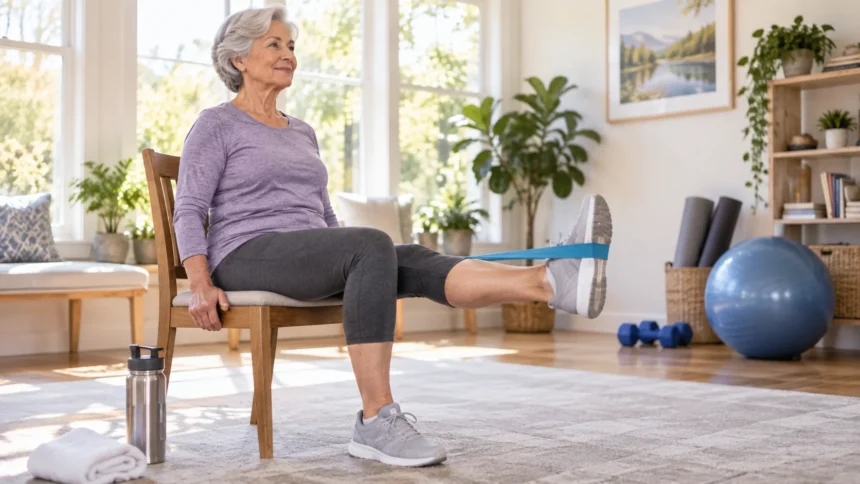
Seated knee extensions are useful for seniors who need an exercise that can be performed safely while sitting. Sit upright in a stable chair with both feet resting on the floor. Slowly straighten one knee until the lower leg extends comfortably in front of you, while keeping the thigh supported by the chair.
Hold the extended position briefly and gently tighten the muscles at the front of your thigh. Lower the foot back toward the floor with control before repeating the movement with the other leg. Avoid kicking quickly or forcing the knee completely straight if doing so causes discomfort or pressure around the joint.
Performing eight to 12 repetitions on each side can be a reasonable starting point for many older adults. When bodyweight knee extensions become easy, resistance may eventually be added under suitable guidance. Even without additional weight, slow and controlled repetitions can provide valuable muscle activity for the quadriceps and support everyday movements such as standing and climbing stairs.
Heel Raises for Stronger Calves and Ankles
Heel raises strengthen the calf muscles while also encouraging ankle control and stability. Stand behind a sturdy chair or beside a counter and lightly hold the surface for support. Keep your feet approximately hip-width apart, then slowly lift both heels until you are standing comfortably on the balls of your feet.
Pause at the top before lowering your heels back to the floor in a controlled manner. Try to keep your body upright instead of leaning heavily onto the chair or counter. The movement does not need to be large to be effective, especially when you perform each repetition slowly and maintain good posture.
Start with eight to 12 repetitions and gradually increase the number as your calves become stronger. Heel raises may help make activities such as walking and climbing steps feel easier because the calf muscles contribute to pushing the body forward. Seniors with balance concerns should continue using a stable support rather than attempting unsupported heel raises too soon.
Standing Hip Abductions for Better Hip Strength
Hip muscles play an important role in keeping the pelvis stable while walking and standing on one leg. Standing hip abductions can strengthen the muscles along the outside of the hips without requiring special exercise equipment. Stand behind a chair, hold it lightly, and keep your body tall with both feet pointing forward.
Slowly move one leg out to the side while keeping the knee relatively straight. Avoid leaning your upper body in the opposite direction, because excessive leaning reduces the work being done by the target muscles. Bring the leg back toward the starting position slowly, then repeat before switching to the opposite side.
Many seniors can begin with eight to 10 repetitions on each leg and gradually progress toward 12 to 15. Keep the movement relatively small rather than trying to lift the leg as high as possible. Controlled hip strengthening exercises can support walking stability, side-to-side movement, and everyday tasks that require shifting your body weight.
Mini Squats for Functional Lower-Body Strength
Mini squats strengthen several important lower-body muscles at the same time, including the quadriceps, glutes, and muscles around the hips. Stand behind a sturdy chair or counter with your feet comfortably apart. Push your hips slightly backward while gently bending your knees, as though you were beginning to sit down.
Only lower yourself as far as feels comfortable and controlled. Your knees should generally follow the direction of your toes rather than collapsing inward, while your heels remain in contact with the floor. Push through your feet and straighten your legs to return to the starting position without locking your knees aggressively.
Start with a shallow range of motion and approximately five to eight repetitions. As leg strength and confidence improve, you may gradually lower slightly farther or perform additional repetitions. Seniors do not need deep squats to benefit because even small, controlled squatting movements can help develop the strength required for sitting, standing, and bending during daily activities.
Step-Ups for Stairs and Everyday Mobility
Step-ups are particularly useful for strengthening the legs in a way that resembles climbing stairs. Use a low, secure step and position yourself near a railing, counter, or other stable support. Place one foot completely on the step, press through that foot, and carefully lift your body upward before returning to the starting position.
Keep the movement slow and avoid pushing excessively from the foot that remains on the ground. The leg placed on the step should perform most of the work whenever possible. Begin with a very low step because increasing the height too quickly can make the exercise unnecessarily difficult for the knees, hips, and balance system.
Try approximately five to eight repetitions on each side before gradually increasing the amount. Step-ups can strengthen the thighs, hips, and glutes while improving confidence with stair-like movements. Seniors who find normal step-ups difficult can begin with controlled toe taps onto a low step until sufficient balance and leg strength have developed.
Marching in Place for Strength and Balance
Marching in place combines gentle strengthening with balance and coordination practice. Stand near a countertop or behind a sturdy chair so support is immediately available if needed. Slowly raise one knee toward a comfortable height, return the foot to the floor, and then repeat the movement with the opposite leg.
Keep your upper body tall and avoid rushing between repetitions. Controlled marching activates the hip flexors and other lower-body muscles while requiring the body to briefly support more weight on one leg. Seniors with limited balance can keep both hands on a stable surface until the movement feels comfortable and predictable.
Begin with approximately 20 to 30 seconds of slow marching and rest when necessary. Over time, you may gradually increase the duration or rely less heavily on your hands for support when it is safe. The objective is controlled movement rather than speed, because fast marching may increase instability without providing additional benefit for beginners.
How Often Should Seniors Strengthen Their Legs?
Many older adults can benefit from performing strengthening activities several times during the week while allowing enough recovery between harder sessions. Beginners might start with two days of lower-body strengthening rather than exercising intensely every day. Muscles need time to recover and adapt, particularly when the exercises are new.
A simple routine might include sit-to-stands, knee extensions, heel raises, hip abductions, and one additional movement suited to your ability. Performing one controlled set of each exercise may initially be enough. Once the routine becomes comfortable, additional repetitions or another set can gradually increase the challenge without suddenly placing excessive stress on the body.
Progress should happen gradually rather than by changing everything at once. You could increase repetitions, improve control, use a slightly greater range of motion, or add appropriate resistance when ready. Staying consistent with manageable exercise is generally more useful than completing an extremely demanding workout and then avoiding exercise because of excessive soreness.
Common Leg Exercise Mistakes Seniors Should Avoid
One common mistake is performing exercises too quickly. Fast repetitions often reduce muscle control and may make it easier to lose balance or use momentum instead of the intended muscles. Slowing down both the lifting and lowering phases allows you to focus on posture, coordination, and how your legs respond to each movement.
Another mistake is progressing before basic movements feel comfortable. Adding heavy resistance, using high steps, performing deep squats, or exercising without support may increase difficulty faster than your strength and balance can adapt. Mastering an easier version first creates a safer foundation for gradually making the exercise more challenging.
Ignoring fatigue can also affect exercise quality. When muscles become very tired, posture and balance may deteriorate, making movements less controlled. Short breaks between exercises are completely acceptable, particularly for beginners, and stopping a session before your form breaks down can be more productive than forcing yourself to complete a specific number of repetitions.
When Leg or Hip Pain Means You Should Stop
Some mild muscle effort or temporary soreness can occur when beginning new leg strengthening exercises, but sharp, sudden, or increasing pain should not be ignored. Stop the movement if you experience significant pain, unexpected weakness, dizziness, chest discomfort, or unusual shortness of breath. Persistent symptoms should be discussed with an appropriate healthcare professional before continuing the exercise.
Pay attention to where discomfort occurs because pain around the hips, buttocks, knees, or lower back can sometimes affect how you walk and exercise. For example, persistent pain limited to one side of the buttocks may have several possible causes. Learning about common causes of left butt cheek pain can help you understand when simple discomfort may deserve closer attention.
Exercise should also be modified if discomfort repeatedly appears during one particular movement. Reducing the range of motion, using more support, or temporarily choosing another exercise may help, depending on the cause. Seniors with ongoing joint pain, recent injuries, unexplained swelling, numbness, or worsening symptoms should get individualized guidance rather than trying to exercise through persistent pain.
How to Progress Leg Strengthening Exercises Safely
Progress does not always mean adding heavy weights. Seniors can make an exercise more challenging by performing a few additional repetitions, moving more slowly, improving balance, or slightly increasing the comfortable range of motion. Changing only one factor at a time makes it easier to understand how your body responds to the increased workload.
For example, someone performing eight sit-to-stands may gradually progress to 10 before attempting a more difficult version. A person using both hands for standing hip exercises might eventually use lighter hand support once stability improves. These small changes can provide continued challenges while reducing the risk of making the routine unnecessarily difficult.
Keeping track of your exercises can make gradual progress easier to notice. Record the movements performed, repetitions completed, and how difficult the session felt. Over several weeks, everyday improvements such as getting out of a chair more easily or feeling steadier while walking may be more meaningful signs of progress than simply lifting heavier resistance.
Conclusion
Leg strengthening exercises for seniors can support mobility, balance, independence, and confidence during everyday activities. Simple movements such as sit-to-stands, knee extensions, heel raises, mini squats, step-ups, and standing hip exercises can work important lower-body muscles without requiring complicated equipment. The key is performing each movement slowly and with good control.
Seniors who are new to exercise should begin with manageable repetitions and use stable support whenever balance is uncertain. Strength gradually develops through regular practice rather than pushing the body through excessive fatigue or discomfort. Making small improvements over several weeks can eventually make walking, standing, climbing stairs, and other everyday movements feel easier.
Most importantly, choose exercises that match your current mobility and physical condition. Pay attention to pain, fatigue, and balance while increasing the challenge gradually as your abilities improve. A safe, consistent routine that you can maintain is more valuable than an intense program that is difficult to continue.
FAQs
What are the best leg strengthening exercises for seniors?
Sit-to-stands, seated knee extensions, heel raises, mini squats, step-ups, and standing hip abductions are practical choices. The best exercises depend on individual mobility, strength, balance, and health conditions.
How often should seniors do leg strengthening exercises?
Many seniors can begin with lower-body strengthening around two days per week and gradually adjust their routine. Rest between harder sessions gives muscles time to recover, especially when starting a new program.
Can an 80-year-old build stronger legs?
Yes, older adults can often improve muscle strength with appropriately selected resistance exercises and consistent practice. Exercises should match the person’s current abilities, and medical guidance may be appropriate when significant health or mobility concerns are present.
Are squats safe for seniors?
Modified or mini squats can be appropriate for many seniors when performed with good technique and stable support. The depth should remain comfortable, and anyone experiencing persistent knee, hip, or back pain should seek individualized guidance.
How long does it take to strengthen weak legs?
The timeline varies depending on age, current strength, activity level, health, and consistency. Rather than expecting an immediate change, focus on gradual improvements in repetitions, movement control, walking ability, balance, and everyday mobility.