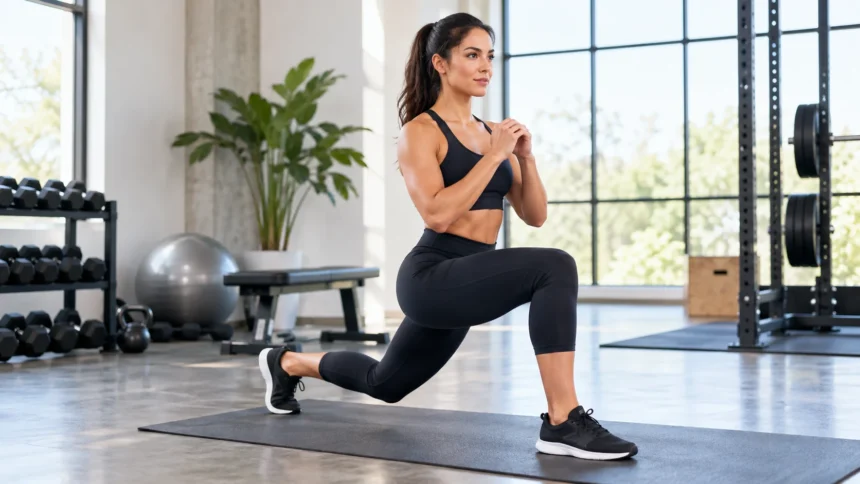
Lunges are one of the most useful lower-body exercises because they strengthen several major muscle groups while also challenging balance, coordination, and core stability. They can be performed almost anywhere and require no equipment, making them suitable for beginners, home workouts, gym routines, and athletic training programs.
Unlike exercises where both legs work together equally, lunges place more demand on one side of the body at a time. This makes them valuable for identifying strength differences between your legs and improving functional movements such as walking, climbing stairs, running, and standing up. Learning proper lunge technique helps you gain these benefits while reducing unnecessary strain.
What Is a Lunge Exercise?
A lunge is a lower-body exercise in which you step or position one leg away from the other and lower your body by bending both knees. The front leg generally carries much of the working load while the back leg helps with balance and stability. Lunges can be performed with body weight or additional resistance.
The basic movement resembles a long walking step followed by a controlled lowering motion. Your hips move downward while your torso stays relatively upright, and both knees bend naturally. Because each side works individually, lunges are classified as a unilateral exercise, meaning they train one side of the body more independently than movements such as traditional squats.
Lunges can be adapted to suit different fitness levels and training goals. Beginners may start with stationary or supported lunges, while experienced exercisers can use walking lunges, reverse lunges, lateral lunges, or weighted variations. The basic movement pattern remains similar, but each variation changes how your muscles and balance are challenged.
How Does a Lunge Exercise Work?
During a lunge, several joints move together to lower and raise your body. Your hips and knees bend as you descend, while your ankle adjusts to help you maintain balance and keep your foot stable. When you push back upward, the muscles surrounding these joints generate force to return your body to the starting position.
The front leg usually performs most of the work in a standard forward or stationary lunge. Your quadriceps help straighten the knee, while your glutes extend the hip as you rise. Your hamstrings, calves, abdominal muscles, and smaller stabilizing muscles also contribute by controlling movement and keeping your body aligned.
Because your feet are positioned separately, your body must continually correct small shifts in balance. This makes lunges different from many machine exercises where your movement path is supported. Your muscles must produce strength while also controlling your hips, knees, ankles, and torso, making the exercise useful for functional movement and coordination.
What Muscles Do Lunges Work?
The quadriceps at the front of your thighs are heavily involved during lunges. They help control your descent and straighten the front knee as you return to standing. You may feel considerable quadriceps effort when taking shorter steps or when performing repeated lunges without allowing much rest between repetitions.
Your gluteal muscles are another major muscle group trained by lunges. They help extend your hip and stabilize your pelvis during each repetition. Taking an appropriately sized step and driving through the front foot can increase glute involvement, which is one reason lunges frequently appear in lower-body strength and glute-focused workout routines.
Lunges also involve the hamstrings, calves, hip muscles, and core. These muscles may not always create the most noticeable burning sensation, but they play important supporting roles. Your abdominal and back muscles help maintain posture, while muscles around your ankles and hips constantly make small adjustments to keep your body balanced throughout the movement.
How to Do a Basic Lunge Correctly
Begin by standing tall with your feet approximately hip-width apart and your core gently engaged. Step one foot forward far enough that you can lower your body comfortably without losing balance. Keep your chest lifted and shoulders relaxed while allowing both knees to bend as your hips move downward toward the floor.
Lower yourself until your front thigh approaches a comfortable position near parallel with the floor, depending on your mobility and experience. Keep the front knee generally tracking in the same direction as your toes rather than collapsing inward. Your back knee should move toward the floor without needing to touch it during every repetition.
Push through your front foot to rise back to the starting position while maintaining control. Avoid bouncing out of the bottom position or using momentum to complete the movement. Perform several repetitions on one side before switching legs, or alternate legs each repetition depending on the lunge variation and structure of your workout.
What Are the Main Benefits of Lunges?
One of the biggest benefits of lunges is improved lower-body strength. The exercise trains the quadriceps, glutes, hamstrings, and supporting muscles through a practical movement pattern. Stronger legs can make everyday tasks such as climbing stairs, carrying groceries, walking uphill, and getting up from a low chair feel easier.
Lunges can also help improve muscular balance between your left and right sides. During exercises where both legs work simultaneously, the stronger side may sometimes compensate for the weaker side. Lunges make each leg contribute more independently, making strength differences easier to notice and giving both sides an opportunity to develop.
Another benefit is their flexibility within a workout program. Lunges can be used for strength training, muscular endurance, mobility-focused sessions, sports conditioning, or general fitness. You can adjust the difficulty by changing the variation, range of motion, repetition count, movement speed, or resistance without needing complex gym equipment.
How Lunges Improve Balance and Core Stability
Balance becomes an important part of the exercise as soon as your feet move into a split stance. Your body must remain controlled while your center of gravity shifts during the lowering and rising phases. Regular practice can improve your ability to maintain stable positioning while your lower body performs a demanding movement.
Your core helps prevent your torso from leaning excessively or rotating as you move. Although lunges are mainly considered a leg exercise, your abdominal and back muscles remain active throughout each repetition. A stable torso creates a stronger foundation for your hips and legs to produce force efficiently and maintain good alignment.
Balance demands become even greater with variations such as walking lunges, reverse lunges, and lunges with weights. Beginners who feel unstable can hold a wall, chair, or sturdy support while learning the movement. Stability usually improves gradually as your muscles become stronger and your nervous system becomes more familiar with the exercise pattern.
Different Types of Lunges to Try
Forward lunges are probably the most familiar variation. You step forward, lower into the lunge, and push back to the starting position. They challenge the quadriceps, glutes, coordination, and balance, but some beginners find them more difficult to control because the body moves forward before having to reverse direction.
Reverse lunges involve stepping backward instead of forward. Many people find this variation easier to control because the front foot remains planted throughout the movement. Walking lunges add continuous forward movement, making them especially useful for developing coordination, muscular endurance, and lower-body strength when enough training space is available.
Side lunges, also known as lateral lunges, move the body in a different direction. Instead of stepping forward or backward, you step sideways and shift your hips toward the working leg. This variation trains the inner thighs, glutes, and muscles responsible for side-to-side movement, making it a useful complement to traditional forward-facing exercises.
Common Lunge Mistakes to Avoid
One common mistake is allowing the front knee to collapse inward during the exercise. Ideally, the knee should generally track in the same direction as the foot throughout the movement. Maintaining this alignment requires control from the hips, thighs, and feet, so beginners should prioritize good technique rather than performing repetitions as quickly as possible.
Another mistake is taking a step that is either extremely short or unnecessarily long. A very short stance can make the movement uncomfortable and difficult to control, while an excessively long stance may make balance challenging. Experiment with your stance until you can lower smoothly while keeping both feet stable and maintaining comfortable joint positioning.
Leaning too far forward, rushing repetitions, or pushing through sharp pain can also create problems. Keep your movements deliberate and use a range of motion that feels controlled. Mild muscular effort is expected during exercise, but sharp knee, hip, ankle, or back pain should not be treated as something you need to ignore.
How Beginners Can Make Lunges Easier
Beginners can start with stationary lunges, sometimes called split squats, before adding a stepping movement. Position your feet in a comfortable split stance and move your body straight down and up without changing foot position. Removing the stepping component reduces the balance challenge and allows you to concentrate more closely on knee and hip alignment.
Holding onto a chair, wall, railing, or other stable surface is another useful modification. Support does not remove the benefits of the exercise because your legs still perform much of the movement. It simply reduces the balance demand so you can build confidence, coordination, and lower-body strength before attempting unsupported repetitions.
You can also shorten the range of motion initially. Lower only as far as you can while maintaining comfortable control, then gradually increase depth as strength and mobility improve. There is no need to force the back knee close to the floor immediately, particularly if you are new to exercise or returning after a long period of inactivity.
How to Add Weights to Lunges Safely
Once bodyweight lunges feel manageable, resistance can make the exercise more challenging. Dumbbells held beside your body are a common option because they increase the load without dramatically changing the movement pattern. Start with relatively light resistance so you can maintain your balance and technique before gradually increasing the weight.
You can also use kettlebells, barbells, or other resistance depending on your training experience. However, heavier variations place greater demands on your grip, core, legs, and overall stability. If holding dumbbells aggravates finger joint pain, bodyweight lunges or another loading method may feel more comfortable while you address the hand discomfort.
Do not increase resistance simply because you can complete a certain number of repetitions. First make sure your knee alignment, balance, posture, and movement control remain consistent throughout the set. Gradual progression usually provides better long-term results than choosing a heavy weight that forces you to shorten the movement or compensate with poor technique.
How Many Lunges Should You Do?
The right number of lunges depends on your experience, goals, and overall training program. Beginners might start with around 6 to 10 controlled repetitions per leg for one or two sets. The priority should be learning consistent technique rather than attempting a large number of repetitions simply to create muscle soreness.
People training for general strength may perform moderate repetition ranges with additional resistance, while muscular endurance workouts may use more repetitions with lighter loads. You do not need to perform lunges every day to gain benefits. Giving trained muscles adequate recovery time allows them to adapt and prepares you for your next workout.
Lunges can be included alongside exercises such as squats, hip hinges, step-ups, calf raises, and glute bridges to create a balanced lower-body routine. Your total workload should match your fitness level and recovery ability. Increase repetitions, sets, resistance, or exercise difficulty gradually rather than changing every training variable at the same time.
Are Lunges Safe for Everyone?
Lunges are appropriate for many people when they are performed with suitable technique and an appropriate level of difficulty. However, individual mobility, previous injuries, balance ability, and joint health can influence which variation feels comfortable. Someone who struggles with standard forward lunges may find supported stationary or reverse lunges easier to control.
People sometimes assume that the front knee must never move forward during a lunge, but movement needs vary with body proportions, mobility, and technique. More important considerations include keeping the foot stable, controlling the movement, and avoiding painful positions. A comfortable lunge should feel challenging in the muscles without producing sharp or worsening joint pain.
If you have an existing knee, hip, ankle, or back injury, consider speaking with a qualified healthcare or rehabilitation professional before adding demanding lunges to your routine. Stop the exercise if you experience sudden pain, significant swelling, instability, or unusual symptoms. Modifying the movement is generally better than forcing your body through a position that does not feel right.
Conclusion
Lunges are a versatile lower-body exercise that strengthens the quadriceps, glutes, hamstrings, calves, and supporting muscles while also challenging balance and core stability. Because each leg works more independently, lunges can help improve coordination and reveal strength differences between the left and right sides.
Beginners can start with supported or stationary lunges and gradually progress to forward, reverse, walking, lateral, or weighted variations. Good technique matters more than depth, speed, or the amount of resistance used. Keeping your movements controlled and increasing difficulty gradually can help you build strength without making the exercise unnecessarily complicated.
Whether you exercise at home or in a gym, lunges can fit easily into a balanced lower-body workout. Choose a variation that suits your current strength, mobility, and balance level, then progress as your control improves. Consistent, well-performed repetitions usually provide greater benefit than rushing through difficult variations before your body is ready.
FAQs
Are lunges good for beginners?
Yes. Beginners can start with stationary or supported lunges before progressing to stepping variations. Using a wall or chair for balance can make learning proper technique easier.
Do lunges build glutes?
Yes. Lunges activate the glute muscles along with the quadriceps and hamstrings. Proper depth, controlled movement, and gradually increasing resistance can make them particularly effective for lower-body strength.
Are lunges better than squats?
Neither exercise is universally better. Squats train both legs together, while lunges challenge each leg more independently and require additional balance, so combining both can create a well-rounded routine.
Can I do lunges every day?
You could perform light lunges frequently, but harder strength workouts generally require recovery between sessions. Training frequency should depend on exercise intensity, total workload, fitness level, and muscle soreness.
Why do my knees hurt when doing lunges?
Knee pain may result from technique, excessive training load, limited mobility, or an existing joint problem. Reduce the difficulty and stop if pain is sharp, persistent, or worsening.