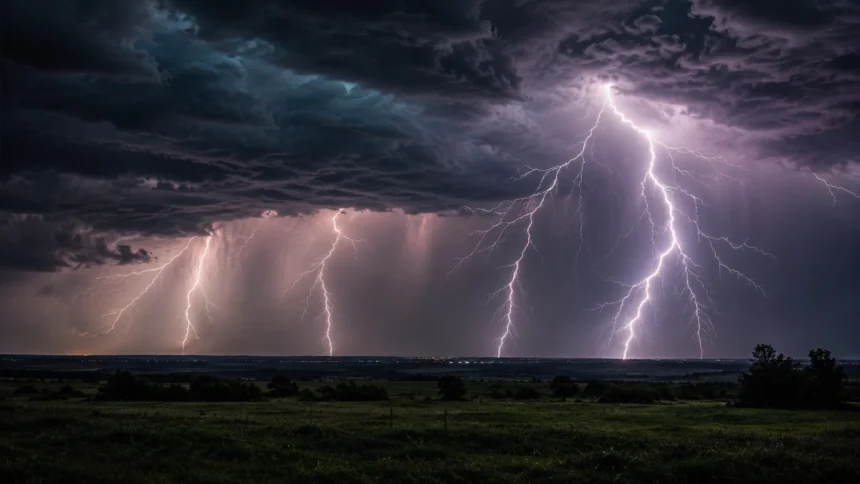
Why Does Lightning Strike?
Lightning is one of nature’s most dramatic displays. A dark thunderstorm can suddenly produce a brilliant flash that travels through the sky or strikes the ground in a fraction of a second. Although lightning may appear random, it develops through a complex electrical process involving storm clouds, water droplets, ice particles, air, and differences in electrical charge.
So, why does lightning strike in the first place? Lightning occurs when an electrical imbalance inside a thunderstorm becomes strong enough to overcome the insulating properties of the surrounding air. Electricity then rapidly moves between charged regions, producing the bright flash we recognize as lightning and heating the surrounding air to extremely high temperatures.
Lightning does not always travel from a cloud to the ground. Electrical discharges can happen within one cloud, between different clouds, or between a cloud and Earth’s surface. In fact, much of the lightning produced by thunderstorms stays within the clouds, although cloud-to-ground lightning is usually the type people notice and worry about most.
Understanding how lightning forms, what causes electrical charges inside thunderstorms, and why certain locations are more likely to be struck can make storms feel less mysterious. It also helps people recognize lightning hazards and make safer decisions whenever thunderclouds begin developing nearby.
What Causes Lightning to Form Inside a Thunderstorm?
Lightning begins inside powerful storm clouds known as cumulonimbus clouds. These towering clouds contain intense upward and downward air currents that move water droplets, ice crystals, and partially frozen particles through different parts of the cloud. As these particles collide, electrical charges gradually become separated throughout the developing thunderstorm.
Scientists are still studying every detail of thunderstorm electrification, but collisions between different types of ice particles play an important role. Smaller ice crystals are often carried toward the upper regions of a storm, while heavier particles called graupel tend to remain lower. During collisions, electrons may transfer between particles, helping different parts of the cloud develop opposite electrical charges.
The upper portion of a thunderstorm usually becomes positively charged, while a large region near the lower part commonly develops a negative charge. Smaller pockets of positive charge may also appear elsewhere inside the storm. This separation creates an increasingly powerful electric field between different parts of the cloud and between the cloud and the ground below.
Air normally acts as an electrical insulator, meaning electricity cannot easily pass through it. However, when the difference in charge becomes strong enough, the electric field begins breaking down the air’s insulating ability. A conductive pathway develops, allowing electricity to move rapidly and creating the electrical discharge that we see as a lightning flash.
Why Does Lightning Strike the Ground?
When a thunderstorm develops a strong negative charge near its base, that charge influences the electrical conditions on the surface below. Electrons near the ground are pushed away from the area beneath the storm, leaving buildings, trees, hills, people, and other elevated objects with a relatively positive electrical charge.
The electrical difference between the storm cloud and the ground can become enormous. When the electric field becomes powerful enough, a faint channel of negatively charged air called a stepped leader begins moving downward from the cloud. Instead of traveling in one smooth line, it advances toward the ground through a series of branching steps.
At the same time, positively charged electrical channels called streamers may rise from trees, buildings, towers, or other objects on the ground. When one of these upward streamers connects with the descending leader, a continuous electrical pathway is established between the cloud and Earth’s surface.
A powerful electrical current then moves through this pathway, producing the intensely bright flash called the return stroke. This is the part of cloud-to-ground lightning that is most visible to the human eye. Several electrical pulses may travel along the same channel, which explains why some lightning bolts appear to flicker repeatedly.
Why Does Lightning Strike Tall Objects More Often?
Tall objects can increase the likelihood of a lightning connection because they reduce the distance between the ground and the electrically charged region of the storm. Towers, tall buildings, isolated trees, mountain peaks, antennas, and similar elevated structures can therefore become favorable locations for upward streamers to develop.
Height is not the only factor determining where lightning strikes. The shape of an object, its surroundings, local terrain, electrical field strength, and location beneath the thunderstorm can all influence lightning behavior. A shorter object in the right electrical environment may sometimes be struck instead of a taller structure nearby.
Pointed or elevated structures can strengthen the electric field around them, increasing the possibility that an upward streamer will form. However, the familiar saying that lightning simply chooses the tallest object is an oversimplification. Lightning follows a complicated electrical pathway influenced by conditions in both the atmosphere and the surrounding landscape.
This is also why standing beneath an isolated tall tree during a thunderstorm is dangerous. The tree may provide a possible pathway for the electrical discharge, and lightning current can move through the tree, jump toward nearby objects, or travel through the ground after the strike. Seeking shelter inside a substantial building is considerably safer.
Does Metal Attract Lightning?
One of the most common lightning myths is that metal automatically attracts lightning. Metal does not pull lightning toward itself from large distances. Instead, factors such as height, shape, location, and the strength of the surrounding electric field generally have a greater influence on where a lightning strike connects with the ground.
However, metal is an excellent conductor of electricity. If lightning strikes a metal object or another structure connected to metal, the electrical current can travel through it very efficiently. This is why touching metal fences, pipes, wiring, railings, or other conductive objects during a thunderstorm can create unnecessary risk.
Cars are often misunderstood for the same reason. A vehicle can provide protection during a lightning strike, but not primarily because its rubber tires prevent electricity from reaching the ground. A fully enclosed metal vehicle can direct much of the electrical current around its exterior, helping protect the occupants inside.
People inside a vehicle during a thunderstorm should avoid touching metal components connected to the exterior whenever possible. Convertibles, motorcycles, bicycles, golf carts, and open vehicles do not provide the same protection. When lightning is nearby, a substantial enclosed building remains one of the safest places to shelter.
Why Is Lightning So Bright and Powerful?
A lightning channel carries an enormous electrical current through a pathway that may be only a few centimeters wide. As electricity moves through the air, it heats the surrounding gases extremely rapidly. The temperature inside a lightning channel can briefly become several times hotter than the surface of the Sun.
This extreme heat causes the surrounding air to expand almost explosively. The rapid expansion creates a pressure wave that travels outward through the atmosphere. As the wave reaches our ears, we hear it as thunder, which is why every lightning flash naturally produces thunder even when it is too far away to be heard.
Lightning appears almost instantly because light travels far faster than sound. Thunder travels through air much more slowly, so people usually see the lightning flash before hearing its thunder. The farther away a lightning strike occurs, the longer the delay between the visible flash and the sound reaching an observer.
The tremendous energy involved also explains why lightning strikes can damage buildings, start fires, split trees, disrupt electrical systems, and injure people. Although the visible flash lasts only a brief moment, the electricity, heat, and rapidly expanding air associated with lightning can produce significant effects.
What Are the Different Types of Lightning?
Cloud-to-ground lightning is probably the best-known form because it reaches Earth’s surface and can affect people, buildings, trees, and electrical infrastructure. It usually develops when an electrical pathway forms between a charged region inside a thunderstorm and an oppositely charged area on the ground.
Intracloud lightning occurs within a single thunderstorm cloud. Electrical discharges travel between areas containing different charges without reaching the ground. This type of lightning is extremely common and can illuminate large sections of a thundercloud, sometimes creating the widespread flashes people informally describe as sheet lightning.
Cloud-to-cloud lightning moves between electrically charged regions in separate clouds. Lightning may also occur between a cloud and the surrounding air when electrical differences become strong enough. These discharges demonstrate that lightning is fundamentally about balancing electrical charges rather than simply transferring electricity to the ground.
There are also unusual lightning events, including upward lightning that can develop from very tall towers or structures. Scientists additionally study high-altitude electrical events above thunderstorms, including sprites and related phenomena. These discoveries continue expanding our understanding of how thunderstorm electricity interacts with different layers of the atmosphere.
Why Does Lightning Sometimes Strike the Same Place Twice?
The familiar phrase suggesting that lightning never strikes the same place twice is false. Lightning can repeatedly strike the same structure, especially when that structure is tall, exposed, and positioned where electrical conditions regularly favor lightning development.
Skyscrapers, communication towers, wind turbines, mountain peaks, and other elevated objects may experience numerous strikes over time. Their height and exposure can make it easier for electrical connections to develop between the structure and electrically charged regions of thunderstorms moving overhead.
Even during a single lightning event, several electrical pulses may pass through the same channel. This repeated current creates the flickering appearance often seen in lightning bolts. What appears to the eye as one strike may therefore contain multiple rapid electrical discharges along nearly the same pathway.
This repeated behavior is important for lightning protection systems. Engineers do not assume that a building is safe simply because it has already experienced a strike. Proper lightning protection is designed to provide a controlled pathway for electrical current whenever future strikes occur.
What Determines Where Lightning Will Strike?
Predicting the exact point where an individual lightning bolt will strike is extremely difficult. Lightning develops through rapidly changing electrical conditions inside thunderstorms, and the final connection between a descending leader and an upward streamer may depend on very localized atmospheric and surface conditions.
Elevation plays an important role because tall objects extend farther into the storm’s electric field. However, local terrain also matters. A building positioned on a hill, for example, may have greater exposure than a similar building located in a lower surrounding area.
Object shape and nearby surroundings can also influence lightning attachment. Sharp points, towers, trees, rooftops, antennas, and other elevated features can affect local electric fields. Yet lightning pathways branch unpredictably, meaning there is no simple rule that identifies exactly which nearby object will receive a strike.
Because precise strike locations cannot reliably be predicted in advance, lightning safety focuses on recognizing dangerous storm conditions rather than guessing where the next bolt will land. If thunder can be heard, lightning is close enough to represent a potential hazard, even when rainfall has not yet reached your location.
Can Lightning Strike When the Sky Looks Clear?
Lightning can sometimes travel significant distances away from the main rainfall area of a thunderstorm. These strikes are sometimes informally called bolts from the blue because they may emerge from the side of a storm and reach areas where people can still see patches of blue sky overhead.
This behavior can create a dangerous sense of security. Someone may assume the storm is too far away because rain has stopped or because the sky directly overhead appears relatively clear. However, electrically active thunderstorms can still produce lightning beyond their most obvious dark clouds and heavy rainfall.
The same risk can occur before a storm fully arrives. Lightning may develop while people are still experiencing relatively calm conditions at ground level. For this reason, waiting for heavy rain before seeking shelter can leave people exposed during a period when lightning is already present.
Thunder provides a useful warning because it indicates that lightning has occurred nearby enough for the sound to reach you. When thunder is audible, moving indoors rather than remaining on beaches, sports fields, rooftops, lakes, or other open areas is the safer decision.
Why Are Some Places More Likely to Have Lightning?
Lightning frequency varies considerably from one region to another because thunderstorms require particular atmospheric ingredients. Warm air, moisture, instability, and rising air currents all support thunderstorm development. Regions where these ingredients frequently occur naturally experience more lightning than areas with cooler or more stable weather.
Tropical and subtropical regions can experience frequent thunderstorms because warm temperatures and abundant moisture encourage strong convection. Mountainous areas may also experience lightning because terrain forces moist air upward, helping clouds grow vertically until conditions become favorable for thunderstorms.
Seasonal weather patterns also influence lightning activity. Some locations experience most thunderstorms during warmer months, while tropical climates may have active thunderstorm seasons linked to rainfall patterns, monsoons, sea breezes, or other regional weather systems.
Modern weather satellites, ground-based lightning detection networks, radar, and atmospheric sensors allow meteorologists to monitor lightning activity with increasing detail. These technologies help scientists understand when and where thunderstorms are becoming electrically active and improve severe-weather awareness for communities.
What Happens When Lightning Strikes a Tree or Building?
When lightning strikes a tree, electrical current may travel through the trunk toward the ground. The intense heat can rapidly vaporize moisture inside the tree, creating internal pressure that may strip bark, split branches, or in severe cases cause part of the tree to break apart.
Buildings can also experience damage when lightning current travels through electrical wiring, plumbing, antennas, communication lines, or structural materials. Electrical surges caused by lightning can damage appliances and electronic equipment even when the main lightning channel does not directly strike a device.
Lightning protection systems are designed to reduce structural damage by providing electricity with a controlled route toward the ground. A complete system can include air terminals, conductive cables, grounding components, bonding, and surge protection designed according to appropriate engineering standards.
A lightning rod does not simply stop thunderstorms from producing lightning. Instead, when properly incorporated into a protection system, it helps provide a preferred conductive pathway so electrical current can travel toward the ground while reducing the chance of dangerous current passing through vulnerable building materials.
How Can You Stay Safe During Lightning?
The safest response to an approaching thunderstorm is to move into a substantial enclosed building. Homes, offices, stores, schools, and similar structures generally provide much better protection than outdoor shelters, porches, tents, gazebos, sheds, or isolated covered structures.
If no suitable building is available, a fully enclosed hard-topped vehicle can offer protection. Stay inside with the windows closed and avoid touching conductive parts connected to the vehicle’s exterior. Motorcycles, bicycles, open carts, and convertibles should not be considered safe lightning shelters.
Avoid open fields, hilltops, beaches, swimming pools, lakes, isolated trees, tall poles, and metal fences when thunderstorms are nearby. Water and conductive materials can carry lightning current, while exposed locations may increase the possibility of becoming part of an electrical pathway.
Lightning danger does not necessarily disappear as soon as rain stops. Storms may continue producing electrical discharges while moving away. Remaining in a safe location until the thunderstorm has clearly passed provides better protection than immediately returning outdoors when rainfall becomes lighter.
Why Understanding Lightning Matters
Learning why lightning strikes turns a frightening weather event into something that can be understood scientifically. Lightning is essentially the atmosphere’s way of rapidly reducing powerful electrical imbalances that develop inside thunderstorms and between storm clouds and the Earth’s surface.
The process begins with collisions between water and ice particles, continues as electrical charges separate inside a storm, and eventually creates an electric field powerful enough to break through the surrounding air. Once a conductive pathway forms, electrical current moves through it at extraordinary speed.
Although scientists understand the major processes responsible for lightning, thunderstorms remain incredibly complex. Researchers continue using satellites, lightning mapping systems, weather radar, aircraft observations, computer models, and ground sensors to investigate how lightning begins and why particular electrical pathways develop.
For everyday life, the most useful lesson is simple: lightning does not need to strike directly overhead to be dangerous. Understanding thunderstorm electricity, lightning safety, and changing weather conditions can help people respect the power of storms while making smarter choices when thunder begins to rumble.
Frequently Asked Questions About Lightning
What attracts lightning to a person?
Lightning is not specifically attracted to people. Height, location, surrounding objects, terrain, and electrical conditions influence where a strike connects. Being exposed in an open area or near tall isolated objects can increase danger.
Can lightning strike through a window?
Lightning is unlikely to simply pass through closed glass, but dangerous current can travel through electrical wiring, plumbing, metal frames, and conductive systems. Staying away from windows and connected electrical equipment during severe thunderstorms is sensible.
Can lightning strike without rain?
Yes. Lightning can occur outside the main rainfall area of a thunderstorm and may travel several miles from the storm. This is why people should seek shelter whenever thunder can be heard, even if their location is dry.
Why does thunder happen after lightning?
Lightning rapidly heats the surrounding air, causing it to expand and create a pressure wave that becomes thunder. Light travels much faster than sound, so the lightning flash reaches your eyes before the thunder reaches your ears.
Does lightning always hit the tallest object?
No. Tall objects are often more likely to be struck because of their elevation, but height is only one factor. Lightning attachment also depends on electrical fields, terrain, object shape, storm location, and surrounding conditions.