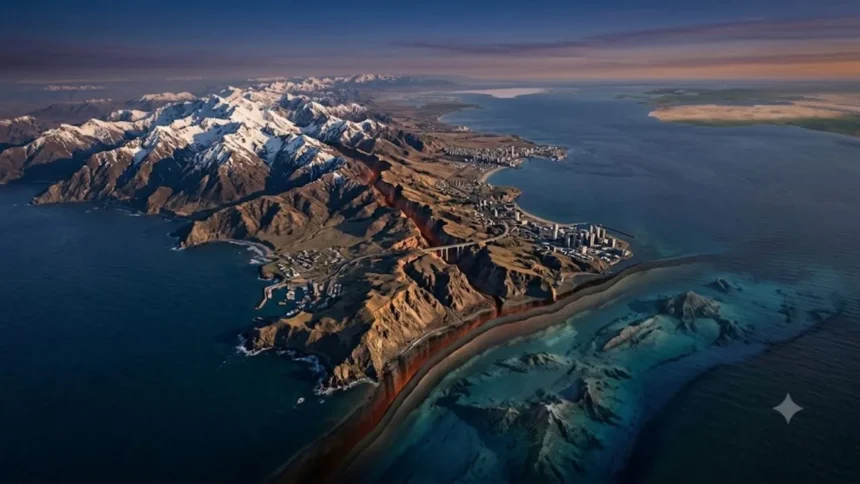
Earthquakes occur in every part of the world, but they are not distributed evenly. Countries such as Japan, Indonesia, Chile, Mexico, New Zealand and the Philippines experience frequent seismic activity, while nations located far from active plate boundaries may feel strong earthquakes much less often. The difference is mainly explained by geology rather than climate, population or a country’s physical size.
The outer part of Earth is divided into enormous slabs of rock called tectonic plates. These plates move slowly, interact with neighboring plates and create stress within the crust. Earthquakes become especially common where plates collide, pull apart or slide alongside one another, which is why global earthquake maps show clear belts of concentrated activity.
A country may also contain several active faults, sit above a subduction zone or lie near a complex meeting point between multiple plates. These conditions increase the number of earthquakes that can occur. They may also allow very large earthquakes to develop when a long, locked section of a fault suddenly releases accumulated strain.
However, experiencing more earthquakes does not automatically mean suffering more deaths or destruction. The effects also depend on earthquake depth, distance from cities, soil conditions, building quality and emergency preparedness. Understanding the difference between earthquake frequency, seismic hazard and disaster risk provides a clearer picture of why some countries are affected more severely than others.
Earth’s Moving Plates Create Earthquake Zones
Earth’s solid outer shell, known as the lithosphere, is broken into tectonic plates. These include large plates such as the Pacific, North American, Eurasian, African and Antarctic plates, along with several smaller ones. The plates move only a few centimeters in many years, but their enormous size means that even gradual movement can generate tremendous geological stress.
The edges of tectonic plates are known as plate boundaries. Some boundaries remain locked by friction even while the plates continue trying to move. As stress accumulates, rocks may bend or deform until the force becomes greater than the fault’s resistance, causing a sudden slip that releases energy through the ground as seismic waves.
Most earthquakes occur on faults near these plate boundaries. This explains why neighboring countries along the same geological belt may all experience regular tremors. Political borders do not influence tectonic activity, so a fault or subduction zone can extend beneath several nations, oceans and coastal regions without following the borders shown on an ordinary map.
Countries situated in the interior of a stable plate generally experience fewer earthquakes than those located along its edges. They are not completely earthquake-free, because stress can reactivate ancient faults and weaknesses within a continent. Nevertheless, the concentration of active faults is usually greater near plate margins, making earthquakes more frequent there.
How Different Plate Boundaries Produce Earthquakes
At a convergent boundary, two tectonic plates move toward one another. One plate may be pushed beneath the other in a process called subduction, or two continental plates may collide and create mountains. These boundaries can produce powerful earthquakes because large fault surfaces may remain locked while stress continues building for decades or centuries.
Subduction zones are responsible for many of the world’s largest earthquakes. When a locked plate boundary ruptures, the fault may move across an enormous area and displace the ocean floor. This movement can generate a tsunami when the earthquake is sufficiently large, shallow and located beneath or close to the sea.
Transform boundaries behave differently because the plates slide horizontally past each other. Their edges may catch rather than move smoothly, allowing strain to accumulate along strike-slip faults. The San Andreas Fault system in California is a widely known example of this type of boundary, where the Pacific and North American plates move relative to one another.
At divergent boundaries, plates move apart and new crust forms as material rises from below. Many of these boundaries lie beneath oceans, including mid-ocean ridges, so their earthquakes may occur far from populated land. They are often shallower and smaller than the greatest subduction-zone earthquakes, although they remain an important part of global seismic activity.
Why the Pacific Ring of Fire Has So Many Earthquakes
The Pacific Ring of Fire is a broad, horseshoe-shaped zone surrounding much of the Pacific Ocean. It contains numerous trenches, volcanic arcs, active faults and subduction zones. According to the USGS, around 81 percent of the planet’s largest earthquakes occur within the circum-Pacific seismic belt, making it the world’s most prominent earthquake zone.
Countries and territories along this belt include Japan, Indonesia, the Philippines, Papua New Guinea, New Zealand, Russia, the United States, Mexico, several Central American nations, Peru and Chile. These places are not connected by politics or climate; they share exposure to the active margins surrounding the Pacific Plate and several neighboring plates.
Japan experiences frequent earthquakes because several tectonic plates interact around the country. Indonesia also lies within a highly complex region where major and smaller plates converge. Along the western coast of South America, the Nazca Plate moves beneath the South American Plate, creating an active subduction zone associated with earthquakes, volcanoes and mountain building.
The Ring of Fire is not a single fault that ruptures all at once. It is a collection of separate plate boundaries and fault systems extending thousands of kilometers. An earthquake in one part does not mean every section is about to rupture, although a major event normally produces many local aftershocks as the surrounding crust adjusts.
Earthquakes Also Occur Beyond the Ring of Fire
The Pacific region receives considerable attention, but it is not the only major seismic belt. Another zone extends from the Mediterranean region through Turkey, Iran, Pakistan and the Himalayan mountain range. This broad belt formed through interactions involving the African, Arabian, Indian and Eurasian plates and includes several densely populated earthquake-prone areas.
The Himalayas developed as the Indian Plate pushed into the Eurasian Plate. Because this continental collision is still active, stress continues to build on faults across the region. Countries such as Nepal, India and Pakistan can therefore experience damaging earthquakes even though they are not part of the Pacific Ring of Fire.
The Mid-Atlantic Ridge is another major plate boundary, but much of it lies beneath the ocean. Iceland is an important exception because it sits directly over this spreading boundary. As a result, Iceland experiences both seismic and volcanic activity, although strong construction practices and a relatively small population can reduce the human impact of many events.
Earthquakes may also happen far from modern plate boundaries. Stress traveling through a plate can reactivate old faults created during earlier geological periods. These intraplate earthquakes are generally less frequent, but they can still be dangerous because communities in supposedly stable regions may have fewer earthquake-resistant structures or lower public awareness.
Why Some Countries Record More Earthquakes Than Others
A country with many active faults is likely to record more earthquakes than one situated on older, stable crust. Japan, for example, has an extensive seismic monitoring network and lies in a complicated tectonic setting. Both the geological conditions and the ability to detect small tremors contribute to the large number of recorded earthquakes.
Monitoring capacity matters when national earthquake totals are compared. Sensitive seismographs can detect tiny events that people never feel, while a limited monitoring network may miss some small or distant earthquakes. A higher reported number can therefore reflect both genuine seismic activity and better detection, rather than a simple difference in how often the ground moves.
The physical size of a country can influence statistics as well. A large nation may contain several geological regions and naturally record more total events than a small one. Comparisons become more meaningful when earthquake frequency is considered alongside land area, population exposure, magnitude and the length of active plate boundaries.
Aftershock sequences can also make one year appear unusually active. Following a large earthquake, the affected fault region may produce hundreds or thousands of smaller earthquakes over weeks, months or longer. These are separate recorded events, although they are connected to the crust’s adjustment after the main rupture.
Frequent Earthquakes Do Not Always Cause Greater Damage
Magnitude measures the overall size of an earthquake, while intensity describes how strongly the shaking is experienced at a particular location. One earthquake has a single calculated magnitude, but its intensity changes from place to place. Communities close to the fault normally feel stronger shaking than those located far from the source.
Earthquake depth is another major factor. A shallow earthquake releases energy closer to the surface and may create intense local shaking. A deeper earthquake can be felt across a much wider region, but the shaking directly above it may be weaker than that produced by a similarly sized shallow event.
Local geology can amplify ground motion. Solid bedrock generally shakes less than loose sediment or soft, water-saturated soil. Valleys, former lakebeds and reclaimed coastal land may therefore experience stronger or longer-lasting shaking than nearby rocky areas, even when both places are approximately the same distance from the earthquake.
Building design can determine whether strong shaking becomes a disaster. A moderate earthquake near vulnerable structures may cause greater losses than a larger earthquake in a sparsely populated area with modern engineering. Seismic building codes, retrofitting and enforcement reduce risk by helping structures absorb movement without suddenly collapsing.
How Population and Infrastructure Affect Earthquake Risk
Seismic hazard refers to the likelihood and expected strength of earthquake-related effects in an area. Earthquake risk goes further by considering the people, buildings, roads, hospitals and other systems exposed to those effects. A highly active fault beneath an uninhabited region creates a hazard, but its immediate human risk may remain comparatively low.
Rapidly growing cities may become vulnerable when construction expands onto unstable slopes, soft sediments or areas close to active faults. Buildings erected without engineering oversight can perform poorly during strong shaking. Damage may be especially serious where older masonry structures, narrow roads and limited emergency access are common.
Earthquakes can also trigger secondary hazards. These include landslides, fires, liquefaction, dam failure and tsunamis. In coastal subduction zones, vertical movement of the seafloor may displace a large volume of water, allowing the earthquake’s impact to reach communities far beyond the area experiencing the strongest ground motion.
A country’s resources and preparedness therefore affect the consequences of earthquakes even though they cannot change the underlying tectonic setting. Strong infrastructure, emergency planning, public education and rapid communication can reduce casualties. The goal is not to prevent plate movement but to prevent predictable ground shaking from becoming an overwhelming human catastrophe.
Can Human Activity Cause Earthquakes?
Most earthquakes are caused naturally by tectonic forces, but some seismic events can be associated with human activity. Mining, reservoir filling, geothermal operations and the injection or withdrawal of underground fluids can alter pressure or stress around existing faults. When conditions are suitable, that change may allow a fault to slip.
Human-induced earthquakes generally occur in specific areas where industrial activity interacts with a fault that is already under stress. The activity does not create an entirely new tectonic plate boundary. Instead, it can change the timing of movement on a pre-existing weakness within the crust.
Not every underground project produces noticeable earthquakes. The outcome depends on local geology, fluid pressure, fault orientation, operating practices and the amount of stress already present. For this reason, seismic monitoring and detailed geological assessment are important around activities known to have the potential to alter subsurface conditions.
Induced seismicity does not explain why entire countries such as Japan, Chile or Indonesia experience frequent earthquakes. Their broader pattern is dominated by plate tectonics and active boundaries. Human activity can affect local earthquake rates in some regions, but it remains separate from the large-scale processes shaping the world’s major seismic belts.
Can Scientists Predict Which Country Will Be Hit Next?
Scientists can identify active faults, study past earthquakes and estimate the probability of future shaking over a period of years. Hazard maps help governments and engineers understand where strong motion is more likely. This information is valuable for building codes, land-use decisions, insurance planning and emergency preparedness.
Scientists cannot currently predict a major earthquake by naming its exact time, location and magnitude in advance. According to the USGS, no reliable scientific method has achieved that standard. Claims based on weather, unusual clouds, bodily sensations or vague patterns do not qualify as successful earthquake predictions.
Earthquake early-warning systems are different from prediction. They detect an earthquake after it has started and send alerts before the strongest seismic waves reach locations farther from the source. Depending on distance and system coverage, people may receive seconds of warning, allowing them to protect themselves or enabling automated systems to take safety actions.
Probabilities should not be interpreted as scheduled events. A fault with a significant long-term earthquake probability could rupture tomorrow or remain quiet for many years. Because the timing remains uncertain, earthquake-prone countries benefit most from continuous preparation rather than waiting for a precise prediction that science cannot currently provide.
How Earthquake-Prone Countries Can Reduce the Danger
The first line of protection is earthquake-resistant construction. Engineers can design buildings to bend, sway and dissipate seismic energy without collapsing. Existing structures may be strengthened through retrofitting, particularly schools, hospitals, bridges and emergency facilities that must remain functional after a major earthquake.
Land-use planning can reduce exposure by limiting unsafe construction directly over active faults, unstable slopes or highly liquefiable ground. Geological maps and site investigations help planners understand where local conditions may intensify shaking. These measures do not eliminate earthquakes, but they can substantially reduce avoidable damage.
Public preparedness is equally important. People should know how to protect themselves during shaking, identify safe places inside buildings and prepare essential supplies for possible service interruptions. Coastal communities exposed to tsunami hazards must also understand natural warnings, evacuation routes and the need to move inland or uphill after severe or prolonged shaking.
Countries that experience frequent small earthquakes may develop strong public awareness, but familiarity should not create complacency. A series of minor tremors does not safely release enough energy to prevent a major earthquake. Long-term resilience depends on science-based building practices, maintained infrastructure, effective warning systems and regular community preparation.
Final Thoughts
Some countries experience more earthquakes because they lie along active tectonic plate boundaries and fault systems. The greatest concentrations occur where plates collide, separate or slide past one another. Subduction zones are especially important because they can generate the world’s largest earthquakes and destructive tsunamis.
The Pacific Ring of Fire contains the most prominent concentration of seismic activity, but earthquakes also occur along the Mediterranean-Himalayan belt, ocean ridges and faults within continental interiors. Each region has its own geological history, fault structure and pattern of accumulated stress.
Frequency alone does not determine the level of danger. Earthquake depth, magnitude, local soil, population density and construction quality shape the final outcome. A country with frequent earthquakes and rigorous building standards may sometimes suffer less damage than a less-prepared country experiencing a rarer event.
Earthquakes cannot be prevented, and their precise timing cannot currently be predicted. Their effects can still be reduced through monitoring, hazard mapping, resilient construction and public preparedness. Understanding why earthquakes cluster in particular countries is therefore the first step toward living more safely in a constantly moving world.
Frequently Asked Questions
Which country experiences the most earthquakes?
The answer depends on whether earthquakes are counted by total number, magnitude, land area or felt events. Japan and Indonesia record many earthquakes because they lie along complex, highly active plate boundaries.
Why does Japan have so many earthquakes?
Japan is located near the meeting points of several tectonic plates and multiple subduction zones. Their ongoing movement creates frequent earthquakes, volcanic activity and tsunami hazards.
Do all earthquakes happen at tectonic plate boundaries?
No. Most occur near plate boundaries, but intraplate earthquakes can happen when stress reactivates old faults or weaknesses far from a modern plate edge.
Why are earthquakes common around the Pacific Ocean?
The Pacific is surrounded by active faults, ocean trenches and subduction zones known collectively as the Ring of Fire. About 81 percent of the world’s largest earthquakes occur in this seismic belt.
Can scientists predict earthquakes before they happen?
Scientists can estimate long-term probabilities and identify high-risk zones, but they cannot reliably predict an earthquake’s exact time, location and magnitude in advance.