What Is the James Webb Space Telescope Discovering?
The James Webb Space Telescope is changing how scientists understand the universe, from its earliest galaxies to planets orbiting nearby stars. Instead of simply producing sharper space photographs, Webb separates infrared light into detailed chemical fingerprints. These observations reveal the temperatures, molecules, motions and physical structures of objects that earlier telescopes could barely detect.
Since beginning scientific operations in 2022, Webb has found unexpectedly bright galaxies from cosmic dawn, investigated rapidly growing black holes and examined the atmospheres of distant exoplanets. It has also looked inside dusty stellar nurseries, studied planets within our solar system and analysed material from an interstellar comet that originated around another star.
Some discoveries have confirmed long-standing theories, while others have forced astronomers to reconsider how quickly galaxies and black holes developed. Webb has shown that the early universe was more active and complex than many models predicted. However, surprising observations do not automatically overturn the Big Bang or prove that accepted cosmology is fundamentally wrong.
The most exciting part of the mission is that Webb is still early in its scientific life. Its growing archive allows different teams to reanalyse the same observations, compare distant objects and identify patterns that were initially missed. The discoveries described below explain what the James Webb Space Telescope is finding and why each result matters.
What Is the James Webb Space Telescope?
The James Webb Space Telescope, commonly called Webb or JWST, is a large infrared space observatory developed by NASA in partnership with the European Space Agency and the Canadian Space Agency. It launched on December 25, 2021, before travelling to an observing location about 1.5 million kilometres from Earth.
Webb does not orbit Earth in the same way as the Hubble Space Telescope. It travels around the Sun near the second Sun-Earth Lagrange point, known as L2. This position allows its sunshield to keep the Sun, Earth and Moon on one side while the telescope’s sensitive instruments remain extremely cold.
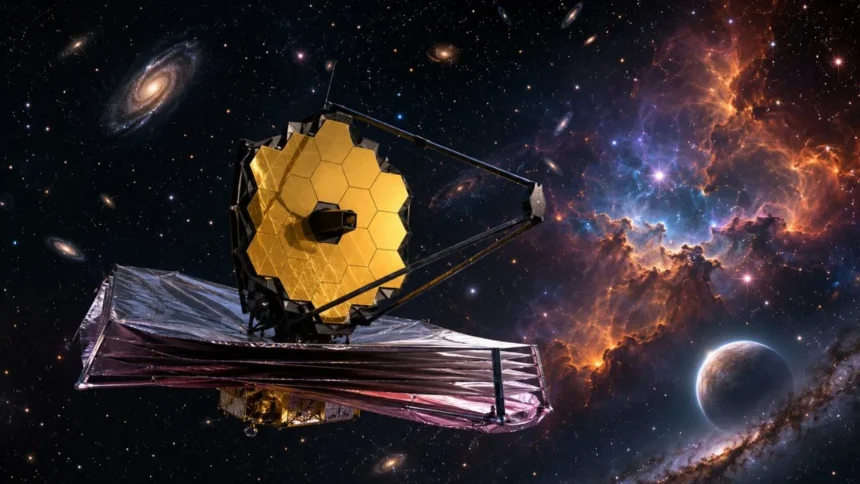
Its primary mirror measures 6.5 metres across and consists of 18 gold-coated hexagonal segments. The large collecting area allows Webb to detect extremely faint infrared light arriving from distant galaxies. A five-layer sunshield protects the telescope from heat that could otherwise overwhelm the weak signals astronomers want to measure.
Webb has four main scientific instruments: NIRCam, NIRSpec, MIRI and FGS/NIRISS. Together, they provide near-infrared and mid-infrared imaging, spectroscopy and precise guidance. These tools allow scientists to study early galaxies, star-forming clouds, black holes, exoplanet atmospheres and objects within our own solar system.
Why Webb Sees Things Other Telescopes Cannot
The universe expands as light travels through it, stretching light from the earliest galaxies into longer infrared wavelengths. This process is called cosmological redshift. A galaxy that originally produced visible or ultraviolet light may therefore appear primarily in infrared by the time its light reaches Earth billions of years later.
Webb is designed to detect this stretched light with exceptional sensitivity. Its instruments can observe objects that are too distant, faint, cool or dust-covered for many visible-light telescopes. This ability makes it particularly useful for exploring cosmic dawn, when the first generations of stars and galaxies began illuminating the young universe.
Infrared observations can also pass through clouds of cosmic dust that block visible light. Webb can therefore look inside stellar nurseries and reveal young stars, jets and planet-forming disks hidden behind thick material. The resulting images often show structures that appear almost completely dark in ordinary visible-light photographs.
Spectroscopy makes Webb even more powerful. Instead of recording only an object’s appearance, a spectrograph divides its light into individual wavelengths. Missing or enhanced wavelengths reveal specific atoms and molecules, allowing astronomers to measure chemical composition, temperature, speed, atmospheric conditions and sometimes the physical processes shaping an object.
Webb Is Finding Galaxies Closer to the Big Bang
One of Webb’s central goals is to identify the first galaxies that formed after the Big Bang. Its deep surveys have repeatedly pushed the observational boundary farther back in cosmic history. These galaxies appear as tiny, faint points, but their light carries information from a period when the universe was only a small fraction of its current age.
In 2026, astronomers confirmed MoM-z14, a bright galaxy seen approximately 280 million years after the Big Bang. Its light travelled through expanding space for roughly 13.5 billion years before reaching Webb. Spectroscopic measurements established its extreme distance rather than relying only on estimates based on its colour.
MoM-z14 is important not simply because it is extremely far away. Its brightness and chemical features provide clues about how rapidly early stars formed and transformed their surroundings. Finding such a developed source so early suggests that star formation may have begun sooner or proceeded more efficiently than many astronomers previously expected.
Webb has not photographed the Big Bang itself, because the early universe was initially too hot and opaque for light to travel freely. Instead, the telescope is observing later periods when the first stars and galaxies began producing detectable light. Each new distant galaxy helps narrow the gap between cosmic darkness and the first visible structures.
Early Galaxies Look Brighter and More Developed Than Expected
Before Webb launched, computer models predicted how many bright galaxies astronomers might find during the universe’s first few hundred million years. Webb’s early surveys revealed more luminous galaxy candidates than many of those forecasts suggested. Some also appeared larger, more chemically enriched or more actively star-forming than expected for their age.
These observations do not necessarily mean that the age of the universe is wrong. Early estimates of galaxy mass can change when researchers obtain better spectra, account for powerful emission lines or separate starlight from an active black hole. Objects that initially appear unusually massive may become easier to explain after detailed analysis.
The findings still present a valuable challenge for galaxy formation models. Scientists are testing whether early galaxies converted gas into stars more efficiently, experienced rapid bursts of star formation or contained different populations of stars. Researchers are also studying how dust, black holes and changing chemical conditions influenced their apparent brightness.
This is how scientific progress usually works. Observations expose gaps in existing models, and researchers revise those models until they explain a broader range of evidence. Webb is providing enough early-universe data to move the discussion beyond a few unusual objects and toward a more representative picture of the first galaxies.
Webb Is Investigating Mysterious Little Red Dots
Webb discovered a population of compact, distant sources that appear unusually red and small in its images. Astronomers call them “little red dots.” They were far more common during an early period of cosmic history than they are in the nearby universe, creating questions about what they contain and what they eventually became.
Many little red dots appear to host actively feeding supermassive black holes. Gas falling toward a black hole becomes extremely hot and releases intense radiation, potentially producing the bright, compact centre Webb detects. However, these objects do not always resemble the active galactic nuclei observed in mature galaxies closer to Earth.
Recent research suggests that little red dots may represent a temporary stage in the growth of black holes and their host galaxies. As the galaxy evolves, its stars and spiral structure may become easier to see, while the intensely active centre becomes less dominant. Astronomers are now looking for nearby descendants that preserve signs of this earlier phase.
The exact explanation is still being tested. Some little red dots may combine dense star formation, dust and rapidly growing black holes, while others could belong to different categories. Webb’s spectroscopy is essential because objects with similar colours can have very different physical causes that ordinary images cannot distinguish.
Did Some Black Holes Form Before Their Galaxies?
Astronomers have traditionally pictured galaxies forming stars that later collapse into black holes. Those black holes can grow by consuming gas and merging with other black holes. Webb is finding massive black holes so early, however, that scientists are questioning whether this gradual pathway can explain every object.
One striking example is Abell2744-QSO1, a tiny galaxy located more than 13 billion light-years away. Webb observations allowed researchers to map gas moving around a black hole estimated to contain roughly 50 million times the Sun’s mass. The black hole appears enormous compared with the relatively small galaxy surrounding it.
Researchers have proposed that this black hole may have formed before most of its host galaxy. Possible explanations include the direct collapse of a massive gas cloud, unusually rapid feeding or the formation of a large initial black hole seed. A more speculative possibility involves primordial black holes originating extremely early in cosmic history.
The observations do not yet prove one formation pathway. They do show that simple models in which small stellar black holes grow slowly may be incomplete. Webb is giving astronomers the spectra needed to measure black hole masses, gas movement and host-galaxy properties during periods that were previously almost impossible to examine.
Webb Is Mapping the Invisible Structure of Dark Matter
Dark matter does not emit, reflect or absorb light, so Webb cannot photograph it directly. Scientists instead detect its gravitational influence on visible matter and light. Massive concentrations of dark matter bend light from background galaxies, producing distortions that researchers can use to map where the invisible material is located.
In 2026, scientists used Webb observations containing nearly 800,000 galaxies to create one of the most detailed high-resolution dark matter maps produced so far. The map revealed dense concentrations connected by thinner filaments, forming part of the enormous cosmic web that shapes the distribution of galaxies across the universe.
The result showed that ordinary matter generally follows the structure created by dark matter. Galaxies form and gather within this invisible gravitational framework rather than appearing randomly throughout space. Webb’s resolution allows researchers to locate smaller structures and measure the relationship between dark and visible matter with greater precision.
These maps may help scientists test competing ideas about the nature of dark matter. Webb is not identifying the unknown particle or substance directly, but it is revealing how dark matter behaves on cosmic scales. Differences between observations and theoretical predictions could eventually provide clues about what this mysterious material actually is.
Webb Is Reading the Atmospheres of Exoplanets
Exoplanets are planets that orbit stars beyond our solar system. Webb studies many of them as they pass in front of their host stars. A tiny portion of the starlight travels through the planet’s atmosphere, where different gases absorb specific infrared wavelengths and leave recognisable chemical patterns in the recorded spectrum.
Webb detected clear carbon dioxide in the atmosphere of the hot gas giant WASP-39 b. It also identified sulfur dioxide, providing evidence of photochemistry driven by energetic starlight. Additional measurements have revealed water vapour, sodium, carbon monoxide and other atmospheric ingredients, creating an unusually detailed chemical profile.
The telescope has also detected methane and carbon dioxide in the atmosphere of K2-18 b, a planet larger than Earth but smaller than Neptune. Some observations have generated discussion about possible additional molecules, but proposed biosignature signals remain uncertain and require independent confirmation through repeated measurements and careful analysis.
These results demonstrate that Webb can measure atmospheric chemistry with remarkable accuracy. By comparing gases, clouds, temperatures and chemical reactions across many planets, astronomers can investigate how exoplanet atmospheres form and evolve. This work also builds the scientific foundation needed for future missions designed to examine smaller Earth-like worlds.
Has Webb Discovered Life on Another Planet?
The James Webb Space Telescope has not discovered alien life. It has detected molecules that are interesting to astrobiologists, but finding a particular gas does not automatically prove biological activity. Many molecules associated with life on Earth can also be produced through geological, atmospheric or chemical processes that do not involve organisms.
A credible biosignature claim would require more than one uncertain spectral feature. Scientists would need repeated observations, several complementary molecules and a strong understanding of the planet’s star, atmosphere, temperature and geological environment. They would also need to eliminate non-biological explanations capable of producing the same chemical pattern.
K2-18 b has attracted considerable public attention because it contains methane and carbon dioxide and may have conditions different from familiar rocky planets. However, its actual structure remains uncertain, and it could possess a deep atmosphere or extreme interior unsuitable for life as humans understand it. Current observations do not confirm an inhabited ocean world.
Webb’s role is to identify promising environments and measure their atmospheric chemistry, not to deliver a simple photograph of living organisms. Any serious evidence of extraterrestrial life would require extensive follow-up observations and confirmation from multiple instruments, research teams and possibly future space telescopes with specialised capabilities.
What Webb Is Learning From the TRAPPIST-1 Planets
The TRAPPIST-1 system contains seven roughly Earth-sized planets orbiting a small red dwarf star. Several lie within the star’s habitable zone, where temperatures could permit liquid water under suitable atmospheric conditions. Their relatively nearby location makes the system an important laboratory for studying the atmospheres of rocky exoplanets.
Webb’s observations suggest that the innermost planets, TRAPPIST-1 b and c, do not possess thick atmospheres. Planet b may be a largely bare rock, while any atmosphere around planet c appears limited. These results help astronomers understand how intense radiation from active red dwarf stars can strip gases from nearby planets.
For TRAPPIST-1 d and e, scientists have ruled out thick hydrogen-dominated atmospheres, but important possibilities remain under investigation. Data from the other planets are also being analysed. Studying such small worlds is extremely difficult because their atmospheric signals are tiny and can become mixed with variations caused by the host star.
The star itself produces flares and has active regions that complicate atmospheric measurements. Astronomers may need to observe many planetary transits over several years before reaching firm conclusions. Even a result showing that a planet has no atmosphere is scientifically valuable because it improves models of planetary evolution and habitability around red dwarf stars.
Webb Discovered a Hidden Planet Through Its Chemistry
The young star Beta Pictoris has one of the most closely studied planetary systems beyond our own. Astronomers already knew about two directly imaged giant planets, Beta Pictoris b and c. A bright disk of dust and rocky debris also surrounds the star, offering a view of an evolving system where planets continue shaping their environment.
In July 2026, researchers announced the discovery of a third giant planet, Beta Pictoris d. The planet had remained hidden within the bright debris disk, where scattered light made conventional imaging difficult. Instead of searching only for a visible point, the team isolated the distinctive chemical fingerprint of the planet’s atmosphere.
Webb’s NIRSpec instrument detected molecular features, including carbon monoxide, that separated the planet’s light from the surrounding dust. The result demonstrates a new way to find planets in crowded or dusty systems. Rather than depending entirely on brightness, astronomers can search large datasets for spectral patterns produced by planetary atmospheres.
Beta Pictoris d may also help explain the sharply defined inner edge and other unusual features of the debris disk. Planets gravitationally shape surrounding material, creating gaps, warps and boundaries. Finding the hidden world shows how spectroscopy can connect a disk’s structure with the unseen planets responsible for sculpting it.
Webb Is Studying Planets That Survived Dying Stars
Stars similar to the Sun eventually exhaust their central fuel and expand into red giants. During this stage, they can engulf nearby planets before shedding their outer layers and leaving behind dense remnants called white dwarfs. Astronomers want to know whether any planets can survive this destructive transformation or move into new orbits afterward.
WD 1856 b is a Jupiter-sized planet orbiting a white dwarf approximately 80 light-years from Earth. The planet completes an orbit in about 34 hours and lies less than three million kilometres from its star. Because the white dwarf is approximately Earth-sized, the planet appears much larger than the stellar remnant it circles.
Webb observations have helped researchers investigate the planet’s properties and survival history. WD 1856 b probably did not remain in its current orbit throughout the star’s red giant phase. Gravitational interactions with additional planets or stars may have moved it inward after the white dwarf had already formed.
This system provides a glimpse of the distant future of planetary systems like ours. The Sun will eventually become a red giant and later a white dwarf, although this will not happen for billions of years. Webb is showing that planetary systems can remain dynamically active even after their stars undergo dramatic transformations.
Webb Is Looking Inside Stellar Nurseries
Stars form inside cold clouds of gas and dust that can hide their earliest stages from visible-light telescopes. Webb’s infrared instruments penetrate these clouds and reveal young stars that are still gathering material. They also expose narrow jets, shocked gas and cavities created as newborn stars interact with their surroundings.
Observations of regions such as the Orion Molecular Cloud have revealed stars across multiple stages of development. Some remain deeply embedded within dense material, while others have begun clearing the surrounding gas. Comparing them within the same cloud helps astronomers reconstruct how stars change during their earliest and least visible phases.
Webb can trace outflows launched by young stars and examine how those outflows affect nearby material. These streams may compress some regions of a cloud while dispersing others, influencing where additional stars can form. Ultraviolet radiation from young stars can also change the chemistry of nearby planet-forming disks.
The telescope’s detailed images are more than visually dramatic pictures. Different infrared filters trace warm dust, glowing hydrogen, complex carbon-rich molecules and other materials. By combining these observations with spectra, researchers can investigate how gas falls onto young stars and how the environments that eventually produce planets develop.
Webb Is Revealing How Planets Begin to Form
Young stars are often surrounded by rotating disks of gas, dust and ice. Tiny solid particles within these protoplanetary disks can collide and gradually build larger objects, eventually forming planets, moons, asteroids and comets. Webb observes the materials and physical structures present during these early stages of planetary construction.
Infrared spectroscopy can identify water, carbon dioxide, carbon monoxide and other molecules within disks. Their location and abundance help scientists understand where rocky planets and giant planets may form. Temperature differences across a disk determine whether important substances remain gases or freeze onto grains as ice.
Webb has also revealed gaps, rings, shadows and streams of material in young planetary systems. Some structures may be produced by newly forming planets, although not every gap proves that a planet is present. Magnetic effects, dust behaviour and changes in pressure can create similar patterns that require further investigation.
By comparing disks around stars of different masses and ages, astronomers can study how quickly planet-forming material disappears. This research may explain why planetary systems are so diverse. It can also reveal whether the architecture of our solar system is common or the result of a relatively unusual formation history.
Webb Is Tracking the Life and Death of Stars
Webb observes stars throughout their entire life cycles, from deeply embedded protostars to ageing objects that are ejecting their outer layers. Infrared light reveals dust and cooler gas that may be difficult to detect at visible wavelengths. These observations help connect stellar evolution with the chemical development of galaxies.
When massive stars die, they distribute newly formed elements into surrounding space. Lower-mass stars also enrich their environments by releasing carbon-rich or oxygen-rich material during their final stages. Webb can map this dust and gas, showing how the ingredients needed for later stars, planets and biological chemistry enter the interstellar medium.
Images of planetary nebulae reveal shells, arcs and molecular structures created by dying stars and their companions. Binary stars can shape the expanding material into complex forms rather than simple spheres. Spectroscopy allows researchers to determine which molecules and dust particles are present within these changing structures.
Studying stellar death also helps astronomers interpret distant galaxies. The light from a galaxy combines radiation from many generations of stars, each contributing different chemical elements. Webb’s observations of nearby stellar remains provide detailed examples that improve the models used to understand unresolved populations in faraway galaxies.
Webb Is Transforming Our View of Nearby Galaxies
Webb is not limited to the most distant reaches of the universe. It can resolve individual stars, dusty clouds and active regions within relatively nearby galaxies. These detailed observations help astronomers understand how galaxies build stars, recycle matter and change shape through collisions and gravitational interactions.
In the Cigar Galaxy, also called Messier 82, Webb has helped researchers distinguish millions of stars and examine regions influenced by intense star formation. Powerful stellar winds and supernova explosions drive gas away from the galaxy, creating an outflow that may eventually reduce its ability to produce new stars.
Webb has also studied Centaurus A, an unusual galaxy shaped by a past cosmic collision. Its central regions are heavily obscured by dust, but infrared observations can reveal stars and structures behind that material. The galaxy also contains an active supermassive black hole that influences gas near its centre.
By examining nearby galaxies star by star, scientists obtain detailed evidence that can be applied to much more distant systems. These observations connect small-scale processes, such as individual star-forming clouds, with large-scale galaxy evolution. Webb therefore acts as both a cosmic time machine and a high-resolution laboratory.
Webb Is Discovering New Details in Our Solar System
Although Webb was designed partly to observe the distant universe, it is also a powerful planetary science observatory. Its infrared instruments can examine the atmospheres, rings, moons and weather systems of nearby planets. These objects are bright and move across the sky, requiring carefully planned observing techniques.
On Jupiter, Webb detected a high-speed equatorial jet located above the planet’s main visible cloud layers. The telescope has also studied auroras, hazes and atmospheric circulation. Combining Webb data with visible-light observations helps researchers build a three-dimensional picture of Jupiter’s rapidly changing atmosphere.
Webb has produced detailed infrared views of Saturn, Uranus and Neptune, revealing rings and atmospheric structures that look different from their visible-light appearances. Methane absorbs certain infrared wavelengths, causing some regions to appear dark while clouds, storms and rings can become especially prominent.
The telescope can also examine smaller solar system bodies, including asteroids, comets and distant icy objects. Spectra reveal surface minerals, frozen gases and molecules released when comets warm near the Sun. These observations provide context for comparing our planetary system with the disks and planets forming around other stars.
Interstellar Comet 3I/ATLAS Revealed an Ancient Origin
Interstellar objects enter our solar system from the space between stars and then continue on paths that carry them away again. They provide rare physical samples of material formed in distant planetary systems. Because these visitors move quickly and remain observable for limited periods, astronomers must respond rapidly.
Webb observed 3I/ATLAS, the third confirmed interstellar comet, as it moved away from the Sun in late 2025. Solar heating had released gas from its ancient ice, forming a bright coma that could be studied with NIRSpec. The resulting spectrum revealed chemical ratios unlike those measured in solar system comets.
The comet contained exceptionally high amounts of deuterium, or heavy hydrogen, along with an unusual carbon isotope ratio. Researchers estimated that it may have formed in a very cold environment approximately 10 to 12 billion years ago, potentially making it far older than our 4.5-billion-year-old solar system.
This discovery offers a direct way to study the material available during an earlier period of the Milky Way’s history. It also shows that comets formed around other stars can differ significantly from those near the Sun. Future interstellar visitors may reveal an even wider range of planetary building materials.
Is Webb Breaking the Standard Model of Cosmology?
Headlines sometimes claim that the James Webb Space Telescope has “broken cosmology” or disproved the Big Bang. Such statements usually exaggerate genuine scientific tensions. Webb has discovered objects that are brighter, more numerous or more developed than some earlier models predicted, but models can be adjusted without abandoning the broader cosmological framework.
Early galaxy measurements are difficult because astronomers must estimate the contributions of stars, dust, gas and black holes from limited light. Strong emission lines can make galaxies appear unusually bright, while active black holes can be mistaken for enormous stellar populations. Spectroscopic observations often provide more reliable answers than initial image-based estimates.
The standard model of cosmology already contains uncertainties about dark matter, dark energy, early star formation and black hole growth. Webb is helping researchers test these uncertain areas with better data. A mismatch between observation and one simulation does not necessarily represent a contradiction with the Big Bang itself.
The telescope’s role is to make theories more precise by revealing where predictions succeed and where they fail. Some ideas may require substantial revision, while others may survive after researchers improve measurements and assumptions. Scientific excitement comes from this productive tension between unexpected evidence and established explanation.
What Has Webb Not Discovered Yet?
Webb has not observed the very first individual star formed after the Big Bang. It has detected extremely early galaxies and possible signatures of unusual stellar populations, but confirming a specific first-generation star remains difficult. These stars may be too faint, short-lived or blended with surrounding objects to identify directly.
The telescope has not found conclusive evidence of life beyond Earth. Atmospheric molecules, habitable-zone locations and possible ocean-world scenarios can identify interesting targets, but they do not confirm biology. Any future biosignature claim will require repeated observations and the elimination of plausible non-living chemical processes.
Webb has not directly photographed dark matter or dark energy. Its observations reveal how dark matter bends light and affects visible structures, while distant galaxies help scientists investigate cosmic expansion. The underlying nature of these dominant components of the universe remains one of modern physics’ greatest unsolved problems.
It has also not replaced every other telescope. Hubble remains valuable for ultraviolet and visible light, while radio, X-ray and gamma-ray observatories reveal different physical processes. Webb achieves its greatest scientific value when its infrared data are combined with observations across the electromagnetic spectrum.
What Will the James Webb Space Telescope Discover Next?
Future Webb programs will continue searching for galaxies from the first few hundred million years of cosmic history. Larger surveys should reveal whether the most surprising early objects are rare exceptions or members of a broader population. Spectroscopy will help determine their distances, chemical compositions and rates of star formation.
Exoplanet researchers will study a wider range of atmospheric temperatures, planet sizes and host stars. Repeated observations may clarify whether small rocky planets around red dwarfs can retain atmospheres. Webb may also uncover additional hidden giant planets by separating their chemical fingerprints from bright stars and dusty disks.
Long-term observations will track weather and chemical changes on planets, brown dwarfs and young stellar objects. Astronomers can compare data gathered months or years apart to observe storms, cloud movement, accretion and orbital motion. Time-based measurements turn Webb from a snapshot camera into a tool for studying cosmic change.
Some of the most important future discoveries may come from questions that were not central when the telescope was designed. Unexpected objects such as little red dots have already created new research areas. As Webb’s archive grows, researchers may find unusual patterns by combining observations collected for entirely different scientific programs.
Why Webb’s Discoveries Matter to Everyday People
Webb addresses some of humanity’s oldest questions: Where did the first galaxies come from, how do stars and planets form, and could environments suitable for life exist elsewhere? Its observations connect the elements in human bodies and on Earth with processes occurring across billions of years of cosmic history.
The telescope also demonstrates what international scientific cooperation can accomplish. Engineers and researchers from multiple countries developed technologies capable of unfolding a segmented mirror, maintaining extremely low temperatures and aligning instruments far beyond the reach of astronauts. Those achievements required decades of testing, problem-solving and shared expertise.
Webb’s open scientific archive allows researchers around the world to use its data. Observations obtained for one purpose can support unexpected discoveries by other teams. Students, independent researchers and citizen scientists can also engage with public images, catalogues and collaborative projects based on space telescope observations.
Its deeper value is not limited to finding one habitable planet or breaking a distance record. Webb is building a connected account of cosmic evolution, showing how simple early material became galaxies, stars, chemical elements, planets and eventually environments where living organisms could emerge.
Final Thoughts on What Webb Is Discovering
The James Webb Space Telescope is revealing a universe that formed complex structures surprisingly quickly. It has identified galaxies from only a few hundred million years after the Big Bang, investigated massive early black holes and uncovered compact red sources that may represent an important stage in galaxy evolution.
Closer to home, Webb is analysing exoplanet atmospheres, finding hidden planets and exploring how planetary systems survive the deaths of their stars. It is examining planet-forming disks, young stars, nearby galaxies and the atmospheres of worlds within our own solar system with exceptional infrared sensitivity.
The telescope has not discovered extraterrestrial life or invalidated the Big Bang. Its most surprising findings instead show that many details of galaxy, black hole and planet formation remain incomplete. Strong scientific claims require spectroscopy, repeat observations, independent analysis and time for competing explanations to be tested.
Webb’s greatest discovery may ultimately be that the universe is more diverse than earlier observations allowed us to see. Every deep field, spectrum and planetary measurement adds another part of the story. With years of observations still ahead, the telescope will continue turning previously invisible questions into measurable scientific evidence.
Frequently Asked Questions
What is the biggest discovery made by the James Webb Space Telescope?
There is no single agreed biggest discovery, but Webb’s observation of galaxies such as MoM-z14 has pushed the confirmed observable universe closer to cosmic dawn. Its findings about early black holes and exoplanet atmospheres are equally important.
Has the James Webb Space Telescope found another Earth?
No, Webb has not discovered a confirmed second Earth. It studies known exoplanets and their atmospheres, but determining whether a small planet truly resembles Earth requires extensive observations and evidence about its surface and atmosphere.
Has Webb found evidence of alien life?
Webb has detected interesting atmospheric molecules, including methane and carbon dioxide on distant planets. None of these observations currently provides confirmed evidence of life, and possible biosignatures require much stronger verification.
How far back in time can the James Webb Telescope see?
Webb has observed confirmed galaxies as they appeared roughly 13.5 billion years ago, only a few hundred million years after the Big Bang. It sees their ancient light rather than viewing their present-day condition.
Why are Webb’s images shown in different colours?
Webb mainly records infrared wavelengths that human eyes cannot see. Image specialists assign visible colours to different infrared filters so people can distinguish temperatures, molecules and structures while preserving the scientific relationships within the data.